Photochemical Deracemization of Chromanes and its Application to the Synthesis of Enantiopure Bioactive Compounds
Biki Ghosh, Maximilian Iglhaut, Daria Babushkina, Mike Pauls, Christoph Bannwarth, Thorsten Bach

TL;DR
A new photochemical method efficiently produces enantiopure chromanes, which are important in pharmaceuticals, using a chiral photocatalyst and a thiol additive.
Contribution
A novel photochemical deracemization method for enantiopure chromane synthesis using a chiral photocatalyst and thiol additive.
Findings
The method achieved 71%–90% yield and 80%–99% ee for 21 examples of chromane deracemization.
A chiral photocatalyst selectively abstracts hydrogen from one enantiomer to establish a photostationary state.
The method was applied to synthesize five enantiopure pharmaceuticals efficiently.
Abstract
Chromanes are frequently encountered as chiral structure elements in active pharmaceutical ingredients (APIs). We have now discovered an access to enantiopure chromanes, which employs a 1:1 mixture of their enantiomers (racemate) in a photochemical deracemization reaction (21 examples, 71%–90% yield, 80%–99% ee). A chiral photocatalyst (10 mol%) acts by selective hydrogen abstraction at one chromane enantiomer and establishes a photostationary state in which the other enantiomer prevails. A thiol additive (20 mol%) was found to improve the enantioselectivity of the process. The mechanism of the reaction was investigated by experimental and quantum‐chemical studies. The oxygen atom of the chromane locks the rotation around the exocyclic C─C bond to the amide by forming an intramolecular hydrogen bond. Forward hydrogen atom transfer (HAT) occurs exclusively in one diastereomeric complex…
Genes, proteins, chemicals, diseases, species, mutations and cell lines named across the full text — each resolved to its canonical identifier and authoritative record.
Click any figure to enlarge with its caption.
 Figure 1
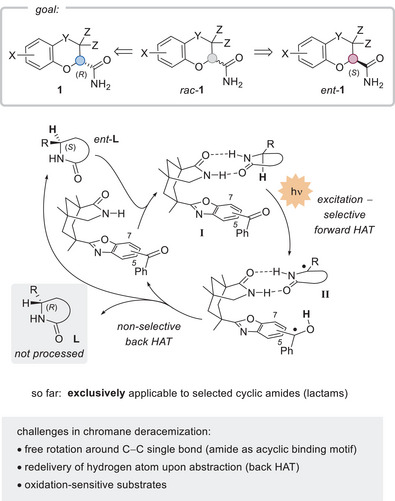 Figure 2
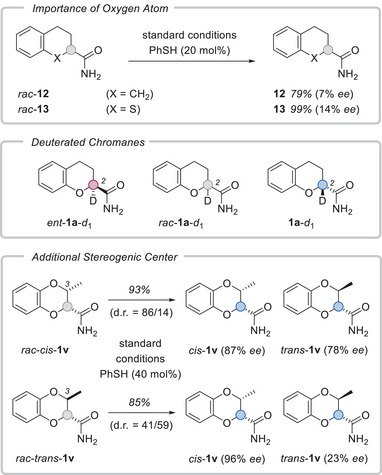 Figure 3
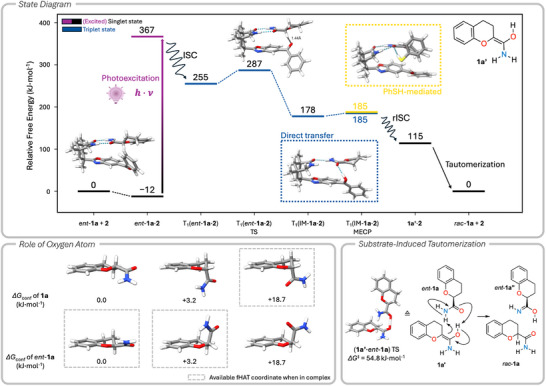 Figure 4
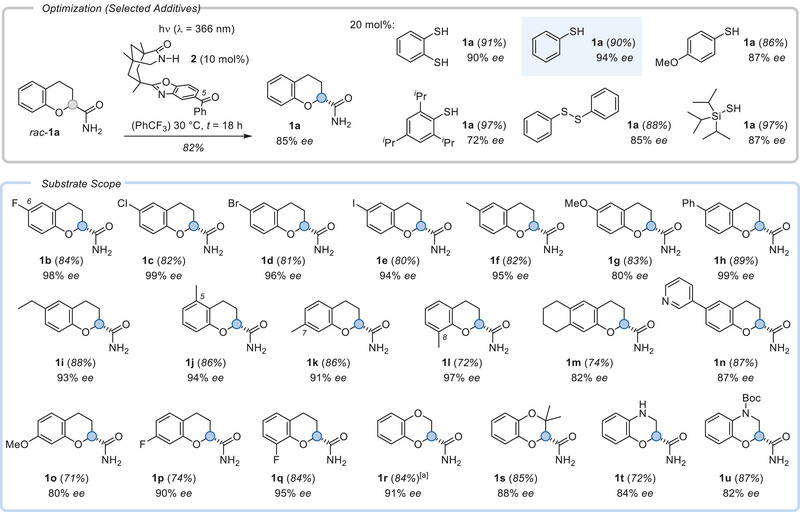 Figure 5
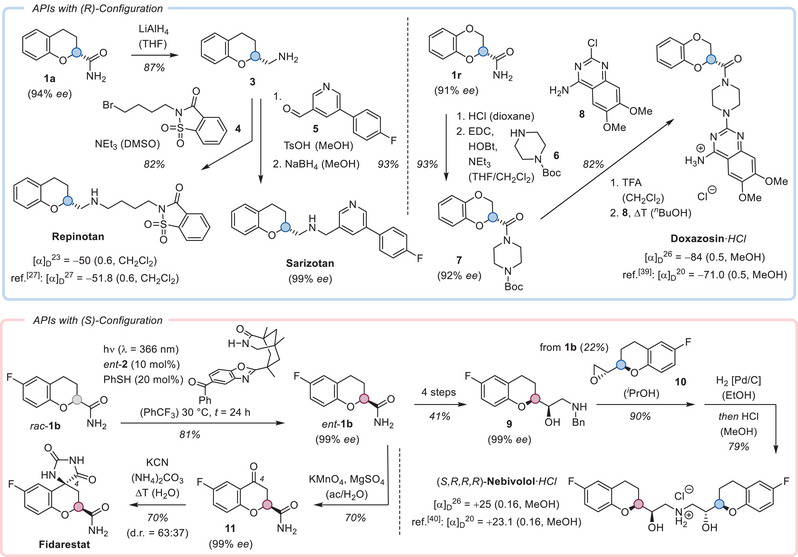 Figure 6
Peer Reviews
No public reviews on file for this paper yet. If you reviewed it on a platform where reviews are public (OpenReview, ICLR, NeurIPS, ICML), you can paste yours below so the community can read it here.
Videos
No videos yet. Explain this paper in a talk, walkthrough, or lecture? Add one.
Taxonomy
TopicsRadical Photochemical Reactions · Advanced Synthetic Organic Chemistry · Asymmetric Hydrogenation and Catalysis