Dual‐Channel Fluorescence Assays with Supramolecular Host‐Dye Reporter Pairs for Membrane Activity Mapping of Peptides
Mohammad A. Alnajjar, Sandra N. Schöpper, Malavika Pramod, Thomas Reingolz, Lina Müller, Justin Neumann, Mohamed Nilam, Werner M. Nau, Andreas Hennig

TL;DR
This paper introduces a dual-channel fluorescence assay to classify membrane-active peptides based on their ability to translocate or create pores in lipid membranes.
Contribution
The novel dual-channel assay combines a dye efflux assay with a supramolecular tandem membrane assay for advanced mechanistic characterization of MAPs.
Findings
The assay distinguishes between peptides that translocate and those that form pores.
Validation with known peptides confirmed their classification as CPPs or AMPs.
An advanced variant can differentiate between transient and stable pores.
Abstract
Membrane‐active peptides (MAPs) are a major class of peptides that renders lipid bilayer membranes permeable for hydrophilic compounds. MAPs include cell‐penetrating peptides (CPPs) and pore‐forming antimicrobial peptides (AMPs), which are believed to be mechanistically related. CPPs render the membrane sufficiently permeable to enable their own translocation, while AMPs create membrane damage and induce cell death. We report herein a fluorescence‐based, dual‐channel assay, which combines a classical dye efflux assay based on self‐quenched carboxyfluorescein (CF) and a recently established supramolecular tandem membrane assay based on the supramolecular host‐dye complex of p‐sulfonatocalix[4]arene (CX4) and lucigenin (LCG). The new assay provides a functional classification of MAPs, which distinguishes between their capability to directly translocate across the vesicle membrane or to…
Genes, proteins, chemicals, diseases, species, mutations and cell lines named across the full text — each resolved to its canonical identifier and authoritative record.
Click any figure to enlarge with its caption.
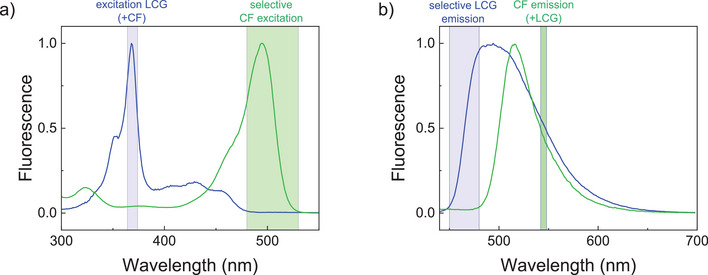 Figure 1
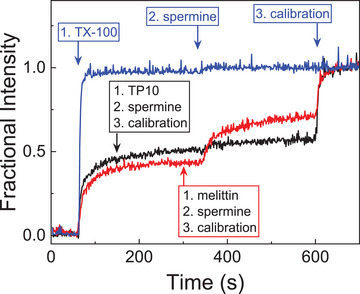 Figure 2
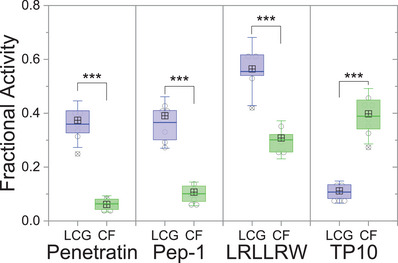 Figure 3
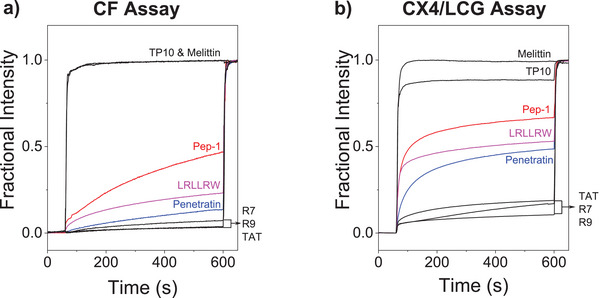 Figure 4
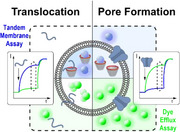 Figure 5
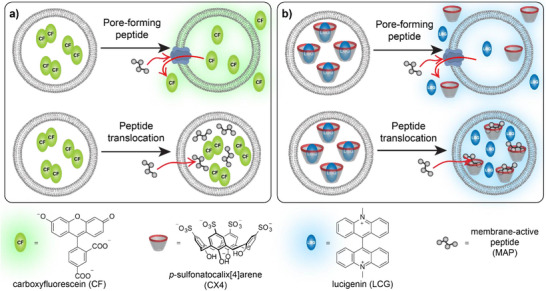 Figure 6
Peer Reviews
No public reviews on file for this paper yet. If you reviewed it on a platform where reviews are public (OpenReview, ICLR, NeurIPS, ICML), you can paste yours below so the community can read it here.
Videos
No videos yet. Explain this paper in a talk, walkthrough, or lecture? Add one.
Taxonomy
TopicsAntimicrobial Peptides and Activities · Lipid Membrane Structure and Behavior · Polydiacetylene-based materials and applications