Versatile and Selective Biomolecule Pulldown with Combinatorial DNA‐Crosslinked Polymers
Sarah K. Speed, Krishna Gupta, Yu‐Hsuan Peng, Elisha Krieg

TL;DR
LASSO is a new method using smart polymers to efficiently and selectively capture biomolecules like DNA, RNA, and proteins with minimal background binding and low cost.
Contribution
LASSO introduces a programmable polymer system using combinatorial DNA crosslinking for sequence-selective biomolecule isolation with high efficiency and low off-target effects.
Findings
LASSO achieves >80% pulldown efficiency for DNA, RNA, and proteins with near-zero background binding.
LASSO outperforms commercial methods with 8–20x higher binding capacity and 7x fewer off-target outliers in RNA-seq.
Thrombin was captured with 90% efficiency and released with 98% enzymatic activity.
Abstract
Current methods for sequence‐selective biomolecule isolation suffer from high cost, off‐target effects, and limited flexibility. Here, we introduce LASSO (crossLink‐Assisted Sequence‐Selective isOlation), a versatile platform using programmable polymer phase separation to capture biomolecules under native conditions. LASSO relies on combinatorial crosslinker libraries—diverse mixtures of DNA strands that collectively trigger the formation of highly swollen polymer agglomerates with near‐zero background binding. We demonstrate >80% pulldown efficiency for diverse targets, including DNA, SARS‐CoV‐2 RNA, and human thrombin. LASSO provides 8–20x higher binding capacity (4 nmol mg−1 polymer) than commercial microbeads. In RNA‐seq workflows, LASSO depleted ribosomal RNA with 86% efficiency, while yielding up to 7x fewer off‐target outliers versus state‐of‐the‐art magnetic beads and…
Genes, proteins, chemicals, diseases, species, mutations and cell lines named across the full text — each resolved to its canonical identifier and authoritative record.
Click any figure to enlarge with its caption.
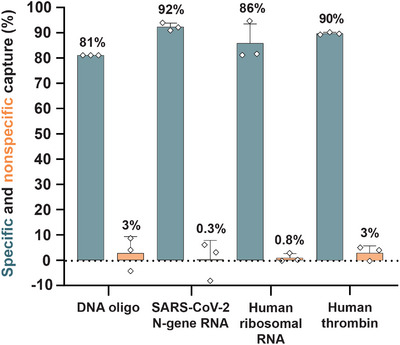 Figure 1
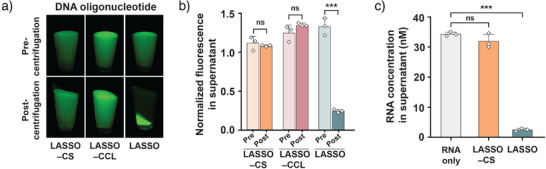 Figure 2
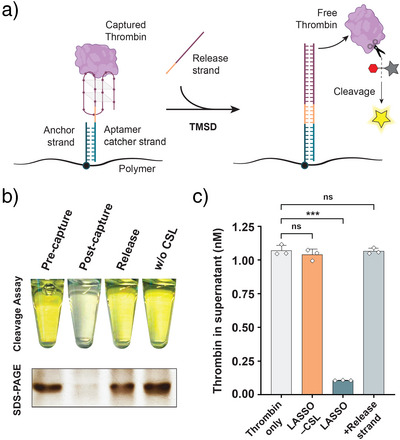 Figure 3
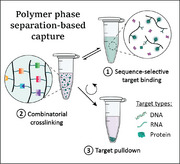 Figure 4
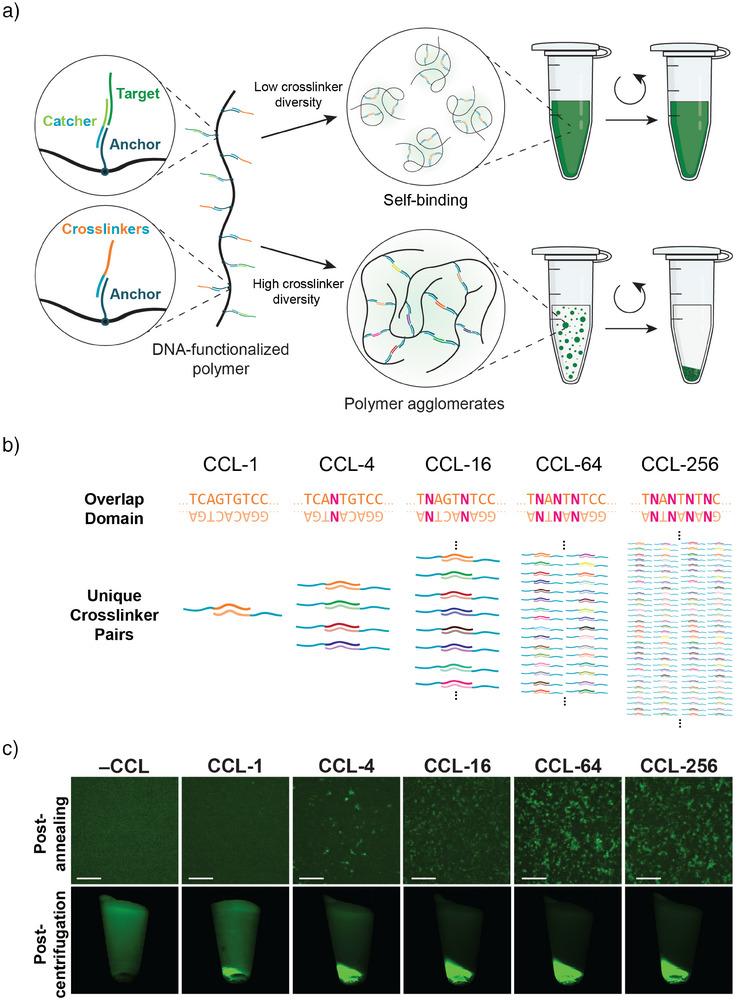 Figure 5
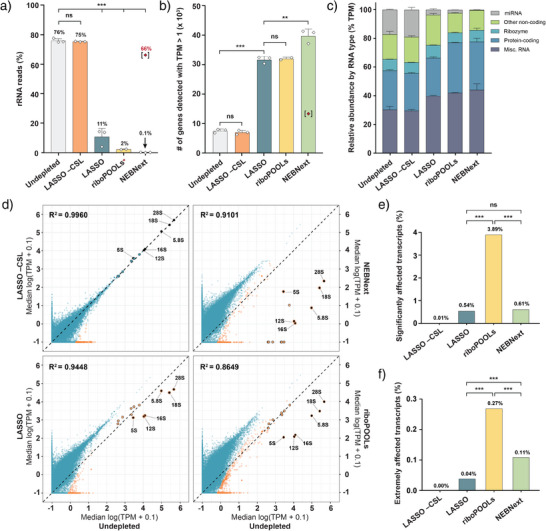 Figure 6
Peer Reviews
No public reviews on file for this paper yet. If you reviewed it on a platform where reviews are public (OpenReview, ICLR, NeurIPS, ICML), you can paste yours below so the community can read it here.
Videos
No videos yet. Explain this paper in a talk, walkthrough, or lecture? Add one.
Taxonomy
TopicsAdvanced biosensing and bioanalysis techniques · Innovative Microfluidic and Catalytic Techniques Innovation · Nanopore and Nanochannel Transport Studies