Hexabenzocoronene–Benzimidazole Hybrid Architectures and Faraday Rotation of the First Hexabenzocoronene–Phthalocyanine
Antonia Rocha‐Ortiz, Abdusalom A. Suleymanov, Pascal Puhlmann, Dustin Krischer, Carolin Müller, Dirk Zahn, Timothy M. Swager, Andreas Hirsch

TL;DR
Scientists created a new hybrid molecule combining hexabenzocoronene and phthalocyanine, which shows strong light absorption and potential for use in Faraday rotation.
Contribution
The first synthesis and characterization of a HBC–phthalocyanine hybrid molecule with notable Faraday rotation properties.
Findings
The HBC–Pc hybrid molecule has a high molar absorption coefficient and extended absorption up to 460 nm.
The hybrid molecule achieved a Verdet constant of −1.4 × 10⁵ deg T⁻¹m⁻¹ at 700 nm, indicating strong Faraday rotation.
DFT calculations confirmed the electronic structure and lower HOMO/LUMO gap in HBC–Pc compared to other HBC compounds.
Abstract
The synthesis and characterization of a first example of a Ni‐phthalocyanine (Pc) hybrid molecule carrying four hexa‐peri‐hexabenzocoronene (HBC) substituents and of three HBC‐benzimidazole derivatives is reported. These π‐electron rich chromophores exhibit a high molar absorption coefficient with extended absorption up to 460 nm. Particularly, HBC‐Pc absorbs throughout most of the UV–vis range with the Pc Q‐band located at 672 nm. This enables its investigation as a Faraday rotator where it displayed a remarkable Verdet constant of −1.4 × 10⁵ deg T−1m−1 at 700 nm assigned to Faraday A‐term activity. Electrochemical measurements supported by DFT calculations elucidated the electronic structure of the molecules together with excited state molecular orbital analysis using TDDFT. Here, HBC‐Pc showed a HOMO/LUMO gap considerably lower than the other HBC‐based compounds due to the…
Genes, proteins, chemicals, diseases, species, mutations and cell lines named across the full text — each resolved to its canonical identifier and authoritative record.
Click any figure to enlarge with its caption.
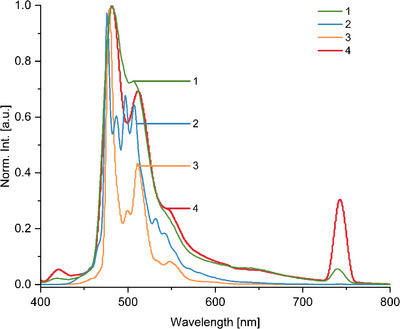 Figure 1
 Figure 2
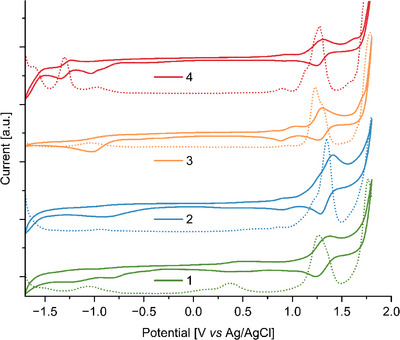 Figure 3
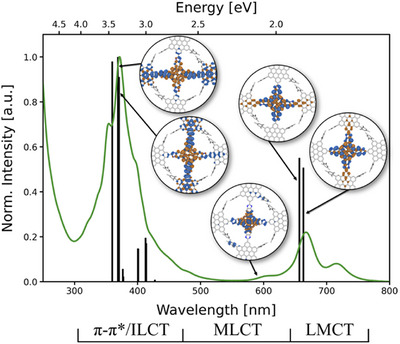 Figure 4
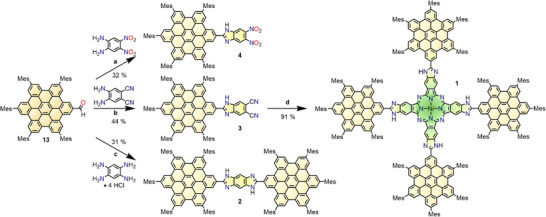 Figure 5
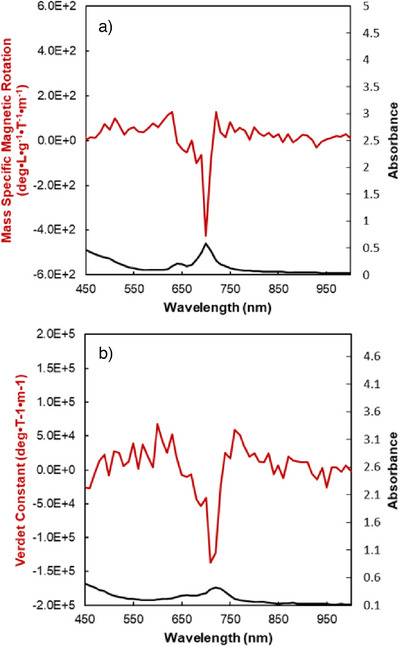 Figure 6
 Figure 7
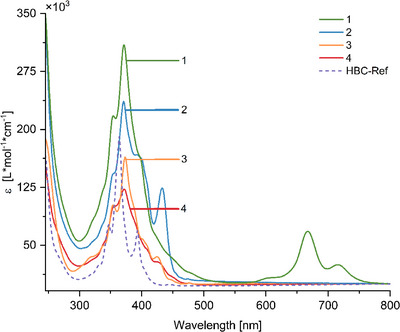 Figure 8
Peer Reviews
No public reviews on file for this paper yet. If you reviewed it on a platform where reviews are public (OpenReview, ICLR, NeurIPS, ICML), you can paste yours below so the community can read it here.
Videos
No videos yet. Explain this paper in a talk, walkthrough, or lecture? Add one.
Taxonomy
TopicsPorphyrin and Phthalocyanine Chemistry · Magnetism in coordination complexes · Synthesis and Properties of Aromatic Compounds