Sex‐Specific Subcutaneous Adipose Tissue Transcriptome in Obesity: Insights From Monozygotic Twin Pairs Discordant for BMI
Hanna Haltia, Maheswary Muniandy, Sini Heinonen, Sina Saari, Marcus Alvarez, Antti Hakkarainen, Jesper Lundbom, Juho Kuula, Per‐Henrik Groop, Jaakko Kaprio, Päivi Pajukanta, Kirsi H. Pietiläinen, Birgitta W. van der Kolk

TL;DR
This study shows how biological sex affects fat tissue gene activity and its response to obesity, influencing metabolic health differently in men and women.
Contribution
The study reveals sex-specific molecular mechanisms in adipose tissue linked to obesity and metabolic health using BMI-discordant twin pairs.
Findings
Sex differences in adipose tissue gene expression correlate with insulin sensitivity.
Obesity-related gene changes in fat tissue are stronger and distinct in females compared to males.
Females show reduced unsaturated fatty acid metabolism in obesity, linked to metabolic health differences.
Abstract
We investigated the impact of sex on the subcutaneous adipose tissue (AT) transcriptome and its obesity‐related adaptations. We studied rare BMI‐discordant monozygotic twin pairs (ΔBMI > 2.5 kg/m2; 21 female, 16 male pairs) to assess how sex affects AT and whole‐body metabolism. AT RNA sequencing was analyzed using linear mixed modeling and pathway enrichment for: (1) sex differences in individual twins, adjusted for BMI, (2) sex‐stratified effects of acquired obesity (ΔBMI between co‐twins separately in females and males), (3) sex‐specific effects of obesity (differences in the ΔBMI effect between sexes). (1) AT transcriptional profiles differed between sexes, associating with insulin sensitivity. (2) Sex‐stratified obesity effects within pairs were stronger in females, with upregulated inflammation and downregulated mitochondrial oxidative phosphorylation; males showed increased…
Genes, proteins, chemicals, diseases, species, mutations and cell lines named across the full text — each resolved to its canonical identifier and authoritative record.
Click any figure to enlarge with its caption.
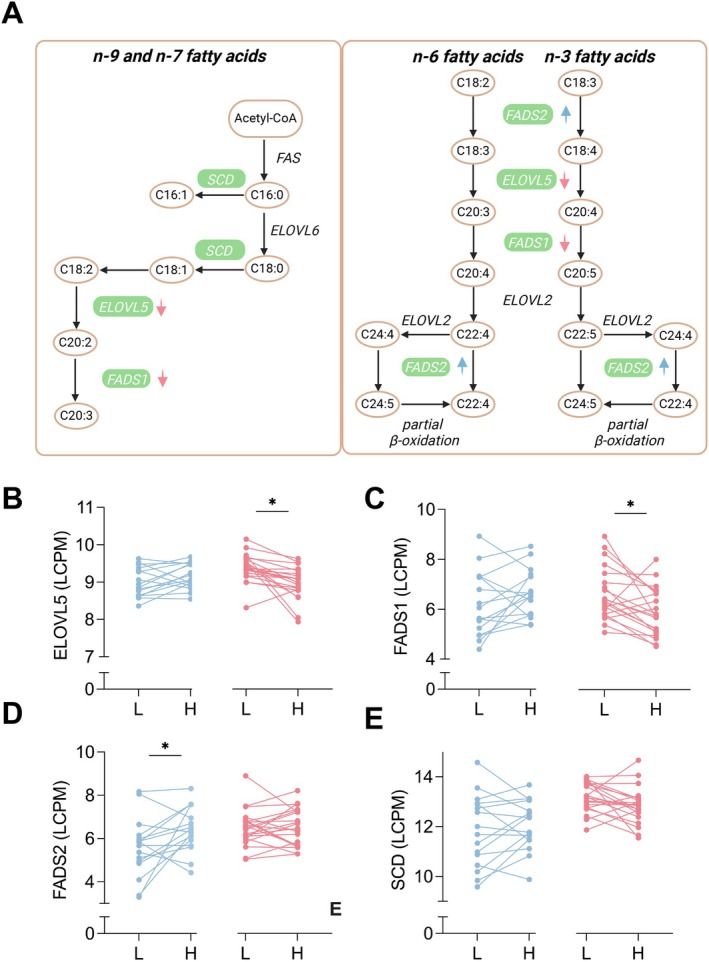 Figure 1
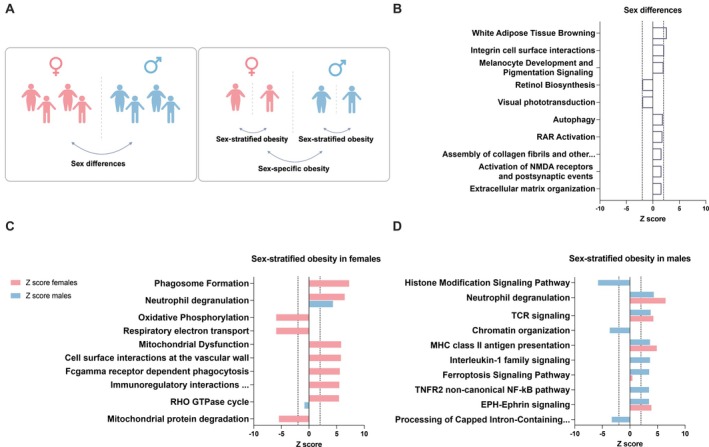 Figure 2
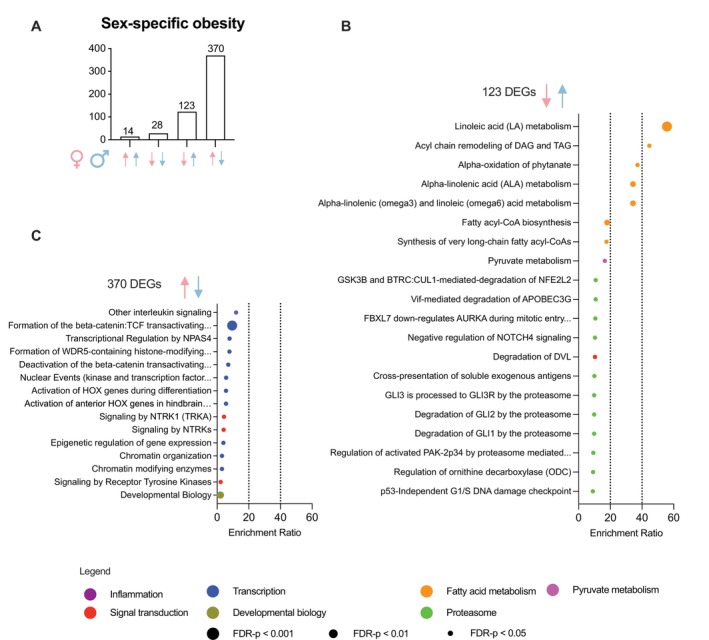 Figure 3
Peer Reviews
No public reviews on file for this paper yet. If you reviewed it on a platform where reviews are public (OpenReview, ICLR, NeurIPS, ICML), you can paste yours below so the community can read it here.
Videos
No videos yet. Explain this paper in a talk, walkthrough, or lecture? Add one.
Taxonomy
TopicsGenetic Associations and Epidemiology · Adipokines, Inflammation, and Metabolic Diseases · Adipose Tissue and Metabolism