A semitendinosus with adjustable button graft construct in patients undergoing hamstring ACL reconstruction results in improved knee flexor strength symmetry and less donor site pain and morbidity: Outcomes from the DOSTAR randomized controlled trial
Adam M. Lawless, Jay R. Ebert, Peter K. Edwards, Shahbaz S. Malik, Peter S. E. Davies, Peter A. D'Alessandro

TL;DR
Using a semitendinosus tendon graft in ACL surgery reduces donor site pain and improves knee strength compared to a combined graft, with similar overall function.
Contribution
Demonstrates that using a single semitendinosus tendon graft reduces donor site pain and improves strength symmetry compared to a combined graft in ACL reconstruction.
Findings
ST group had significantly lower hamstring pain and donor site morbidity at 6 months.
ST group showed higher knee flexor strength symmetry compared to the STG group.
Functional outcomes were comparable between the two groups.
Abstract
To compare donor site morbidity and patient‐reported outcome measures (PROMs), knee laxity and early strength and functional outcomes, following anterior cruciate ligament reconstruction (ACLR) using a semitendinosus (ST) tendon autograft with suspensory adjustable button tibial fixation or semitendinosus–gracilis (STG) autograft with tibial screw fixation. While 153 patients were prospectively recruited and randomized to an ST or STG autograft, 131 (62 ST and 69 STG) were retained following ACLR and followed post‐surgery. Standardized surgical techniques were employed, varying only in graft selection and fixation. The primary study outcomes were early hamstring pain, donor site morbidity and strength recovery. However, several outcomes were assessed pre‐surgery and at 3 and 6 months, encompassing the Donor‐site‐related Functional Problems following Anterior Cruciate Ligament…
Genes, proteins, chemicals, diseases, species, mutations and cell lines named across the full text — each resolved to its canonical identifier and authoritative record.
Click any figure to enlarge with its caption.
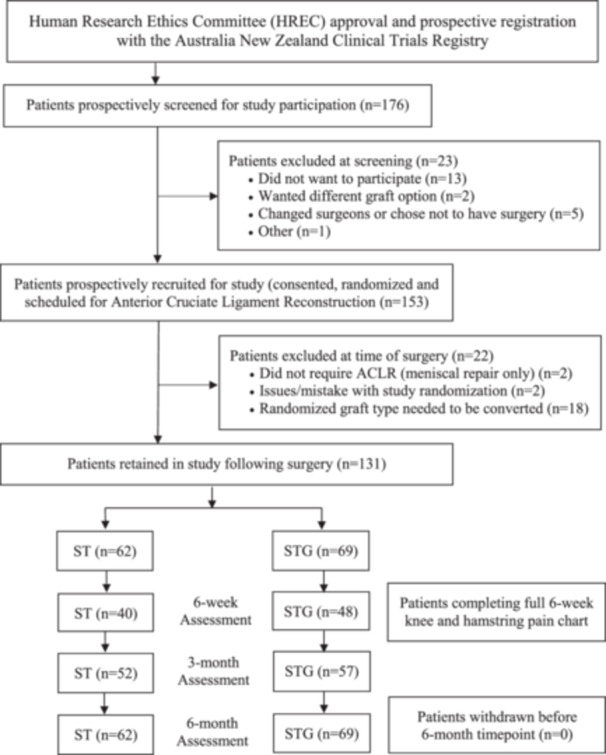 Figure 1
Peer Reviews
No public reviews on file for this paper yet. If you reviewed it on a platform where reviews are public (OpenReview, ICLR, NeurIPS, ICML), you can paste yours below so the community can read it here.
Videos
No videos yet. Explain this paper in a talk, walkthrough, or lecture? Add one.
Taxonomy
TopicsKnee injuries and reconstruction techniques · Total Knee Arthroplasty Outcomes · Sports injuries and prevention