Pair‐Feeding Study Designs Can Create Biases and Inflate Type I Error Rates: A Simulation Study
Wasiuddin Najam, Daniel E. Kpormegbey, Deependra K. Thapa, Bret Rust, Lilian Golzarri‐Arroyo, Lance H. Baumgard, Louis Wai‐Tong Fan, Joseph G. Ibrahim, Edith J. Mayorga, David B. Allison

TL;DR
Pair-feeding study designs can lead to incorrect conclusions due to inflated error rates, but adjusting for food intake in analysis can fix this issue.
Contribution
This study quantifies how pair-feeding can inflate type I error rates and shows that adjusting for food intake mitigates this bias.
Findings
Both individual and group pair-feeding increased type I error rates from 0.12 to 0.71 in unadjusted models.
Adjusting for food intake in statistical analysis reduced error rates to the expected 0.05 level.
Pair-feeding can lead to false positive results if food intake is not accounted for in the analysis.
Abstract
Pair‐feeding is a study design element where one group's food intake is provided to another group to assess whether a treatment effect is independent of food intake. Investigators often assume equivalent food intake across experimental conditions and exclude it from the statistical analysis. However, the impact of this practice on type I error (T1Er) rates has not been quantified. We conducted a Monte Carlo simulation in which animals were assigned baseline weights and food intakes, then randomized to non‐pair‐fed or pair‐fed groups. Daily food intake for both groups was initially drawn from the baseline food intake distribution. For pair‐fed animals, food intake was truncated if it exceeded the previous day's intake of the matched non‐pair‐fed animal (individual pair‐feeding) or the group's average (group pair‐feeding). Weight changes were calculated as a function of food intake, and…
Genes, proteins, chemicals, diseases, species, mutations and cell lines named across the full text — each resolved to its canonical identifier and authoritative record.
Click any figure to enlarge with its caption.
 Figure 1
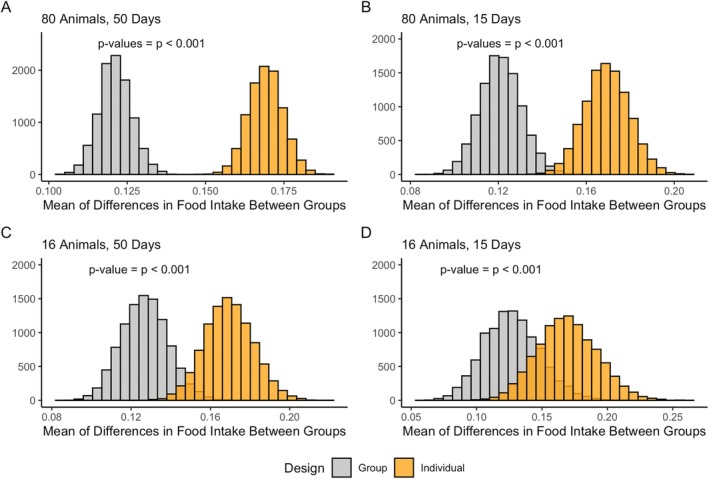 Figure 2
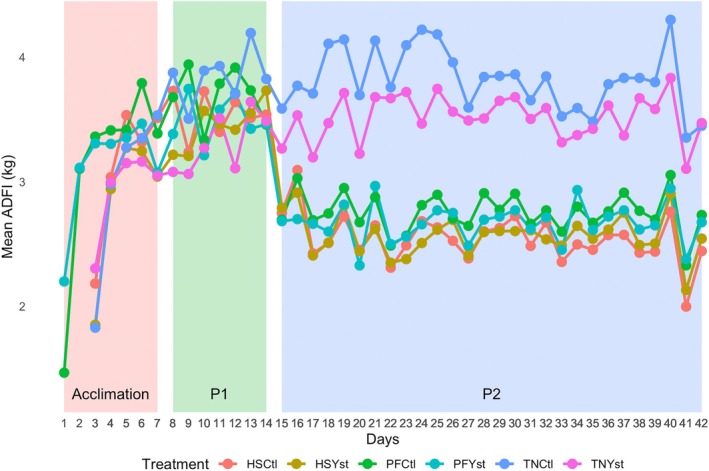 Figure 3
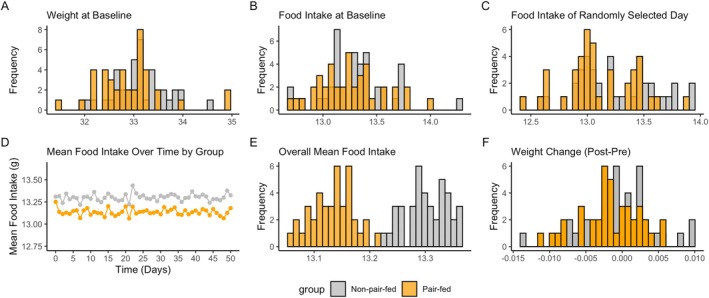 Figure 4
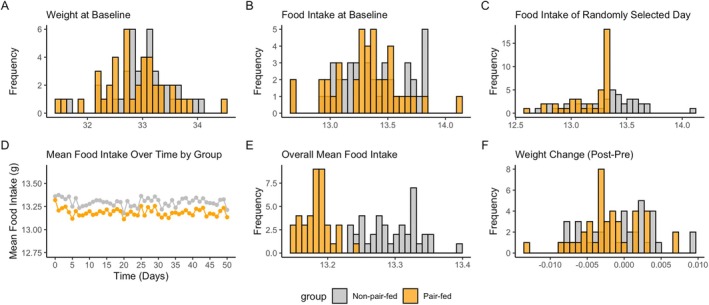 Figure 5
Peer Reviews
No public reviews on file for this paper yet. If you reviewed it on a platform where reviews are public (OpenReview, ICLR, NeurIPS, ICML), you can paste yours below so the community can read it here.
Videos
No videos yet. Explain this paper in a talk, walkthrough, or lecture? Add one.
Taxonomy
TopicsNutritional Studies and Diet · Advanced Causal Inference Techniques · Obesity, Physical Activity, Diet