How and why does aging occur? Updating evolutionary theory to meet a new era of data
C Jessica E Metcalf, Rozalyn M Anderson, Michael E Hochberg, Joanna Masel, Jacob Moorad, Daniel E L Promislow, Shripad Tuljapurkar, Noah Snyder-Mackler

TL;DR
This paper explores how new data technologies can improve our understanding of aging and help develop better models to extend healthspan.
Contribution
The paper proposes integrating richer biological detail into aging models to better understand and predict aging variability.
Findings
Classical models of aging based on individual age have limitations that new data can address.
Incorporating biological detail into models can improve predictions about aging patterns in populations.
Abstract
Our ability to define the causes of aging could enable targeted interventions to extend healthspan. Classical evolutionary models based on individual age have provided critical insights into empirical trajectories of aging; however, gaps remain. We argue that technological advances in data capture, resolution, and scale present a rich opportunity to shed light on heterogeneity in patterns of aging. Computational and data analysis advances have produced expanded theoretical models that explicitly address details of the underlying biology, introducing variables and dynamics that go beyond ‘age’ itself. We argue that by incorporating richer biological detail to create more integrative predictive models, we can gain insight into expected future distributions of aging within populations, and better understand the molecular and demographic context in which selection has given rise to…
Click any figure to enlarge with its caption.
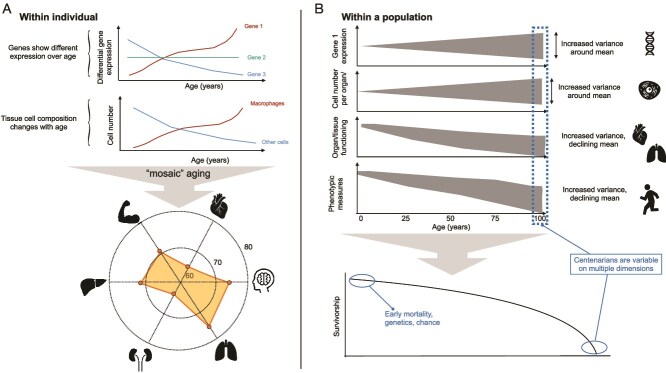 Figure 1
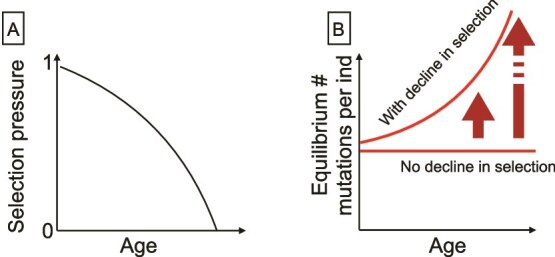 Figure 2
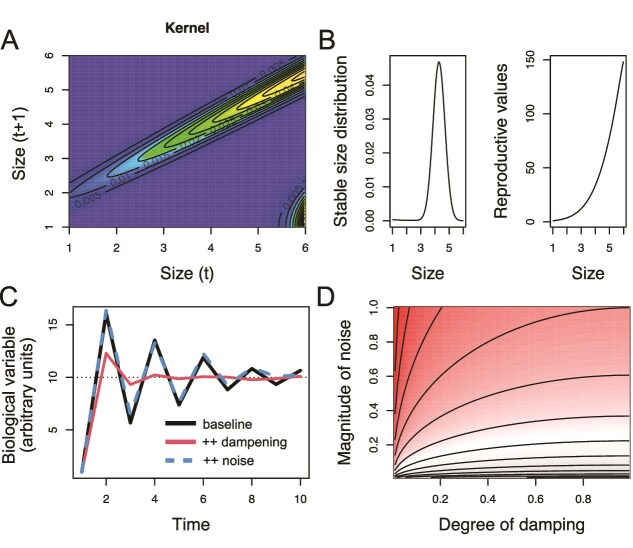 Figure 3
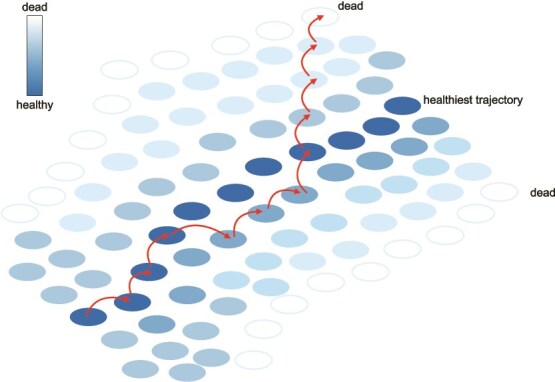 Figure 4
Peer Reviews
No public reviews on file for this paper yet. If you reviewed it on a platform where reviews are public (OpenReview, ICLR, NeurIPS, ICML), you can paste yours below so the community can read it here.
Videos
No videos yet. Explain this paper in a talk, walkthrough, or lecture? Add one.
Taxonomy
TopicsGenetics, Aging, and Longevity in Model Organisms · Evolutionary Psychology and Human Behavior · Evolution and Genetic Dynamics