Ultra‐Sensitive Dual‐Resonator Graphene Pressure Sensor with Temperature Self‐Compensation
Zhen Wan, Cheng Li, Zhengwei Wu, Pengcheng Zhao, Yang Liu, Wanting Li, Shangchun Fan, Wei Jin

TL;DR
A new graphene-based pressure sensor with high sensitivity and temperature compensation is developed for use in aerospace, automotive, and healthcare.
Contribution
A dual-resonator graphene sensor with integrated temperature self-compensation is introduced, offering ultra-sensitive pressure detection.
Findings
The sensor achieves a sensitivity of 24.1 kHz kPa−1, 68 times higher than silicon sensors.
It has a maximum pressure error of 6.51 kPa with an accuracy of 1.302% FS over a wide temperature range.
The sensor's compact design enables drone-based field experiments and portable sensing applications.
Abstract
Silicon resonator sensors have limitations in detecting small pressure changes due to their structural dimensions. Graphene nanomechanical resonators, with their ultra‐small thickness and excellent mechanical properties, offer the opportunity to break this limitation. Here, a highly sensitive graphene nanomechanical pressure sensor with integrated temperature self‐compensation is reported. It consists of two vacuum anode‐bonded graphene resonators: one is sensitive to pressure and temperature while the other to temperature only, allowing for the cancellation of thermal effects via detecting the difference in the resonant frequencies. A sensitivity of 24.1 kHz kPa−1 is achieved over the pressure range of 0.001 to 500 kPa, 68 times higher than the state‐of‐the‐art silicon pressure sensors. The full‐scale (FS) hysteresis error is 0.31% with a repeatability of 0.75% in three forward and…
Genes, proteins, chemicals, diseases, species, mutations and cell lines named across the full text — each resolved to its canonical identifier and authoritative record.
Click any figure to enlarge with its caption.
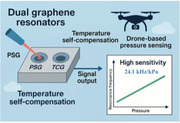 Figure 1
 Figure 2
 Figure 3
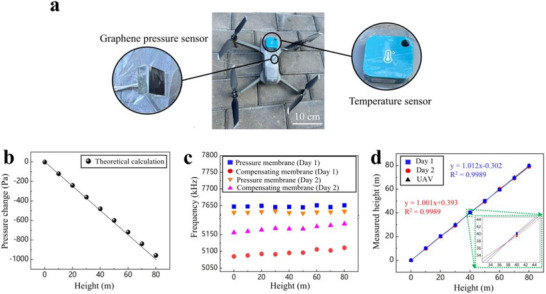 Figure 4
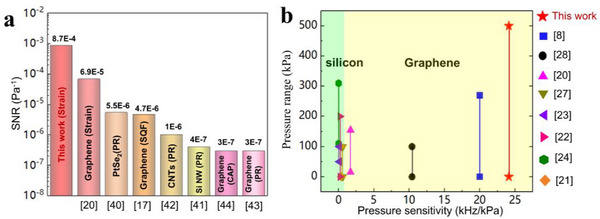 Figure 5
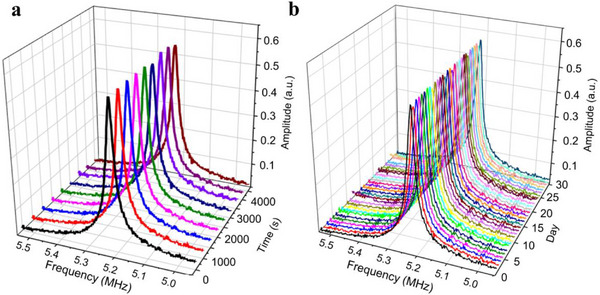 Figure 6
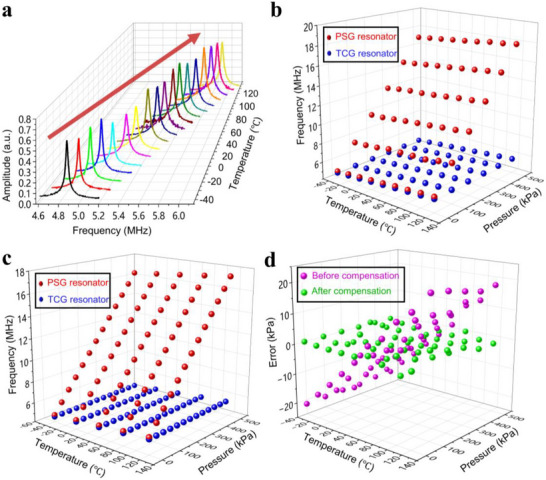 Figure 7
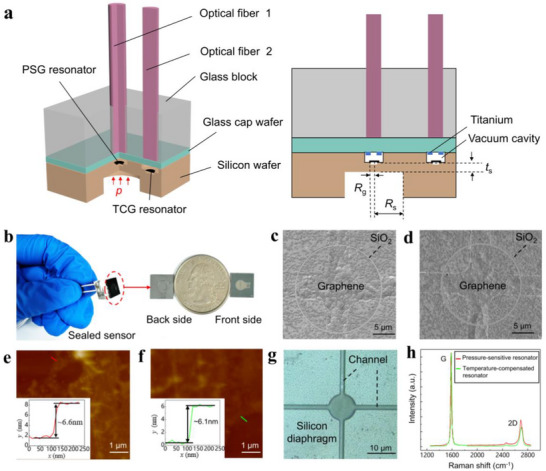 Figure 8
Peer Reviews
No public reviews on file for this paper yet. If you reviewed it on a platform where reviews are public (OpenReview, ICLR, NeurIPS, ICML), you can paste yours below so the community can read it here.
Videos
No videos yet. Explain this paper in a talk, walkthrough, or lecture? Add one.
Taxonomy
TopicsMechanical and Optical Resonators · Advanced MEMS and NEMS Technologies · Nonlocal and gradient elasticity in micro/nano structures