Empatica E4 wristband assessment of probable REM sleep behavior disorder in people with Parkinson’s disease. Results from the DIGI.PARK study
Lisa Aaslestad, Brice Marty, Monica Patrascu, Haakon Reithe, Bettina S. Husebo, Rolf Moe Nilssen, Erika Sheard, Simon Kverneng, Charalampos Tzoulis, Line Iden Berge

TL;DR
This study explores using a wristband to objectively assess sleep behavior disorder in Parkinson’s patients, improving accuracy over self-reported questionnaires.
Contribution
The study introduces a novel method combining wearable sensor data with self-reported questionnaires to assess probable REM sleep behavior disorder in Parkinson’s disease.
Findings
Accelerometry data showed higher nocturnal motor activity in individuals with probable RBD compared to sensor data.
Sensor data integrated with RBDSQ items showed high internal consistency (α = 0.87).
Wearable data can supplement self-reports to reduce subjective biases in RBD assessment.
Abstract
Parkinson’s disease is frequently accompanied by Rapid Eye Movement (REM) sleep behavior disorder (RBD), causing individuals to physically act out their dreams. The REM Sleep Behavior Disorder Questionnaire (RBDSQ) is a 13-items self-report tool to identify individuals with probable REM Sleep Behavior Disorder (pRBD). While self-report of symptoms is limited by inaccuracies in recall and subjective interpretation, some of the RBDSQ items concerns nocturnal motor behavior that could be suitable for digital assessment. Therefore, we examined the potential of the Empatica E4 wristband to objectively support RBD assessment alongside the self-reported RBDSQ. To capture nocturnal motor behavior (e.g., number, total sleep time, magnitude) and heart rate variability, data from 149 nights were recorded continuously from 14 people with Parkinson’s disease. Data were analyzed by visual…
Genes, proteins, chemicals, diseases, species, mutations and cell lines named across the full text — each resolved to its canonical identifier and authoritative record.
Click any figure to enlarge with its caption.
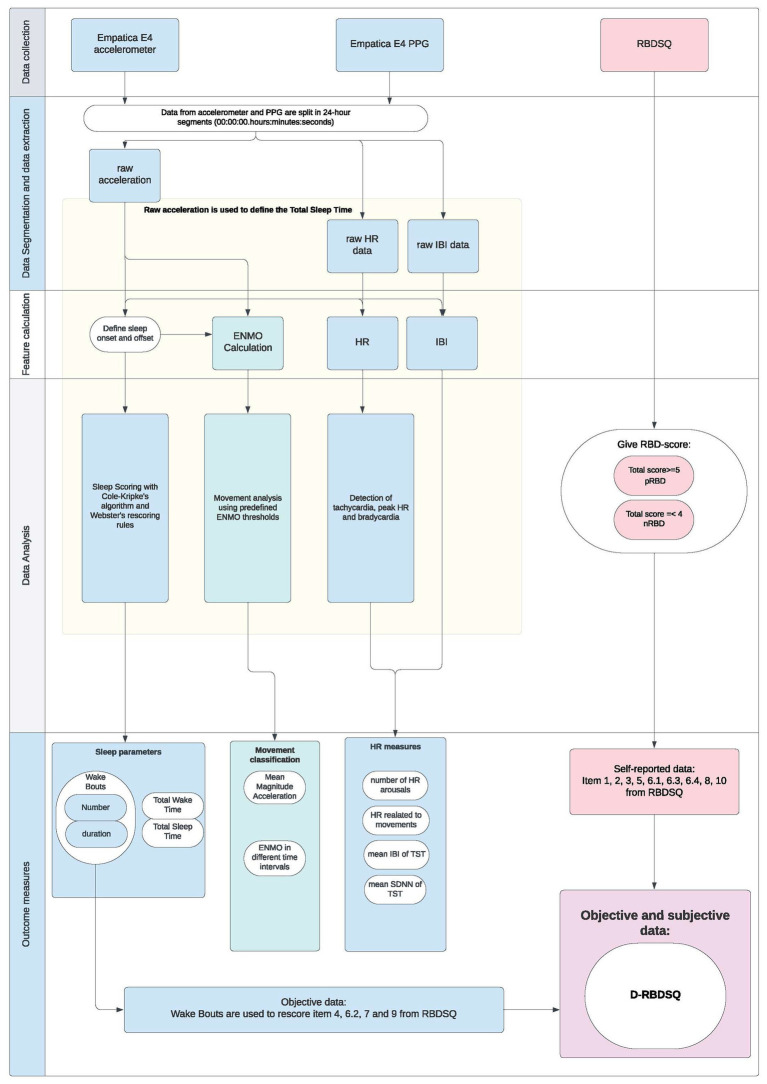 Figure 1
Peer Reviews
No public reviews on file for this paper yet. If you reviewed it on a platform where reviews are public (OpenReview, ICLR, NeurIPS, ICML), you can paste yours below so the community can read it here.
Videos
No videos yet. Explain this paper in a talk, walkthrough, or lecture? Add one.
Taxonomy
TopicsParkinson's Disease Mechanisms and Treatments · Restless Legs Syndrome Research · Sleep and related disorders