Heavy Prussian Blue Analog with Magnetic Ordering above 400 K
Michał Magott, Gabriela Handzlik, Dominik Dzierżek, Alexey Maximenko, Itziar Oyarzabal, Nathan J. Yutronkie, Fabrice Wilhelm, Andrei Rogalev, Dawid Pinkowicz

TL;DR
Scientists created a new magnetic material that works above 400 K, a major step toward room-temperature multifunctional magnets.
Contribution
A cyanido-bridged Prussian Blue analog with ferrimagnetic ordering above 400 K is synthesized and characterized.
Findings
The compound shows ferrimagnetic ordering with a critical temperature exceeding 400 K.
SQUID and XMCD confirm antiparallel alignment of vanadium and molybdenum magnetic moments.
Hexacyanomolybdate(III) is established as a viable precursor for high-temperature molecule-based magnets.
Abstract
Molecule‐based magnets hold promise for a variety of applications in information technologies owing to their chemical tunability. This feature can facilitate the integration of desired magnetic properties alongside additional functionalities within a single material. Although numerous cyanido‐bridged assemblies are identified as multifunctional materials at cryogenic temperatures, achieving analogous behavior at room temperature remains a challenge. This study reports a cyanido‐bridged compound, which shows ferrimagnetic ordering with a critical temperature exceeding 400 K. This breakthrough is achieved through the mechanochemical synthesis of vanadium(II)‐hexacyanomolybdate(III) Prussian Blue Analog (PBA) under anhydrous conditions. The ferrimagnetic order is evidenced by SQUID (SQUID = superconducting quantum interference device) magnetometry and X‐ray Magnetic Circular Dichroism…
Genes, proteins, chemicals, diseases, species, mutations and cell lines named across the full text — each resolved to its canonical identifier and authoritative record.
Click any figure to enlarge with its caption.
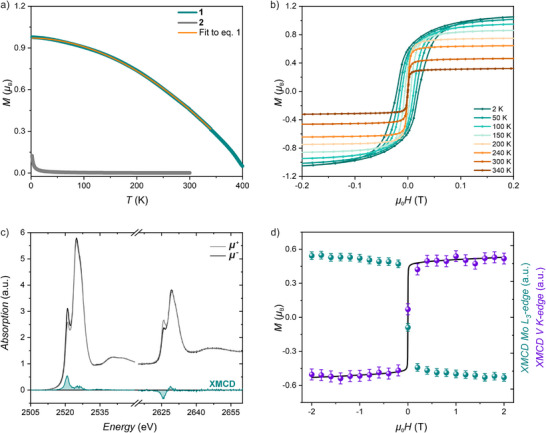 Figure 1
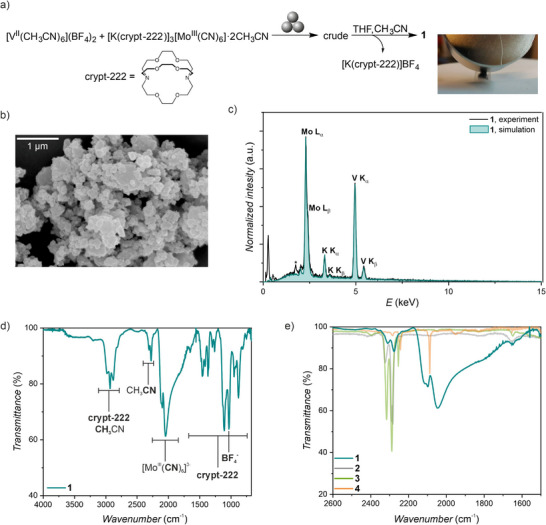 Figure 2
 Figure 3
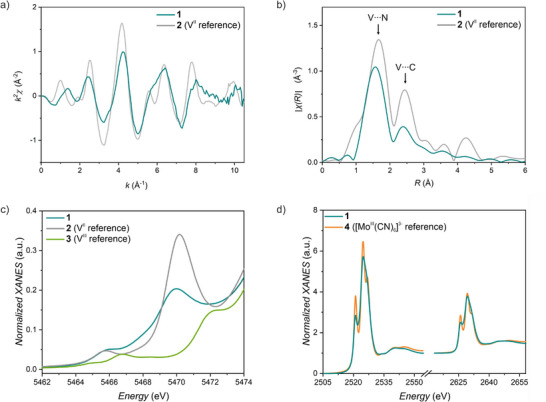 Figure 4
Peer Reviews
No public reviews on file for this paper yet. If you reviewed it on a platform where reviews are public (OpenReview, ICLR, NeurIPS, ICML), you can paste yours below so the community can read it here.
Videos
No videos yet. Explain this paper in a talk, walkthrough, or lecture? Add one.
Taxonomy
TopicsMagnetism in coordination complexes · Organic and Molecular Conductors Research · Metal-Organic Frameworks: Synthesis and Applications