Hematocolpometra due to Imperforate Hymen
Asae Inoue, Takuya Otsuki, Kosuke Ishizuka, Kasane Ikegami, Ruri Isono, Kenya Ie, Chiaki Okuse

TL;DR
Imperforate hymen can cause serious complications if not diagnosed early, requiring careful examination and imaging in girls with unexplained abdominal pain or constipation.
Contribution
Highlights the importance of genital examination and imaging in diagnosing imperforate hymen to prevent complications like hematocolpometra.
Findings
Imperforate hymen can lead to fluid accumulation in the vaginal canal and uterine cavity.
Missed diagnosis in primary care is common due to nonspecific symptoms.
Imaging reveals complications such as bladder distension and hydronephrosis.
Abstract
Early recognition of imperforate hymen in premenarchal girls enables timely intervention to prevent serious complications; however, its nonspecific presentation often leads to missed diagnosis in primary care. Careful genital examination, supplemented by appropriate imaging, is essential when evaluating lower abdominal pain or constipation in girls with amenorrhea. 2a: Significant fluid accumulation in the vaginal canal (yellow arrows) extending into the uterine cavity (red arrows), along with bladder distension (yellow arrowheads). 2b: Bilateral hydronephrosis and ureteral dilatation.
Genes, proteins, chemicals, diseases, species, mutations and cell lines named across the full text — each resolved to its canonical identifier and authoritative record.
Click any figure to enlarge with its caption.
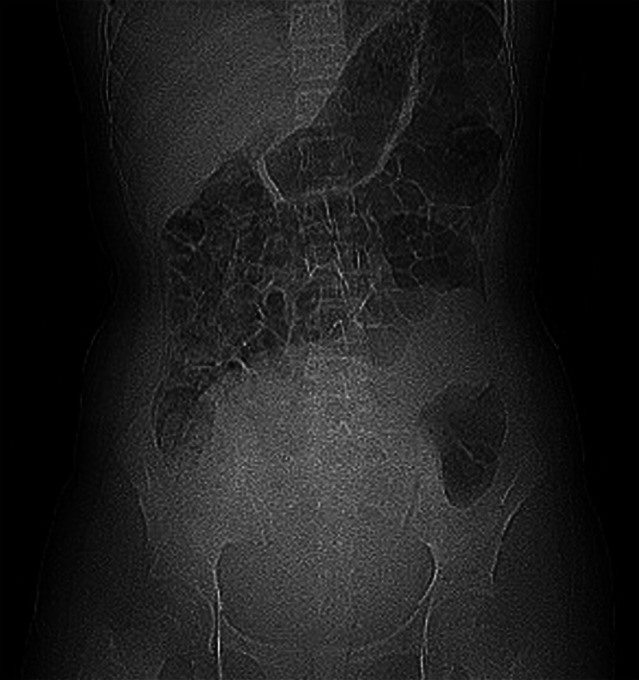 FIGURE 1
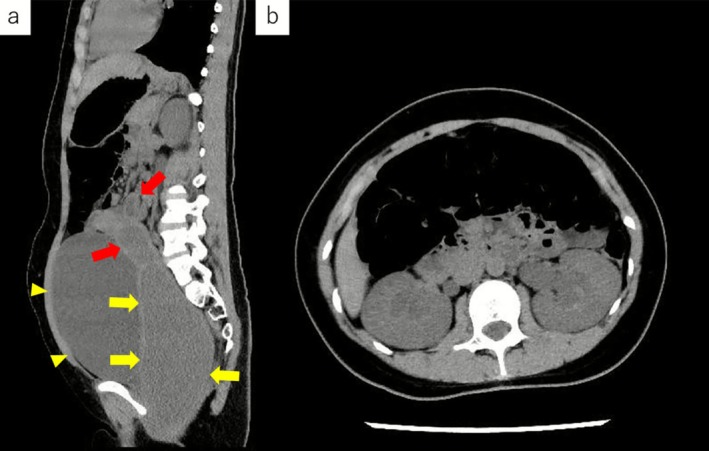 FIGURE 2
Peer Reviews
No public reviews on file for this paper yet. If you reviewed it on a platform where reviews are public (OpenReview, ICLR, NeurIPS, ICML), you can paste yours below so the community can read it here.
Videos
No videos yet. Explain this paper in a talk, walkthrough, or lecture? Add one.
Taxonomy
TopicsGynecological conditions and treatments · Ectopic Pregnancy Diagnosis and Management · Endometriosis Research and Treatment
Case
1
A 9‐year‐10‐month‐old girl with a developmental disorder presented with a 4‐day history of lower abdominal pain and genital discomfort, accompanied by urinary and fecal urgency. She had not yet experienced menarche. Physical examination revealed marked abdominal distension, decreased bowel sounds, and diffuse lower abdominal tenderness. Genital examination showed an imperforate hymen and compression of the external urethral meatus. Abdominal X‐ray revealed increased soft tissue density in the pelvic cavity and cranial displacement of the bowel loops (Figure 1). Computed tomography showed significant fluid accumulation in the vaginal canal extending into the uterine cavity, pelvic organ prolapse, bladder distension, and bilateral hydronephrosis (Figure 2a,b). Based on these findings, the patient was diagnosed with hematocolpometra due to imperforate hymen, complicated by urethral compression and bilateral hydronephrosis. A hymenotomy was promptly performed, evacuating approximately 500 mL of bloody fluid, followed by vaginal irrigation, resulting in clinical improvement.
Abdominal X‐ray revealed decreased bowel gas and increased soft tissue density in the pelvic cavity, with cranial displacement of the gastrointestinal tract.
(2a) Sagittal CT demonstrated significant fluid accumulation in the vaginal canal (yellow arrows) extending into the uterine cavity (red arrows), along with pelvic organ prolapse and bladder distension (yellow arrowheads). (2b) Axial CT demonstrated bilateral hydronephrosis and ureteral dilatation.
Imperforate hymen (IH) is an uncommon congenital anomaly of the urogenital sinus, with an incidence of 0.05%–0.1% [1], typically presents in early puberty with cyclic abdominal pain or voiding dysfunction. Owing to its low incidence and nonspecific symptoms, IH can be misdiagnosed as constipation or psychogenic disorders, leading to delayed diagnosis—especially when developmental disorders impede proper history‐taking, as seen in this case [2]. Without appropriate management, IH can cause infections, hydronephrosis, and endometriosis‐associated infertility [3]. Therefore, gynecological examination is essential in evaluating lower abdominal pain in premenarchal girls.
Author Contributions
Asae Inoue: investigation, writing – original draft. Takuya Otsuki: writing – original draft, writing – review and editing. Kosuke Ishizuka: writing – review and editing. Kasane Ikegami: data curation, investigation, writing – review and editing. Ruri Isono: investigation, writing – review and editing. Kenya Ie: supervision, writing – review and editing. Chiaki Okuse: writing – review and editing.
Funding
The authors have nothing to report.
Consent
Written consent to use patient's case record (including X‐ray and Computed tomography) was obtained.
Conflicts of Interest
The authors declare no conflicts of interest.
The reference list from the paper itself. Each links out to its DOI / PubMed record.
- 1J. W. Mou , P. M. Tang , K. W. Chan , Y. H. Tam , and K. H. Lee , “Imperforate Hymen: Cause of Lower Abdominal Pain in Teenage Girls,” Singapore Medical Journal 50 (2009): e 378–e 379.19960149 · pubmed ↗
- 2M. E. Cihangir , E. K. Kazim , A. Ibrahim , and U. Mustafa , “Imperforate Hymen Causing Hematocolpos and Acute Urinary Retention in an Adolescent Girl,” Taiwanese Journal of Obstetrics & Gynecology 50, no. 1 (2011): 118–120.21482390 10.1016/j.tjog.2011.01.005 · doi ↗ · pubmed ↗
- 3A. S. Eksioglu , H. A. Maden , G. Cinar , and Y. Tasci Yildiz , “Imperforate Hymen Causing Bilateral Hydroureteronephrosis in an Infant With Bicornuate Uterus,” Case Reports in Urology 2012 (2012): 102683.22720183 10.1155/2012/102683 PMC 3375070 · doi ↗ · pubmed ↗