New species in the Elachista praelineata species group (Lepidoptera, Elachistidae, Elachistinae) from East Africa, with identification keys to the Afrotropical species

Abstract
Click any figure to enlarge with its caption.
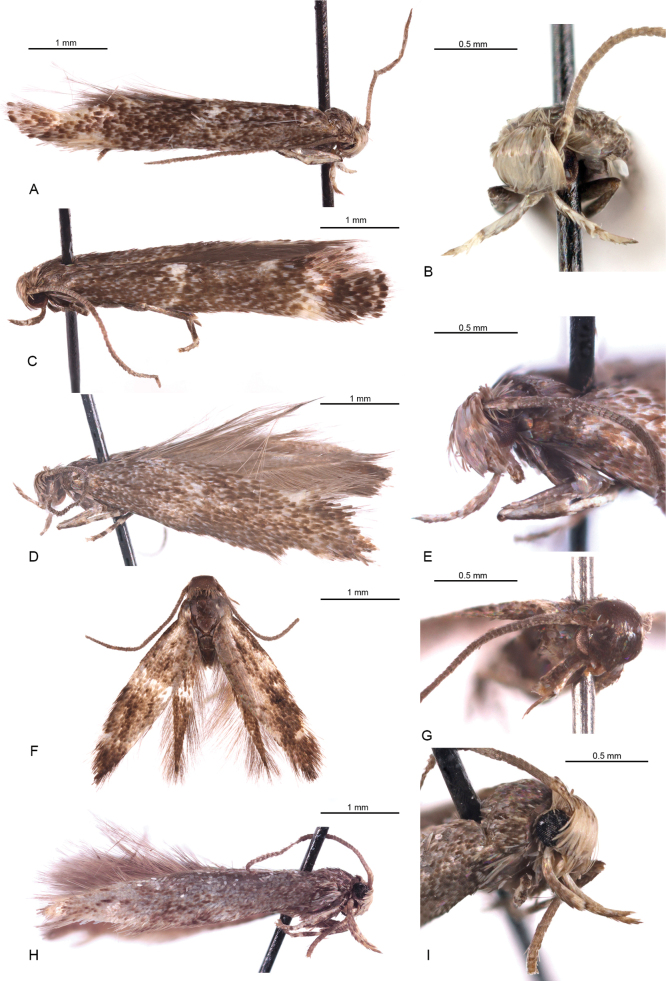 Figure 1
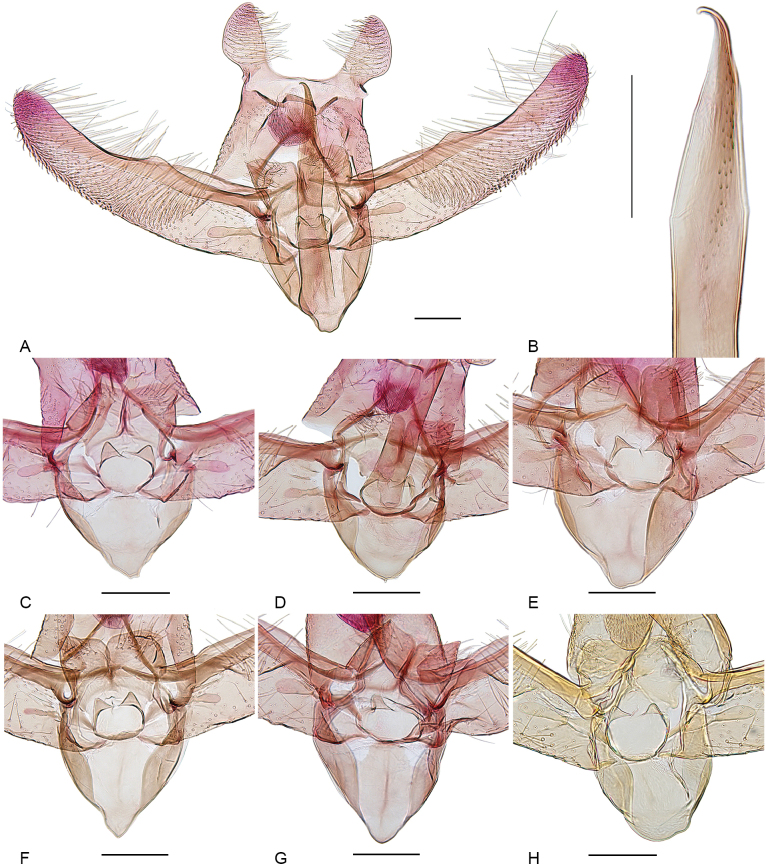 Figure 2
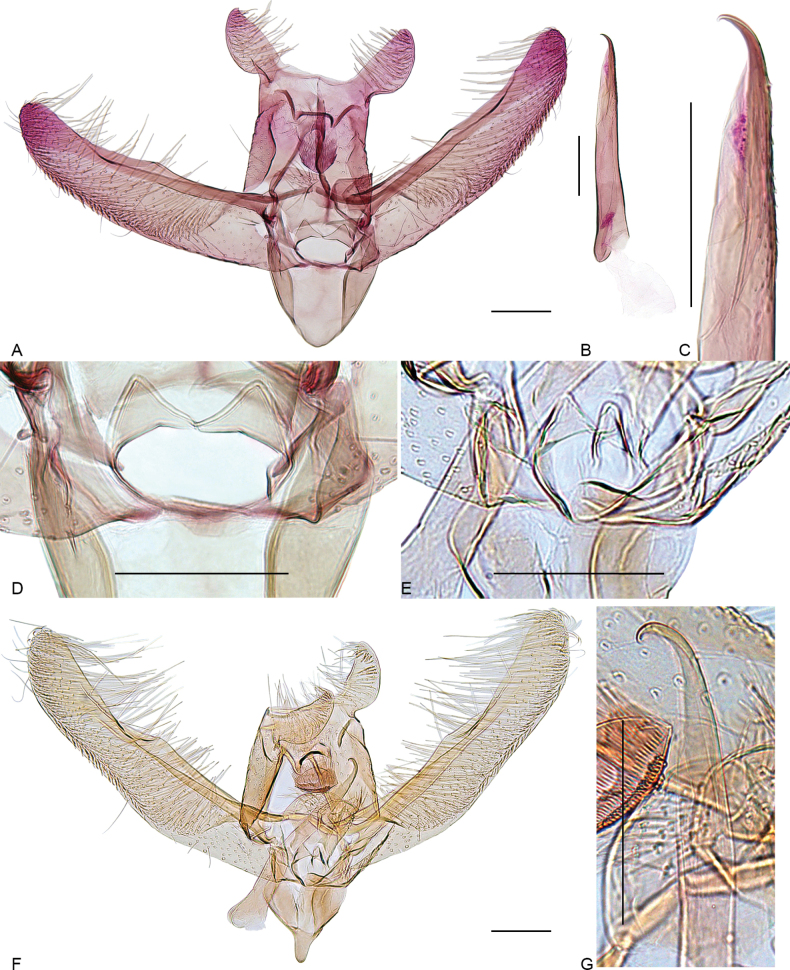 Figure 3
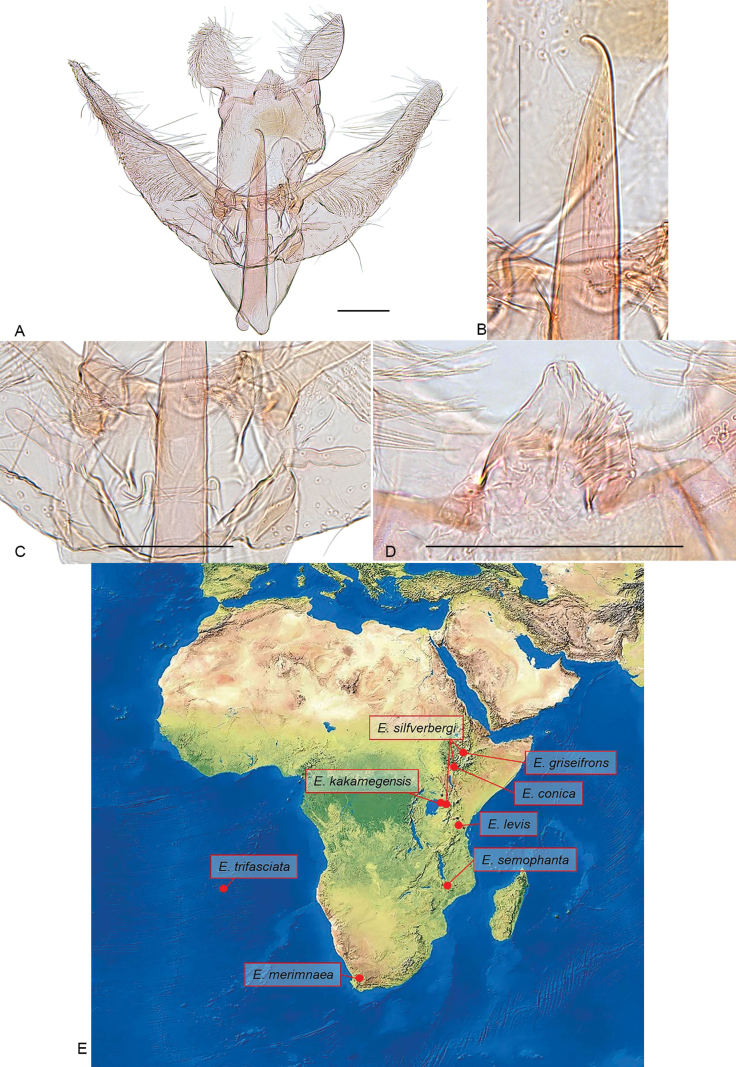 Figure 4
| 1 | Uncus lobes are reduced, very small, like a pustule ( |
|
| – | Uncus lobes well developed, large, widely apart from each other |
|
| 2 | Vesica with two longitudinal, weakly sclerotized bands ( |
|
| – | Vesica without any sclerotized formations |
|
| 3 | Phallus with a band of proximally directed small spines in apical 1/3 |
|
| – | Phallus without spines in apical 1/3 |
|
| 4 | Digitate process short and triangularly shaped (Fig. |
|
| – | Digitate process narrow and long, at least 5 times as long as its width |
|
| 5 | Spinose knob of gnathos large, rounded (Fig. |
|
| – | Spinose knob of gnathos reduced, not rounded (Fig. |
|
| 6 | Digitate process short and triangularly shaped; phallus with hooked apex (Fig. |
|
| – | Digitate process narrow and long; apex of phallus acute, but not hooked ( |
|
| 1 | Corpus bursae with signa ( |
|
| – | Corpus bursae without signa |
|
| 2 | Antrum short, bowl-shaped, membranous, without any sclerotized formations; colliculum narrow, strongly sclerotized ( |
|
| – | Antrum long, gradually tapering anteriorly, with two prolonged sclerotized bands; colliculum not pronounced ( |
|
Peer Reviews
No public reviews on file for this paper yet. If you reviewed it on a platform where reviews are public (OpenReview, ICLR, NeurIPS, ICML), you can paste yours below so the community can read it here.
Videos
No videos yet. Explain this paper in a talk, walkthrough, or lecture? Add one.
Taxonomy
TopicsLepidoptera: Biology and Taxonomy · Biological Control of Invasive Species · Insect Pheromone Research and Control
Introduction
Elachista Treitschke, 1833, is a genus of small, often dull-coloured moths, but sometimes showing shiny, metallic markings on forewings. Their larvae are leaf miners on monocotyledons, most commonly grasses and sedges (Parenti and Varalda 1994). It is the most diverse genus within the subfamily Elachistinae and is currently divided into five subgenera and 19 species groups (Kaila 2019). Prior to the addition of the new taxa described herein, the genus comprised 698 recognized species (Kaila et al. 2025; Kaila and Tokár 2026).
The E. praelineata species group was delineated by Kaila (1999b, 2000), based on Elachista praelineata Braun, 1915, which is known from the Nearctic region. It comprises predominantly dark-coloured moths often with pale transverse fascia near the middle of the forewing and a pair of pale distal spots. In some species, these markings are shiny, metallic, and silvery. Diagnostic features of the male genitalia include an elongate cucullus, a subtle hump along the distal fold of the costa, and a more or less reduced digitate process. Female abdominal tergite VII exhibits a distinctive morphological trait: a prominent tuft of elongated, hair-like scales arising from tergite VII (Kaila 1999b; Sugisima 2005; Sruoga and Havelka 2023). The life history of the species is poorly known. Food plants, all belonging to Poaceae or Cyperaceae, have been recorded for fewer than half of the known species, and only that of E. trifasciata (Wollaston, 1879), Carex dianae Steud., is documented from the Afrotropical region, St. Helena (Fowler and Karisch 2020).
The Afrotropical species of the E. praelineata species group remain poorly explored. Prior to this publication, only four out of the 37 species known in the group had been recorded from the Afrotropical region (De Prins and De Prins 2011–2025). In the present study, four new species are described, and keys to the Afrotropical species are provided.
Material and methods
This paper is based on material mainly obtained from the Finnish Museum of Natural History, Helsinki, Finland (MZH); one specimen from the Zoological Museum, University of Copenhagen, Denmark (ZMUC); and one specimen from the research collection of David J. L. Agassiz, Weston-super-Mare, United Kingdom (DJLA).
Adult specimens were examined externally using a Nikon SMZ445 stereomicroscope. The forewing length was measured along the costa from the wing base to the apex of the terminal fringe scales with an ocular micrometer. The head width was measured between the inner edges of the antennal bases. The genitalia were prepared following the standard method described by Robinson (1976) and Traugott-Olsen and Nielsen (1977). The male genital capsule was stained with fuchsin, the abdominal pelt, and the female genitalia with chlorazol black (Direct Black 38/Azo Black). The genital morphology was examined using a Leica DM6 B microscope. The photographs of adults were taken using a Canon EOS 80D camera fitted with a Canon MP-E 65 mm macro lens, attached to a macro rail (MJKZZ Qool Rail). Genitalia photographs were taken with a Leica DM6 B microscope and a Leica K3C digital camera. Zerene Stacker 1.0, with a retouch function, was used for image stacking. All images were optimized and grouped into plates using Adobe Photoshop CC 2019.
The descriptive terminology of morphological structures follows Traugott-Olsen and Nielsen (1977), with some modifications by Kaila (1997, 1999a, 2011). A comparison of the length of the phallus in relation to the valva was measured as the longest line from the base of the sacculus to the apex of the cucullus.
Results
Checklist of the Afrotropical species of the Elachista
praelineata species group:
1. Elachista conica sp. nov.
Distribution. Ethiopia.
Holotype ♂ in MZH.
2. Elachista griseifrons sp. nov.
Distribution. Ethiopia.
Holotype ♂ in MZH.
3. Elachista kakamegensis Sruoga & De Prins, 2009
Elachista kakamegensisSruoga and De Prins 2009: 8.
Distribution. Kenya.
Holotype ♂ and 2♀ paratypes in the Royal Museum for Central Africa, Tervuren, Belgium.
4. Elachista levis sp. nov.
Distribution. Tanzania.
Holotype ♂ in ZMUC.
5. Elachista merimnaea Meyrick, 1920
Elachista merimnaea Meyrick, 1920: 297; Parenti 1988: 189.
Distribution. South Africa.
Holotype ♂ in the South Africa Museum, Cape Town, Republic of South Africa.
6. Elachista semophanta Meyrick, 1914
Elachista semophanta Meyrick, 1914: 281; Sruoga 2002: 138.
Distribution. Malawi.
Holotype ♂ in the Natural History Museum, London, United Kingdom.
7. Elachista silfverbergi sp. nov.
Distribution. Ethiopia, Kenya.
Holotype ♂ and 40 ♂ paratypes in MZH; 1 ♂ paratype in DJLA.
8. Elachista trifasciata (Wollaston, 1879)
Stagmatophora trifasciata Wollaston, 1879: 437.
Elachista trifasciata (Wollaston); Sinev 2002: 164; Fowler and Karisch 2020: 28
Distribution. Saint-Helena.
Syntypes (12) in the Natural History Museum, London, United Kingdom.
Key to the Afrotropical species of the Elachista
praelineata species group
Based on male genitalia (male of E. semophanta is unknown).
**: **
Key to the Afrotropical species of the Elachista
praelineata species group
Based on female genitalia (females of E. conica sp. nov., E. griseifrons sp. nov., E. levis sp. nov., E. merimnaea, and E. silfverbergi sp. nov. are unknown).
**: **
Elachista
silfverbergi
sp. nov.
Taxon classificationAnimaliaLepidopteraElachistidae
520C9D2C-F054-5777-A5C8-2DE0433D796D
https://zoobank.org/E0A98868-9BAB-4412-9B4B-C8E42B63811C
Material examined.
Holotype. Ethiopia • ♂; Addis Ababa; 8.9506°N, 38.8256°E; 3–4 Feb. 1974; H. Silfverberg leg.; gen. prep. VS622; MZH. Paratypes. Ethiopia • 7 ♂; Addis Ababa; 8.9506°N, 38.8256°E; 30 Jan.–1 Feb. 1974; H. Silfverberg leg.; gen. prep. L. Kaila 1897, 1898, 1899, VS617; MZH • 2 ♂; same data except date; 1–3 Feb. 1974; gen. prep. L. Kaila 1900, VS641 • 1 ♂; same data except date; 3–4 Feb. 1974; gen. prep. VS621 • 1 ♂; same data except date; 4–5 Feb. 1974; gen. prep. VS640 • 8 ♂; same data except date; 21–23 Feb. 1974; gen. prep. VS624, VS625, VS629 • 4 ♂; same data except date; 23–25 Feb. 1974; gen. prep. VS626, VS631 • 3 ♂; same data except date; 25–27 Feb. 1974; gen. prep. VS620, VS642 • 12 ♂; same data except date; 18–19 Mar. 1974; gen. prep. L. Kaila 1896, VS618, VS619, VS628, VS630 • 1 ♂; same data except date; 20–21 Mar. 1974; gen. prep. VS623 • 1 ♂; Arba Minch; 6.03°N, 37.54°E; 28 Feb.–1 Mar. 1974; gen. prep. L. Kaila 1387; Mzh. Kenya • 1 ♂; Rift Valley, Prov. Turi; 8000 ft; 4. Mar 1999; DJL Agassiz leg.; gen. prep. L. Kaila 850; DJLA.
Diagnosis.
Among the known Afrotropical species of the E. praelineata species group, E. silfverbergi can be compared with E. merimnaea Meyrick, 1920, known from South Africa (for external characters and male genitalia, see Parenti 1988, figs 4, 12–15). However, in contrast to E. silfverbergi, moths of E. merimnaea are lightly coloured, the cucullus of the valva is blunt, the phallus lacks a band of spines, and the apex of the phallus is not hooked as in E. silfverbergi. Elachista silfverbergi also resembles E. amamii Parenti, 1983, known from Japan and Thailand (for external characters and male genitalia, see Parenti 1983, table 2, Sugisima 2005, figs 1, 2, 15, 39), and E. simulans Sruoga, 2022, known from Nepal (for external characters and male genitalia, see Sruoga 2022, figs 24–27). However, unlike E. silfverbergi, in those species the saccus is prominent and narrow, the phallus lacks a band of spines, and the apex of the phallus is not as hooked as in E. silfverbergi.
Description.
Male. (Fig. 1A, B). Forewing length 3.6–4.5 mm; wingspan 7.8–9.4 mm (N = 42). Head: frons white to off-white, vertex whitish-grey intermixed with brownish-grey, some scales with darkened tips, neck tuft brownish-grey; labial palpus 1.3–1.5 times as long as width of head, off-white above and greyish-brown below; scape and first flagellomere blackish-brown, flagellum brownish-grey, pecten off-white. Thorax, tegula, and forewing strongly mottled with scales, basally off-white and distally grey-brown; antemedian transverse fascia white, blurred, interrupted at middle, present as two small white spots near costal and dorsal margins; small costal and tornal spots blurred, off-white; fringe brownish-grey. Hindwing and its fringe brownish-grey.
Elachista species. AE. silfverbergi sp. nov., adult male, holotype; B ibid., head, frontal view; CE. silfverbergi sp. nov., adult male, paratype; DE. griseifrons sp. nov., adult male, holotype; E ibid., head, lateral view; FE. levis sp. nov., adult male, holotype; G ibid., head, fronto-lateral view; HE. conica sp. nov., adult male, holotype; I ibid., head, fronto-lateral view.
Female. Unknown.
Male genitalia (Fig. 2). Uncus lobes widely apart from each other, longer than wide, broadest before middle, tapered distally, setae on ventral surface dense, scale-like near apex and along lateral margin, becoming longer and thinner in mediobasal part. Socius with a few long setae. Spinose knob of gnathos rounded, about as large as width of uncus lobe at its widest point. Valva long and narrow, about four times as long as wide at costal hump; basal fold of costa extended to 1/2 of valva, beyond it with small, broad hump; cucullus long, slightly bent towards costa. Median plate of juxta with a pair of dorsally directed lateral pockets. Juxta lobes large, median margin straight, joining straight distal margin at right angle, distal margin convex, ventral surface distally with long setae. Digitate process wide basally, nearly parallel or slightly varying in shape from middle, sometimes with single seta near tip (Fig. 2C). Vinculum V-shaped, saccus short, not prominent, varies slightly in length and width, with weak median ridge in some specimens. Phallus about 0.7 as long as valva, weakly bent before middle, caecum small, apex acute, and curved to form strongly sclerotized hook; ventral surface with band of proximally directed small spines in apical 1/3; vesica without cornuti.
Male genitalia of Elachista silfverbergi sp. nov. A general view, holotype, gen. prep. VS622; B distal part of phallus, paratype, gen. prep. 624; C–H juxta region: C paratype, gen. prep. VS620; D paratype, gen. prep. VS621; E paratype, gen. prep. VS625; F paratype, gen. prep. VS626; G paratype, gen. prep. VS641; H paratype, gen. prep. 850. Scale bars: 0.1 mm.
Biology.
Unknown.
Flight period.
Adults were collected from early January until early March.
Distribution.
Central and south-western Ethiopia and south-western Kenya.
Etymology.
The species is named after the Finnish entomologist Hans Silfverberg, who collected most type material.
Elachista
griseifrons
sp. nov.
Taxon classificationAnimaliaLepidopteraElachistidae
1D0B3564-719D-5B4F-B16E-43654072EF0E
https://zoobank.org/3F70F486-E38B-455D-B5E3-79F7453D0421
Material examined.
Holotype. Ethiopia • ♂; Addis Ababa; 8.9506°N, 38.8256°E; 1–3 Feb. 1974; H. Silfverberg leg.; gen. prep. VS627; MZH.
Diagnosis.
Elachista griseifrons externally closely resembles E. silfverbergi, known from the same locality, but it differs in a more grey frons and longer labial palpus compared to the width of the head. Also, the male genitalia are very similar to those of E. silfverbergi. However, the digitate process is reduced to a bluntly triangular lobe in E. griseifrons, whereas in E. silfverbergi it is well developed and about twice as long as in E. griseifrons.
Description.
Male. (Fig. 1D, E). Forewing length 3.9 mm; wingspan 8.4 mm (N = 1). Head: frons whitish-grey, vertex greyish-brown intermixed with whitish-grey, some scales with darkened tips, neck tuft greyish-brown; labial palpus 1.75 times as long as width of head, whitish-grey above and greyish-brown below; scape, pecten, and flagellum brownish-grey. Thorax dark grey-brown, tegula grey-brown. Forewing: strongly mottled with scales basally off-white and distally grey-brown; wing slightly darker beyond middle; antemedian transverse fascia blurred, incomplete, present as small, greyish-white spot at fold, small costal and tornal spots blurred, greyish-white; fringe brownish-grey. Hindwing and its fringe brownish-grey.
Female. Unknown.
Male genitalia (Fig. 3A–D). Uncus lobes widely apart from each other, longer than wide, broadest before middle, tapered distally, setae on ventral surface dense, scale-like near apex and along lateral margin, becoming longer and thinner in mediobasal part. Socius with a few long setae. Spinose knob of gnathos large and rounded, as large as width of uncus lobe at its widest point, proximal margin shortly pointed. Valva long and narrow, about four times as long as wide at costal hump; basal fold of costa extended to 1/2 of valva, beyond it with small, broad hump; cucullus long, slightly bent towards costa. Median plate of juxta with a pair of large dorsally directed lateral pockets. Juxta lobes large, separated from each other with shallow incision; median margin straight, joining straight distal margin at right angle, distal margin convex, ventral surface distally with long setae. Digitate process glabrous, reduced to a small, bluntly triangular lobe. Vinculum V-shaped, saccus not prominent. Phallus about 0.7 as long as valva, straight, caecum small, apex acute and curved to form strongly sclerotized hook; ventral surface with band of proximally directed small spines in apical 1/3; vesica without cornuti.
Male genitalia of Elachista species. A–DE. griseifrons sp. nov., holotype: A general view, phallus removed, gen. prep. VS627; B phallus, gen. prep. VS627; C ibid., distal part; D juxta region, gen. prep. VS627; E–GE. levis sp. nov., holotype, gen. prep. 1514: E juxta region; F general view; G distal part of phallus. Scale bars: 0.1 mm.
Male genitalia and distribution map of Elachista species. A–D male genitalia of E. conica sp. nov., holotype, gen. prep. 1388: A general view; B distal part of phallus; C juxta region; D gnathos; E Afrotropical distribution of E. praelineata species group. The map was made using Google Maps. Scale bars: 0.1 mm.
Biology.
Unknown.
Flight period.
The single specimen was collected in early February.
Distribution.
So far, this species is known only from central Ethiopia.
Etymology.
From the Latin griseus, meaning “grey” and frons, meaning “forehead”, in reference to the grey forehead of the moth. The name is a noun in apposition.
Remarks.
The forewings of this specimen are somewhat abraded. Therefore, the description is approximate.
Elachista
levis
sp. nov.
Taxon classificationAnimaliaLepidopteraElachistidae
ED9310F7-7A59-5F01-A654-E7A31754198B
https://zoobank.org/98956FCA-3E8B-4D4F-B2B9-0586F092522E
Material examined.
Holotype. Tanzania • ♂; West Usambara Mts, Mazumbai; 1600 m; 01 Aug. 1980; M. Stoltze & N. Scharff leg.; gen. prep. L. Kaila 1514; ZMUC.
Diagnosis.
The male genitalia of E. levis closely resemble those of E. silfverbergi, known from Ethiopia and Kenya, and E. griseifrons, known from Ethiopia. However, E. levis lacks a band of spines in the apical part of the phallus and has a vinculum with a long, narrow saccus. Additionally, E. levis differs from E. silfverbergi by having a short, triangular digitate process.
Description.
Male. (Fig. 1F, G). Forewing length 2.6 mm; wingspan 5.7 mm (N = 1). Head: labial palpus 1.25 times as long as width of head, whitish-grey above and greyish-brown below; scape and pecten brownish-grey, flagellum brownish-grey, with very short cilia. Thorax dark grey-brown, tegula brownish-grey. Forewing: mottled with scales basally whitish-grey and distally grey-brown; wing slightly darker beyond middle; antemedian transverse fascia blurred, small costal and tornal spots blurred, greyish-white; fringe grey-brown. Hindwing and its fringe greyish-brown.
Female. Unknown.
Male genitalia. (Fig. 3E–G). Uncus lobes widely apart from each other, broadest in basal part, longer than wide, tapered distally, setae on ventral surface dense, scale-like near apex and along lateral margin, becoming longer and thinner in mediobasal part. Socius with a few short setae. Spinose knob of gnathos large and oval, slightly larger than width of uncus lobe at its widest point. Valva long and narrow, about five times as long as wide at costal hump; basal fold of costa extended to 1/2 of valva, beyond it with small, broad hump; cucullus long, slightly bent towards costa. Median plate of juxta with a pair of large dorsally directed lateral pockets. Juxta lobes large, median margin straight, joining straight distal margin at right angle, distal margin convex, ventral surface distally with long setae. Digitate process glabrous, reduced to a small, bluntly triangular lobe. Vinculum V-shaped, saccus prominent, long, and narrow. Phallus about 0.6 as long as valva, weakly bent before middle, caecum small, apex acute, and curved to form strongly sclerotized hook; vesica without cornuti.
Biology.
Unknown.
Flight period.
The single specimen was collected in early August.
Distribution.
So far, this species is known only from north-eastern Tanzania.
Etymology.
From the Latin levis, meaning “smooth, polished” in reference to the phallus without coarse spines on the surface.
Remarks.
The holotype moth is somewhat abraded. Therefore, the description is approximate.
Elachista
conica
sp. nov.
Taxon classificationAnimaliaLepidopteraElachistidae
064C00F3-5263-5518-A449-6170E0BCF41D
https://zoobank.org/A8652E69-4FB5-4302-9E9F-DF031D560D1B
Material examined.
Holotype. Ethiopia • ♂; Gemu Gofa, Arba Minch; 6.03°N, 37.54°E; 28 Feb.–1 Mar. 1974; H. Silfverberg leg.; gen. prep. L. Kaila 1388; MZH.
Diagnosis.
Among the species of the E. praelineata species group, E. conica can be readily separated by its peculiar shape of the valva with a narrow, tapered cucullus and a strongly reduced spinose knob of the gnathos. As such, E. conica cannot be confused with any other known species of the E. praelineata species group.
Description.
Male. (Fig. 1H, I). Forewing length 4.0 mm; wingspan 8.6 mm (N = 1). Head: frons yellowish-white, vertex, and neck tuft yellowish-white, with few brownish-grey tipped scales; labial palpus 1.4 times as long as width of head, yellowish-white above and brownish-grey below; antenna brownish-grey, in distal half with slightly raised scales and weakly annulated with paler rings. Thorax, tegula, and forewing ground colour greyish-white, variably covered by greyish-brown tipped scales; fringe brownish-grey. Hindwing and its fringe brownish-grey.
Female. Unknown.
Male genitalia. (Fig. 4A–D). Uncus lobes widely apart from each other, broadest in basal part, longer than wide, tapered distally, setae on ventral surface dense, scale-like near apex and along lateral margin, becoming longer and thinner in mediobasal part. Socius with a few long setae. Spinose knob of gnathos very small and weakly sclerotized, in shape of two drop-like lobes. Valva broadest in basal part, about four times as long as wide at costal hump; basal fold of costa extended to 1/2 of valva, beyond it with small, inconspicuous hump; cucullus long and narrow, gradually tapered towards apex. Median plate of juxta with a pair of large dorsally directed lateral pockets. Juxta lobes large, separated from each other with shallow incision; median margin straight, joining straight distal margin at right angle, distal margin convex, ventral surface distally with long setae. Digitate process glabrous, almost parallel-sided. Vinculum V-shaped, saccus short, not prominent. Phallus about 0.8 as long as valva, straight, caecum narrow and long, apex acute, and curved to form strongly sclerotized hook; ventral surface with band of proximally directed small spines in apical 1/3; vesica without cornuti.
Biology.
Unknown.
Flight period.
The single specimen was collected at the end of February or in early March.
Distribution.
So far, this species is known only from south-western Ethiopia.
Etymology.
From the Latin conica, the feminine form of the adjective conicus, meaning “conical” in reference to the shape of the valva.
Remarks.
The holotype moth is somewhat abraded. Therefore, the description is approximate.
Discussion
Our current research is based on the morphology of the adult males. Attempts to extract DNA from the studied material were unsuccessful, likely due to the considerable time elapsed since the specimens were collected.
Including the species described herein, the Elachista praelineata species group now comprises 41 species, distributed across all continents except Antarctica, with the highest species diversity reported in the Palearctic and Nearctic regions (Sruoga and Havelka 2023). In the Afrotropics, the number of described species within this group has doubled—from four to eight—with most species occurring in the eastern and southern regions (Fig. 4E). However, these findings are likely due to uneven geographic sampling rather than representing a true pattern of species diversity. As large areas of tropical Africa remain underexplored, the actual number of species in the E. praelineata species group is likely to be considerably higher.
Supplementary Material
XML Treatment for Elachista silfverbergi
XML Treatment for Elachista griseifrons
XML Treatment for Elachista levis
XML Treatment for Elachista conica
The reference list from the paper itself. Each links out to its DOI / PubMed record.
- 1De Prins J De Prins W (2011–2025) Afromoths, online database of Afrotropical moth species (Lepidoptera). World Wide Web electronic publication. http://www.afromoths.net [accession date 04-11-2025]
- 2Fowler L Karisch T (2020) Elachista trifasciata (Wollaston, 1879) on St Helena Island (Lepidoptera, Elachistidae, Elachistinae).Metamorphosis 31(1): 28–32. 10.4314/met.v 31i 1.7 · doi ↗
- 3Kaila L (1997) A revision of the Nearctic species of Elachista s. l. II. The argentella group (Lepidoptera, Elachistidae).Acta Zoologica Fennica 206: 1–93.
- 4Kaila L (1999 a) Phylogeny and classification of the Elachistidae s. s. (Lepidoptera: Gelechioidea).Systematic Entomology 24(2): 139–169. 10.1046/j.1365-3113.1999.00069.x · doi ↗
- 5Kaila L (1999 b) A revision of the Nearctic species of the genus Elachistas. l. III. The bifasciella, praelineata, saccharella and freyerella groups (Lepidoptera, Elachistidae).Acta Zoologica Fennica 211: 1–235.
- 6Kaila L (2000) A review of the South American Elachistidae s. str. (Lepidoptera, Gelechioidea), with descriptions of 15 new species.Steenstrupia (Copenhagen)25: 159–193.
- 7Kaila L (2011) Elachistine Moths of Australia (Lepidoptera: Gelechioidea: Elachistidae). Monographs on Australian Lepidoptera (Vol. 11).CSIRO Publishing, Melbourne, 443 pp. 10.1071/9780643103481 · doi ↗
- 8Kaila L (2019) An annotated catalogue of Elachistinae of the World (Lepidoptera: Gelechioidea: Elachistidae.Zootaxa 4632(1): 1–23. 10.11646/zootaxa.4632.1.131712495 · doi ↗ · pubmed ↗