Intratumoral microorganisms and artificial antitumor bacteria
Wenna Li, Xiaotu Ma, Xiao Zhao

TL;DR
This paper explores how bacteria inside tumors can be used to develop new cancer treatments and diagnostics.
Contribution
The paper highlights the potential of using engineered bacteria for controllable and precise cancer therapy.
Findings
Intratumoral microorganisms influence tumor progression and treatment outcomes.
Synthetic biology can program bacteria for better control in cancer therapy.
Engineered bacteria may be combined with immunotherapy for precision cancer treatment.
Abstract
Intratumoral microorganisms have been detected in multiple cancer types, which can significantly affect the tumor progression and antitumor treatment efficacy. Considering the important role of intratumoral microorganisms in cancer development, novel therapeutic and diagnostic approaches based on living bacteria have received increasing attention in oncology. In addition to wild types, bacteria can also be programmed through synthetic biology techniques to enhance the spatial and temporal controllability. Therefore, once perfected, intratumoral microorganisms can be combined with immunotherapy or other powerful antitumor agents and possibly unlock the next generation of precision cancer diagnosis and therapy. Moreover, the current challenges and perspectives have also been discussed.
Genes, proteins, chemicals, diseases, species, mutations and cell lines named across the full text — each resolved to its canonical identifier and authoritative record.
Click any figure to enlarge with its caption.
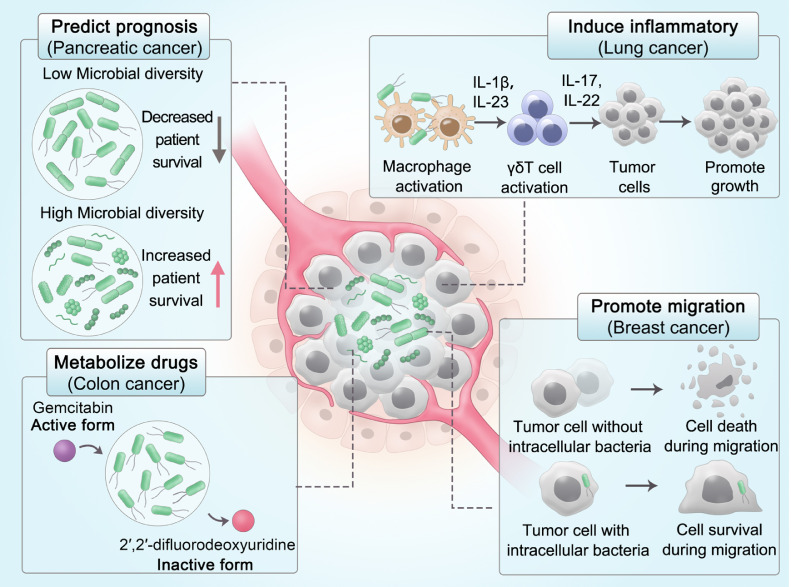 Figure 1
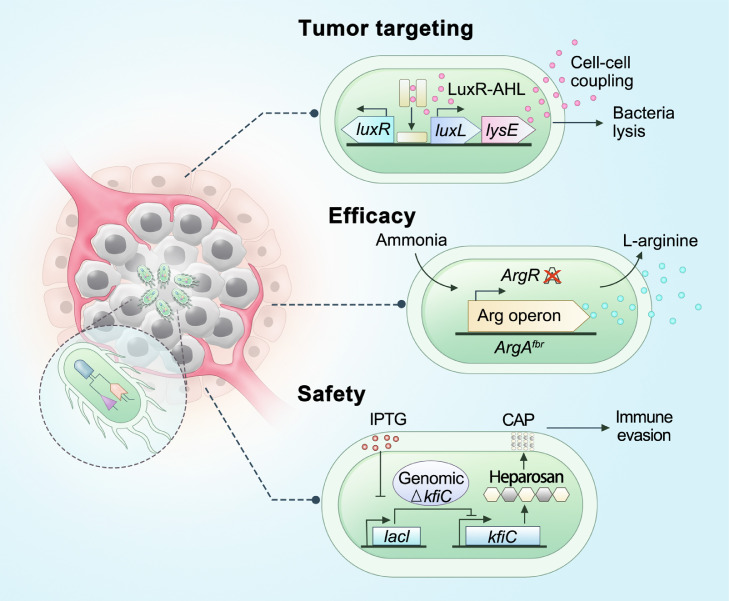 Figure 2
Peer Reviews
No public reviews on file for this paper yet. If you reviewed it on a platform where reviews are public (OpenReview, ICLR, NeurIPS, ICML), you can paste yours below so the community can read it here.
Videos
No videos yet. Explain this paper in a talk, walkthrough, or lecture? Add one.
Taxonomy
TopicsCancer Research and Treatments · Lung Cancer Diagnosis and Treatment · Bacteriophages and microbial interactions
Human body is a superorganism composed of its own cells and numerous symbiotic microorganisms. The gastrointestinal microorganisms have been shown to affect proximal and even distant tumor biology. For instance, intestinal commensal Bifidobacterium evoke anti-melanoma immunity via promoting the infiltration and activation of tumor-specific CD8^+^ T cells, thereby facilitating the efficacy of programmed cell death 1 ligand 1 (PD-L1) blockade therapy [1]. Interestingly, it has recently been discovered that many microorganisms also colonize in the tumor tissues, being termed as intratumoral microorganisms. Due to the closer spatial relationship, their impact on tumors may be more pronounced than the gastrointestinal microorganisms, which is still unclear.
Presence and discovery of intratumoral microorganisms
1
Bacteria were first detected in human tumors more than 100 years ago, but these bacteria were considered as contaminants during specimen collection. With the advances in sampling and sequencing technologies, more and more intratumoral microorganisms have been confirmed and identified, including bacteria, fungi, and viruses. The unique physicochemical and biological characteristics of tumor microenvironment (TME) are beneficial to the microorganism colonization and growth, such as the vasculature disorder, the highly hypoxic but nutrient-rich components, and the immunosuppression. It has been shown that the potential sources of intratumoral microorganisms can be classified into different categories, through mucosal barrier sources, from adjacent normal tissues, or hematogenous spread. The most intratumoral microorganisms are intracellularly present in both cancer and immune cells with a low biomass level. At present, intratumoral microorganisms have been found in varieties of cancer types, such as lung, breast, colorectum, pancreatic and ovary tumors. However, there are distinct intratumoral microorganism spectrums in different tumor types, and of course their effects on cancer biology (such as tumor growth, metastasis, physical and immune microenvironment) are also greatly different [2]. The existence of intratumoral microorganisms increases the complexity of cancer biology, and the in-depth exploration of intratumoral microorganisms may provide new strategies for cancer therapy.
Relationship between intratumoral microorganisms and tumors
2
Intratumoral microorganisms can affect the tumor progression and the antitumor treatment efficacy through several mechanisms, such as DNA damage, induction of immunosuppression or inflammatory response, promotion of migration, and metabolization of therapeutic drugs (Fig. 1). For instance, commensal microbiota can promote lung cancer development by activating lung-resident γδ T cells to secrete inflammatory effector molecules [3]. Intracellularly colonized bacteria can promote metastasis of breast cancer by reorganizing the actin cytoskeleton and enhancing the resistance of tumor cells to fluid shear stress [4]. Intratumoral Gammaproteobacteria can metabolize the chemotherapeutic drug gemcitabine into its inactive form, leading to the drug resistance, which is proved by the evidence that the co-treatment of gemcitabine and the antibiotic ciprofloxacin can eliminate the drug resistance [5]. Although the intratumoral microorganisms are mainly reported to promote the tumor progression, they can also inhibit tumor development in certain condition. Pancreatic cancer patients with higher intratumoral microbial diversity have longer median survival, and therefore the microbial diversity can be used to predict patient prognosis [6]. In addition to bacteria, it has been recently found that the intratumoral fungi also possesses close relationship to cancer. The presence of Malassezia globosa in breast cancer and the enrichment of Candida in gastrointestinal cancer are significantly associated with decreased patient survival [7,8]. In brief, the intratumoral microorganisms exhibit a great influence on tumor progression and therapeutic outcome, thus the comprehensive exploration and artificial manipulation of intratumoral microorganisms may pave the way for novel treatment options for cancer patients.Fig. 1Relationship between intratumoral microorganisms and multiple types of cancer. Commensal microbiota can promote lung cancer development by activating lung-resident γδ T cells to secrete inflammatory effector molecules [3]. Intracellularly colonized bacteria can promote metastasis of breast cancer by reorganizing the actin cytoskeleton and enhancing the resistance of tumor cells to fluid shear stress [4]. Intratumoral Gammaproteobacteria can metabolize the chemotherapeutic drug gemcitabine into its inactive form, leading to the drug resistance [5]. Intratumoral microorganisms can affect the tumor progression and the antitumor treatment efficacy through several mechanisms. Pancreatic cancer patients with higher intratumoral microbial diversity have longer median survival, and therefore the microbial diversity can be used to predict patient prognosis [6].Fig 1
Artificial antitumor bacteria
3
Considering the important role of intratumoral microorganisms in cancer development, novel therapeutic and diagnostic approaches based on living bacteria have received increasing attention in cancer research. Wild-type bacteria can be used for tumor treatment and diagnosis due to their natural tumor-specific targeting and intratumoral penetration capabilities. Certain microorganisms can be employed as efficient vehicles for tumor-targeted drug delivery because they can specifically colonize in tumor tissues. In addition, different types of tumors have their distinct and specific intratumoral microorganism profiles, which are closely associated with patient survival. Therefore, the plasma-derived cell-free microbial nucleic acids have been used as effective tools for early tumor prediction in clinic [9].
In addition to utilizing wild types, bacteria can also be programmed through genetic engineering to the second-generation antitumor bacteria (Fig. 2). Synthetic biology techniques are being employed to enhance the spatial and temporal controllability of antitumor bacteria, which can largely improve their safety and efficacy. Firstly, genetic engineering can further improve the bacterial tumor targeting capacity. A quorum-sensing gene circuit was designed to generate synchronized cell lysis and antitumor drug delivery, so that the intratumoral bacterial population can be maintained at a defined size and minimize the potential risk [10]. Secondly, some additional antitumor function modules can be assembled to bacteria by applying genetic engineering. For example, a probiotic bacteria system was designed to continuously in situ produce and release checkpoint blockage antibodies within tumors [11]. In addition, an engineered Escherichia coli was established with the ability of locally and continuously produce l-arginine in tumor tissues [12]. Intratumoral colonization of these bacteria could increase the tumor concentration of l-arginine and the infiltration of T cells, thereby exhibiting remarkable synergistic effect with PD-L1 blocking antibodies. Thirdly, safety modules also can be assembled to bacteria by genetic engineering to reduce its toxicity. A genetically encoded microbial encapsulation system with tunable and dynamic expression of surface capsular poly-saccharides was constructed to precisely control bacterial immunogenicity and survivability in vivo [13]. This programmable encapsulation system was able to enhance the therapeutic efficacy and safety of living engineered bacteria for treating cancer. With more rationally design in future, the artificial antitumor bacteria will hopefully become a powerful weapon in the fight against cancer.Fig. 2Artificial antitumor bacteria. Synthetic biology techniques are being employed to enhance the spatial and temporal controllability of antitumor bacteria, which can largely improve their safety and efficacy. A quorum-sensing gene circuit was designed to generate synchronized cell lysis and antitumor drug delivery, which can thus maintain the intratumoral bacterial population at a defined size and minimize the potential risk [10]. An engineered Escherichia coli was established with the ability of locally and continuously produce l-arginine in tumor tissues [12]. A genetically encoded microbial encapsulation system with tunable and dynamic expression of surface capsular poly-saccharides was constructed to precisely control bacterial immunogenicity and survivability in vivo[13]. CAP, capsular polysaccharides; IPTG, isopropyl-β-d-thiogalactoside.Fig 2
Current challenges and future developments
4
Once perfected, intratumoral microorganisms are promised to become essential clinical tools enabling multiple functions that are unachievable by other therapies. Therefore, it is meaningful to explore the detection, identification, and functional analysis of intratumoral microorganisms. However, the existing technologies have limited the scope and depth of studies on intratumoral microorganisms. First of all, characterization of intratumoral microorganisms still remains challenging due to their low biomass levels. Thus, the detection methods with low thresholds need to be developed to improve the sensitivity. In addition, environmental contamination greatly hampers the detection of intratumoral microorganisms. Therefore, besides improving experimental design, it is also important to develop perfect decontamination algorithms for data analysis. Finally, current studies mostly focus on the correlation between intratumoral microorganisms and tumor biology, and the high difficulty of in vitro cultivation of intratumoral microorganisms limited the mechanism study. Some new cultivation technologies can be employed for culturing intratumoral microorganisms, such as cultivation using microfluidic systems to mimic TME and culturomics which can use multiple conditions to culture different types of intratumoral microorganisms.
It has been found that regulating the gut microbiome can promote tumor therapy, thus studying and manipulating the intratumoral microbiome is also expected to enhance clinical responses to cancer therapy. In terms of the engineering of artificial antitumor bacteria, novel therapeutic targets need to be discovered. For example, bacteria can be programmed to secrete small molecular immunomodulators to improve immunotherapy, such as S-2-hydroxyglutarate [14]. In addition, most of the current artificial antitumor bacteria are based on model bacteria (e.g., E. coli Nissle 1917, attenuated Salmonella, Lactobacilli, Bifidobacterium, and Akkermansia muciniphila), and using the highly abundant intratumoral microorganisms and engineering them for fighting tumors maybe a better option. Moreover, in addition to studying the interactions between microorganisms and tumor cells (or immune cells), it is also very important to understand the interactions between different microorganisms inside one tumor. For example, metabolites excreted from one kind of bacteria can possibly influence the growth of other kinds of bacteria. Finally, despite the high diversity and availability of microorganisms within tumors, and substantial advances have been made in the progression of bacteria cancer therapies (e.g., attenuated Mycobacterium bovis strain derived Bacillus Calmette-Guerin and E. coli Nissle strain derived SYN1891), biocontainment and safety concerns need to be evaluated during clinical translation. If employing microorganisms for fighting cancers, many problems still limit their development and applications, such as the unclear antitumor mechanism, toxicity, and weak spatiotemporal controllability. Engineering in situ intratumoral microorganisms through synthetic biology techniques, or combining artificial antitumor bacteria with immunotherapy or other more-powerful antitumor agents, may unlock the next generation of precision cancer diagnosis and therapy.
CRediT authorship contribution statement
W. L. analyzed the literatures, conceived the manuscript structure, and wrote the manuscript. X. M. edited the figures and participated in the writing and revision of the manuscript. X. Z. inspired the main ideas of this perspective article, supplied the relevant literatures, and revised the manuscript in detail.
Declaration of competing interest
The authors declare that they have no conflicts of interest in this work.
The reference list from the paper itself. Each links out to its DOI / PubMed record.
- 1Sivan A.Corrales L.Hubert N.Commensal Bifidobacterium promotes antitumor immunity and facilitates anti-PD-L 1 efficacy Science 35062642015108410892654160610.1126/science.aac 4255 PMC 4873287 · doi ↗ · pubmed ↗
- 2Nejman D.Livyatan I.Fuks G.The human tumor microbiome is composed of tumor type-specific intracellular bacteria Science 36864942020973980 May 29 TN 3246738610.1126/science.aay 9189 PMC 7757858 · doi ↗ · pubmed ↗
- 3Jin C.Lagoudas G.K.Zhao C.Commensal microbiota promote lung cancer development via gammadelta T cells Cell 176520199981013 e 163071287610.1016/j.cell.2018.12.040PMC 6691977 · doi ↗ · pubmed ↗
- 4Fu A.Yao B.Q.Dong T.T.Tumor-resident intracellular microbiota promotes metastatic colonization in breast cancer Cell 1858202213561372 e 263539517910.1016/j.cell.2022.02.027 · doi ↗ · pubmed ↗
- 5Geller L.T.Barzily-Rokni M.Danino T.Potential role of intratumor bacteria in mediating tumor resistance to the chemotherapeutic drug gemcitabine Science 35763562017115611602891224410.1126/science.aah 5043 PMC 5727343 · doi ↗ · pubmed ↗
- 6Riquelme E.Zhang Y.Zhang L.Tumor microbiome diversity and composition influence pancreatic cancer outcomes Cell 17842019795806 e 123139833710.1016/j.cell.2019.07.008PMC 7288240 · doi ↗ · pubmed ↗
- 7Narunsky-Haziza L.Sepich-Poore G.D.Livyatan I.Pan-cancer analyses reveal cancer-type-specific fungal ecologies and bacteriome interactions Cell 18520202237893806 e 173617967010.1016/j.cell.2022.09.005PMC 9567272 · doi ↗ · pubmed ↗
- 8Dohlman A.B.Klug J.Mesko M.A pan-cancer mycobiome analysis reveals fungal involvement in gastrointestinal and lung tumors Cell 18520202238073822 e 123617967110.1016/j.cell.2022.09.015PMC 9564002 · doi ↗ · pubmed ↗