Correction: Storms et al. Identification of Hunnivirus in Bovine and Caprine Samples in North America. Viruses 2025, 17, 1491
Suzanna Storms, Ailam Lim, Christian Savard, Yaindrys Rodriguez Olivera, Sandipty Kayastha, Leyi Wang

Abstract
Genes, proteins, chemicals, diseases, species, mutations and cell lines named across the full text — each resolved to its canonical identifier and authoritative record.
Click any figure to enlarge with its caption.
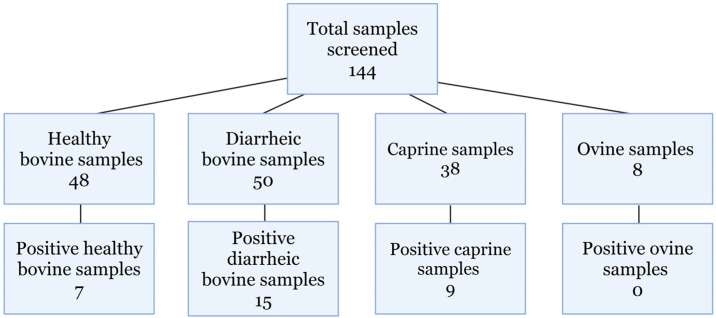 Figure 1
Peer Reviews
No public reviews on file for this paper yet. If you reviewed it on a platform where reviews are public (OpenReview, ICLR, NeurIPS, ICML), you can paste yours below so the community can read it here.
Videos
No videos yet. Explain this paper in a talk, walkthrough, or lecture? Add one.
Taxonomy
TopicsAnimal Disease Management and Epidemiology · Vector-Borne Animal Diseases · Zoonotic diseases and public health
Text Correction
There were errors in the original publication [1]. The total number of healthy cattle was incorrect and the total number of cattle screened (sum of healthy and diarrheic cattle) was also incorrect. The corrected numbers are as follows:
Abstract
“Screening of 144 ruminant fecal samples showed that 9 of 38 goat, 22 of 98 cattle, and 0 of 8 sheep samples were positive for hunnivirus.”
Section 2.2. Samples,
“Fecal samples from cattle (n = 98)”
3.2. Real-Time RT-PCR Screening of Archived Samples
“Real-time RT-PCR screening of archived samples identified 31 positive samples (Figure 2). The samples originated from animals that were 5 days old to 10 years old. Ninety-eight bovine samples were screened, with 48 healthy and 50 diarrheic samples, of which there were 7 and 15 positive identifications, respectively. Thirty-eight caprine and eight ovine samples from both diarrheic and healthy animals were screened, and nine caprine samples were positive for hunnivirus. Additionally, 48 of the 50 bovine samples were previously screened for Salmonella spp. and bovine kobuvirus. Diarrheic bovine, caprine, and ovine hunnivirus Ct values are presented in Table 2, with healthy bovine sample information provided in Supplementary Table S1”.
Error in Figure 2
In the original publication [1], there was a mistake in Figure 2. Samples screened. The total number of samples screened was incorrect. The correct figure is below.
In the original publication [1], there was a mistake in Supplementary Table S1. Two extra-healthy bovine samples were incorrectly included. The correct table is below.
The authors state that the scientific conclusions are unaffected. This correction was approved by the Academic Editor. The original publication has also been updated.
The reference list from the paper itself. Each links out to its DOI / PubMed record.