Environmental behaviors and ecotoxicity of imidaclothiz: a comprehensive review on fate, degradation processes, and ecological risks
Ju Yang, Hao Chen, Ke-Wei Song, Yi-Fei Chen, Yue Shen, Wen-Jing Li, Xiao-Fang Li, Peng-Fei Zhai, Yun-Xiu Zhao

TL;DR
This paper reviews the environmental persistence, degradation, and ecological risks of the pesticide imidaclothiz, highlighting gaps in understanding and the need for sustainable management.
Contribution
The paper provides a comprehensive review of imidaclothiz's environmental behavior and ecotoxicity, emphasizing the lack of systematic studies on its microbial degradation and transformation products.
Findings
Imidaclothiz is widely used in agriculture but persists in the environment, posing risks to non-target organisms.
Microbial degradation and chemical pathways are key to mitigating imidaclothiz's environmental impact.
Current research on imidaclothiz is limited, with few identified microorganisms and enzymes involved in its degradation.
Abstract
Neonicotinoid insecticides (NEOs) are among the most widely used pesticide classes globally, primarily applied to control crop pests and vector plant pathogens. As a fourth-generation NEO, imidaclothiz (IMT) has seen rapidly expanding agricultural use across Asia—particularly in China—in recent years. However, increasing evidence highlights the persistence of NEO residues in the environment and their toxic effects on non-target organisms. The frequent detection of NEOs in aquatic systems indicates growing contamination that may pose significant risks to human and ecosystem health. Microbial degradation, alongside chemical pathways, plays a crucial role in mitigating the environmental impacts of these pesticides, with microbial remediation emerging as a promising ecological strategy. Nevertheless, current research on IMT remains limited: only a few IMT-degrading microorganisms and key…
Genes, proteins, chemicals, diseases, species, mutations and cell lines named across the full text — each resolved to its canonical identifier and authoritative record.
Click any figure to enlarge with its caption.
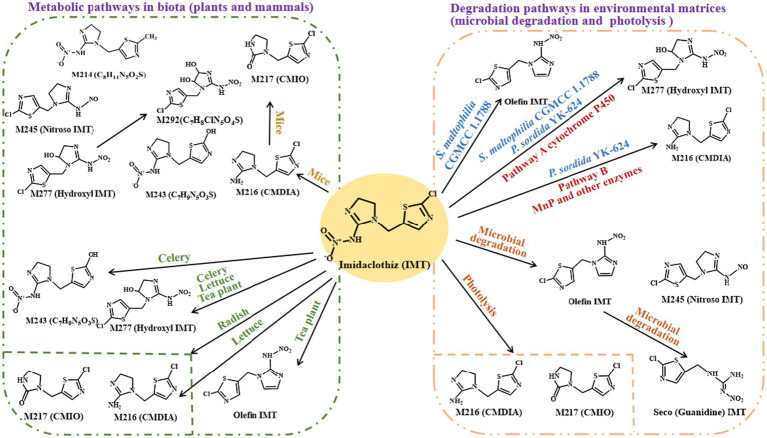 Figure 1
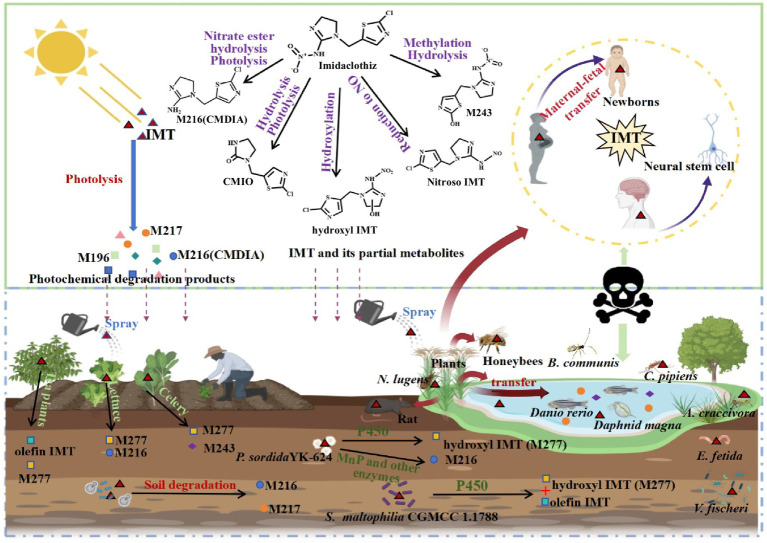 Figure 2
Peer Reviews
No public reviews on file for this paper yet. If you reviewed it on a platform where reviews are public (OpenReview, ICLR, NeurIPS, ICML), you can paste yours below so the community can read it here.
Videos
No videos yet. Explain this paper in a talk, walkthrough, or lecture? Add one.
Taxonomy
TopicsInsect and Pesticide Research · Pesticide and Herbicide Environmental Studies · Environmental Toxicology and Ecotoxicology