Near-UVA Radiation at 405 nm: Germicidal Effect With and Without Sub-Lethal Conditions on Gram-Positive and Gram-Negative Bacteria
Davide Amodeo, Giulio Pedrazzoli, Isa De Palma, Alessandro Puccio, Giacomo Trillocco, Gaia Papale, Gabriele Cevenini, Marco Tani, Gabriele Messina

TL;DR
This study shows that 405 nm near-UVA light can effectively kill bacteria, especially when combined with stress conditions or porphyrins, offering a new disinfection method for healthcare.
Contribution
The study demonstrates the enhanced germicidal effect of near-UVA radiation when combined with sub-lethal stress and porphyrins.
Findings
P. aeruginosa showed the highest reduction (2.4 log10) under near-UVA alone.
Osmotic stress combined with light achieved up to 5.46 log10 reduction in E. faecalis.
Exogenous porphyrins significantly improved disinfection for S. aureus and P. aeruginosa.
Abstract
The need for contrasting Healthcare-Associated Infections requires the promotion and support of alternative disinfection techniques. Due to the antimicrobial potential of UV, devices equipped with UVC, UVB and UVA lamps or LEDs have been developed in recent years for domestic, everyday use. In this study, four bacterial strains (S. aureus, E. faecalis, E. coli, and P. aeruginosa) were exposed to different doses of near-UVA radiation at 405 nm, with an average irradiance of 21 mW/cm2, using an experimental multi-LED device. Bacterial suspensions were irradiated under both sub-lethal and non-sub-lethal stress conditions. When using only near-UVA light, the highest abatement effect was observed on P. aeruginosa (2.4 log10). Treatment with osmotic stress, in combination with light irradiation, was effective on all bacterial strains (mean abatement of 2.76, 5.46, 5.31, and 1.5 log10 on E.…
Genes, proteins, chemicals, diseases, species, mutations and cell lines named across the full text — each resolved to its canonical identifier and authoritative record.
Click any figure to enlarge with its caption.
 Figure 1
 Figure 2
 Figure 3
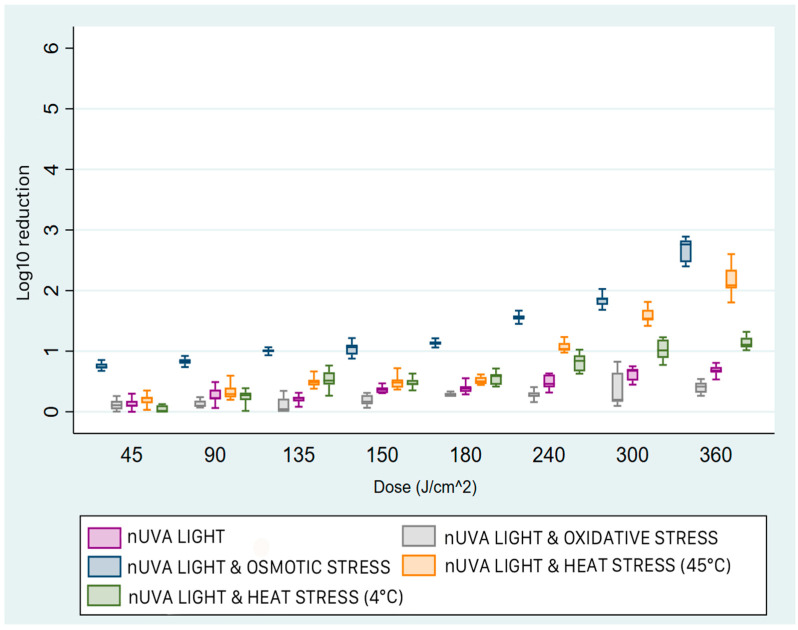 Figure 4
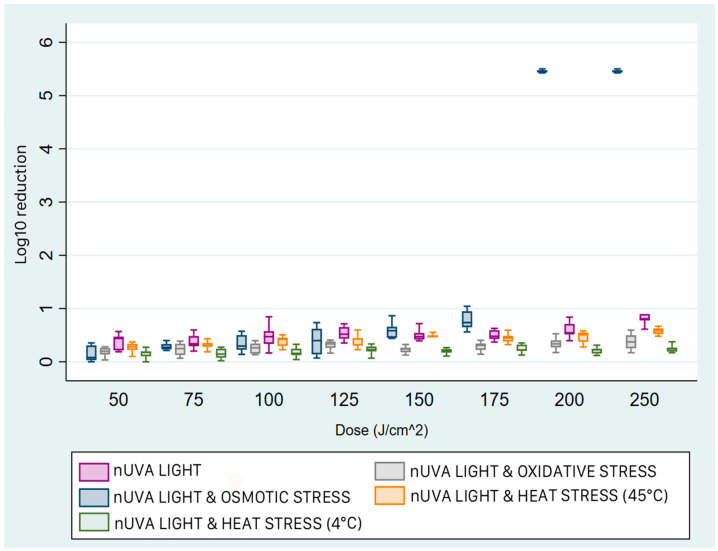 Figure 5
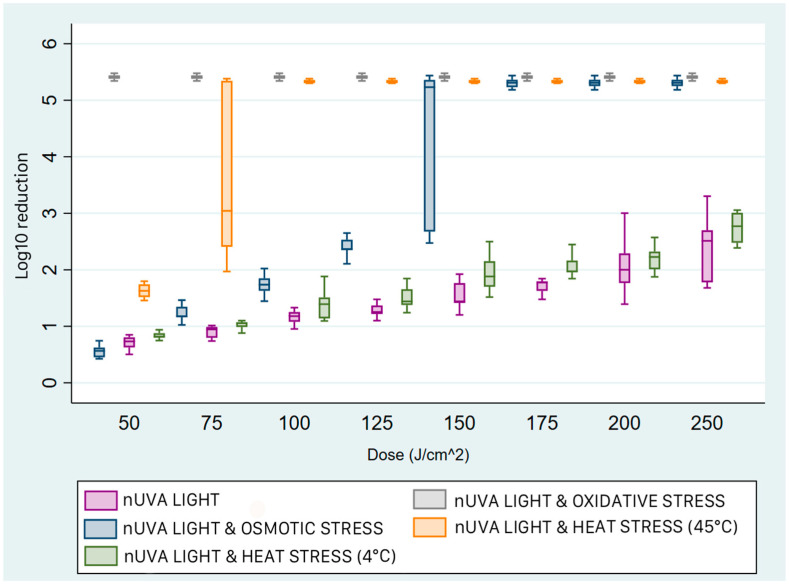 Figure 6
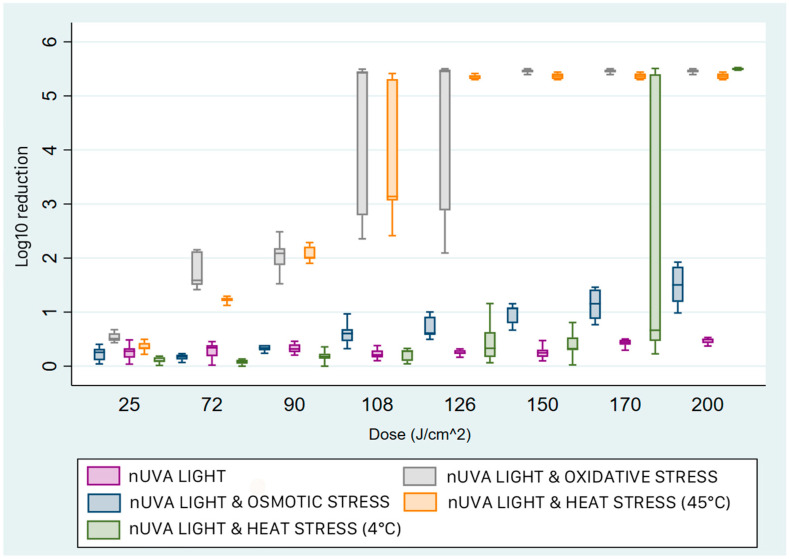 Figure 7
Peer Reviews
No public reviews on file for this paper yet. If you reviewed it on a platform where reviews are public (OpenReview, ICLR, NeurIPS, ICML), you can paste yours below so the community can read it here.
Videos
No videos yet. Explain this paper in a talk, walkthrough, or lecture? Add one.
Taxonomy
TopicsPhotodynamic Therapy Research Studies · Listeria monocytogenes in Food Safety · Medical and Biological Ozone Research