Advances in Colorectal Cancer: Epidemiology, Gender and Sex Differences in Biomarkers and Their Perspectives for Novel Biosensing Detection Methods
Konstantina K. Georgoulia, Vasileios Tsekouras, Sofia Mavrikou

TL;DR
This paper reviews colorectal cancer trends, sex differences in biomarkers, and the potential of biosensors for non-invasive, early detection.
Contribution
The paper highlights novel biosensing technologies and their integration with sex-specific molecular pathways for improved CRC detection.
Findings
Men have higher CRC incidence and worse outcomes compared to women, who show stronger immune responses.
Biosensors offer non-invasive, rapid detection of CRC biomarkers from blood, stool, or breath.
Advances in nanotechnology and AI are improving biosensor accuracy and applicability in clinical settings.
Abstract
Colorectal cancer (CRC) remains a major cause of morbidity and mortality worldwide, with its incidence and biological behavior influenced by both genetic and environmental factors. Emerging evidence highlights notable sex differences in CRC, with men generally exhibiting higher incidence rates and poorer prognoses, while women often display stronger immune responses and distinct molecular profiles. Traditional screening tools, such as colonoscopy and fecal-based tests, have improved survival through early detection but are limited by invasiveness, cost, and adherence issues. In this context, biosensors have emerged as innovative diagnostic platforms capable of rapid, sensitive, and non-invasive detection of CRC-associated biomarkers, including genetic, epigenetic, and metabolic alterations. These technologies integrate biological recognition elements with nanomaterials, microfluidics,…
Genes, proteins, chemicals, diseases, species, mutations and cell lines named across the full text — each resolved to its canonical identifier and authoritative record.
Click any figure to enlarge with its caption.
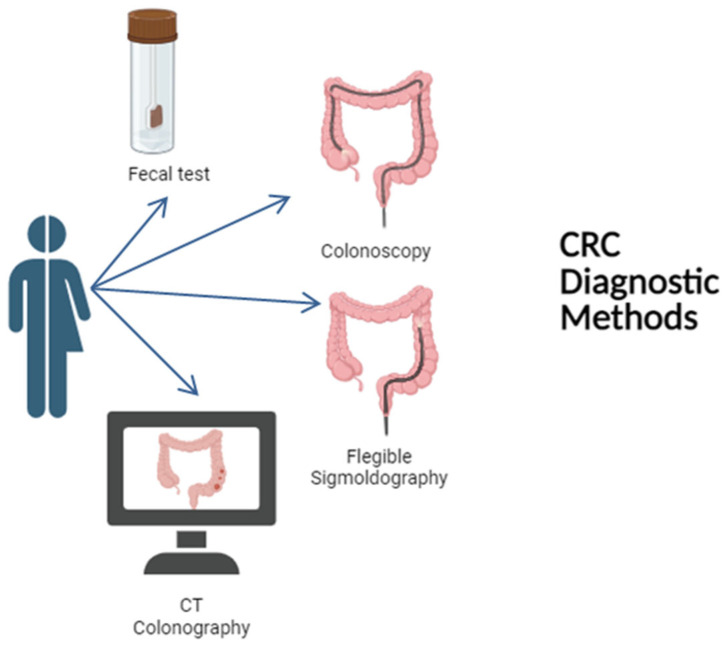 Figure 1
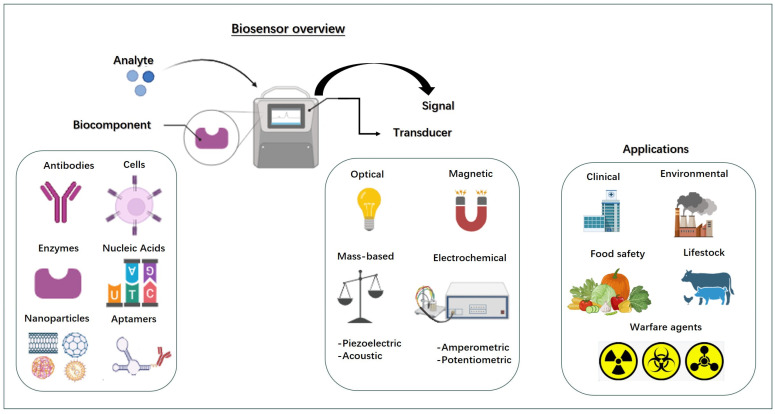 Figure 2
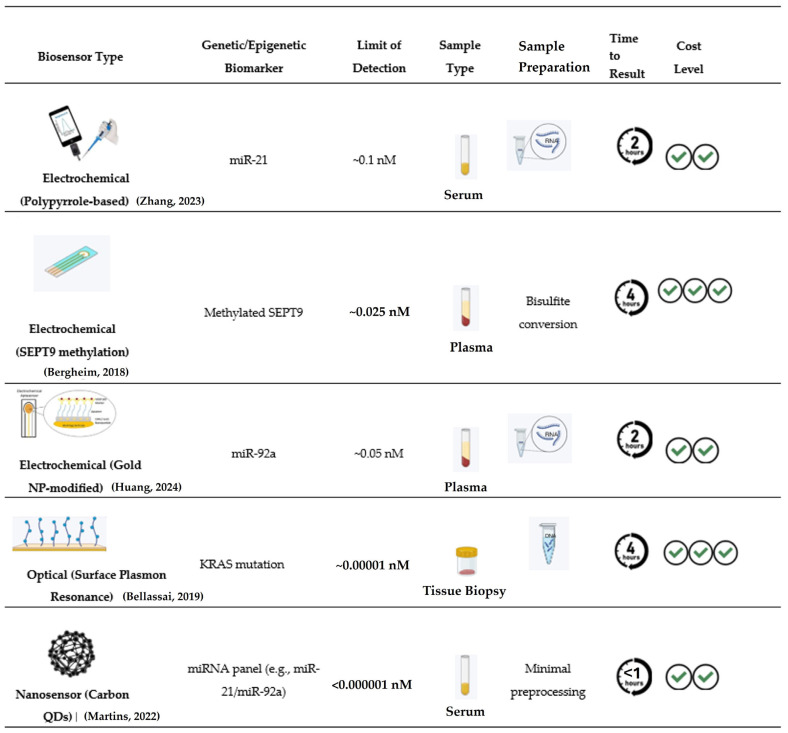 Figure 3
Peer Reviews
No public reviews on file for this paper yet. If you reviewed it on a platform where reviews are public (OpenReview, ICLR, NeurIPS, ICML), you can paste yours below so the community can read it here.
Videos
No videos yet. Explain this paper in a talk, walkthrough, or lecture? Add one.
Taxonomy
TopicsBiosensors and Analytical Detection · Advanced biosensing and bioanalysis techniques · Advanced Chemical Sensor Technologies