Host-Filtered Blood Nucleic Acids for Pathogen Detection: Shared Background, Sparse Signal, and Methodological Limits
Zhaoxia Wang, Guangchan Chen, Mei Yang, Saihua Wang, Jiahui Fang, Ce Shi, Yuying Gu, Zhongping Ning

TL;DR
This study evaluates the potential of blood-based RNA sequencing for detecting pathogens, finding that most signals come from a shared background rather than specific disease-causing organisms.
Contribution
The paper provides a quantitative benchmark of the limitations of plasma cfRNA metagenomics for pathogen detection.
Findings
Classified non-host reads formed a small fraction of total cfRNA, dominated by low-abundance skin, oral, and environmental taxa.
Mycobacterium tuberculosis reads were sparse and occurred at similar levels in TB-negative samples, limiting reliable detection.
Background-associated clades, not distinct pathogen clusters, explained visually 'enriched' taxa in TB-positive samples.
Abstract
Plasma cell-free RNA (cfRNA) metagenomics is increasingly explored for blood-based pathogen detection, but the structure of the shared background “blood microbiome”, the reproducibility of reported signals, and the practical limits of this approach remain unclear. We performed a critical re-analysis and benchmarking (“stress test”) of host-filtered blood RNA sequencing data from two cohorts: a bacteriologically confirmed tuberculosis (TB) cohort (n = 51) previously used only to derive host cfRNA signatures, and a coronary artery disease (CAD) cohort (n = 16) previously reported to show a CAD-shifted “blood microbiome” enriched for periodontal taxa. Both datasets were processed with a unified pipeline combining stringent human read removal and taxonomic profiling using the latest versions of specialized tools Kraken2 and MetaPhlAn4. Across both cohorts, only a minority of non-host reads…
Genes, proteins, chemicals, diseases, species, mutations and cell lines named across the full text — each resolved to its canonical identifier and authoritative record.
Click any figure to enlarge with its caption.
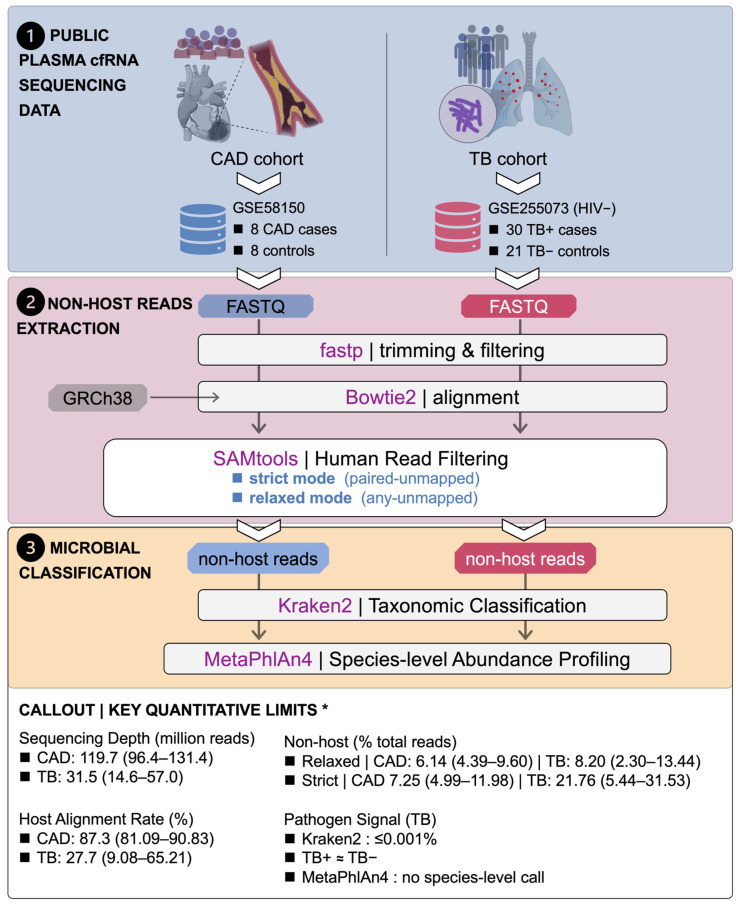 Figure 1
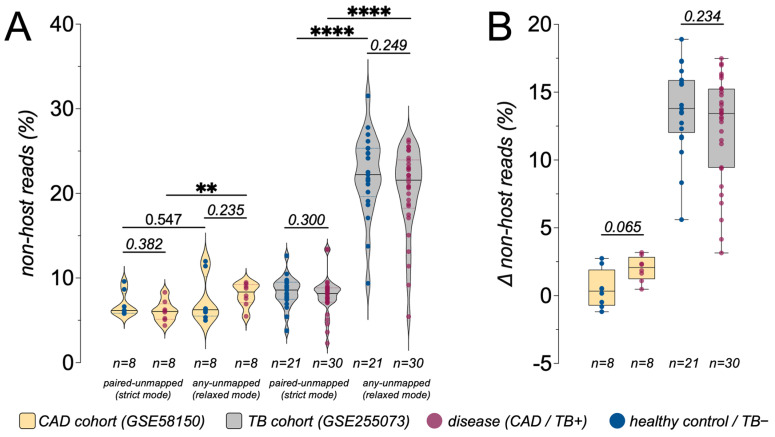 Figure 2
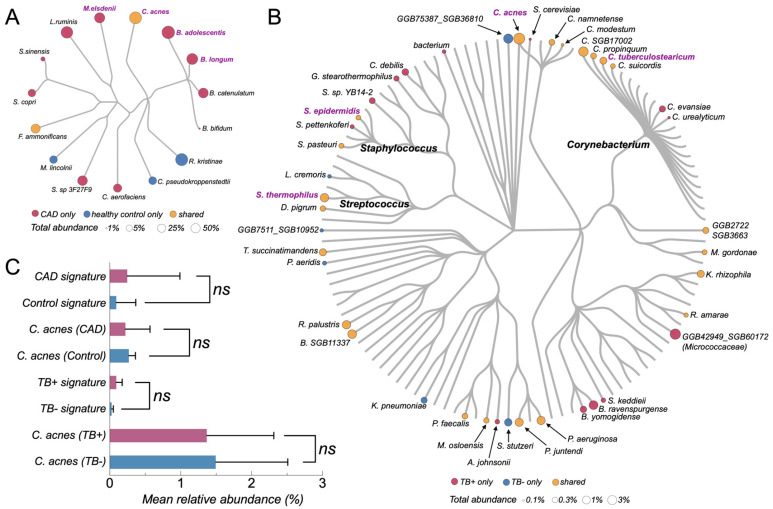 Figure 3
Peer Reviews
No public reviews on file for this paper yet. If you reviewed it on a platform where reviews are public (OpenReview, ICLR, NeurIPS, ICML), you can paste yours below so the community can read it here.
Videos
No videos yet. Explain this paper in a talk, walkthrough, or lecture? Add one.
Taxonomy
TopicsTuberculosis Research and Epidemiology · Bacterial Identification and Susceptibility Testing · Cancer Genomics and Diagnostics