Anthelmintic Activity of Protocatechuic Acid Against Ivermectin-Susceptible and Resistant Haemonchus contortus Strains
Jorge Alberto Cortes-Morales, Agustín Olmedo-Juárez, Manasés González-Cortazar, Alejandro Zamilpa, María Eugenia López-Arellano, Humberto Flores-Bustamante, Dante Avilés-Montes, Juan Manuel Rivas-González, César Sotelo-Leyva, David Osvaldo Salinas-Sánchez

TL;DR
This study shows that protocatechuic acid, a natural compound, can effectively control parasitic worms in sheep and goats, even in resistant strains.
Contribution
The study demonstrates the anthelmintic potential of protocatechuic acid against both ivermectin-susceptible and resistant Haemonchus contortus strains.
Findings
Protocatechuic acid inhibited egg hatching by over 98% at low concentrations against ivermectin-susceptible worms.
The compound caused significant larval mortality in ivermectin-susceptible strains at higher concentrations.
Protocatechuic acid was more effective against ivermectin-susceptible worms than resistant ones.
Abstract
The frequent and indiscriminate use of all classes of synthetic anthelmintics to deworm small ruminants has decreased their effectiveness in a worldwide problem of anthelmintic resistance. Using active plant metabolites with anthelmintic properties has become a suggested alternative to control parasitic helminths. The present study investigated the ovicidal and larvicidal activity of a fraction (CnF4) containing protocatechuic acid (3,4-dihydroxybenzoic acid) from Chamaecrista nictitans (Fabaceae) and a commercial standard of protocatechuic acid against strains of the parasitic nematode Haemonchus contortus susceptible (HcIVM-S) and resistant (HcIVM-R) to ivermectin, using egg hatch inhibition (EHI) and L3 larval mortality assays. The CnF4 fraction showed an EHI greater than 90% at 0.8 mg/mL against HcIVM-S and an EHI = 88.39% at 1.6 mg/mL against HcIVM-R. The commercial standard of…
Genes, proteins, chemicals, diseases, species, mutations and cell lines named across the full text — each resolved to its canonical identifier and authoritative record.
Click any figure to enlarge with its caption.
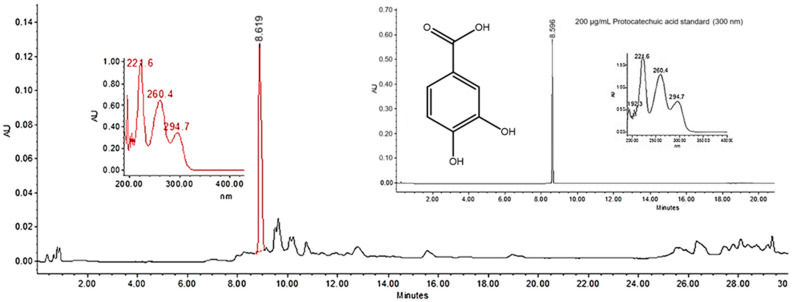 Figure 1
Peer Reviews
No public reviews on file for this paper yet. If you reviewed it on a platform where reviews are public (OpenReview, ICLR, NeurIPS, ICML), you can paste yours below so the community can read it here.
Videos
No videos yet. Explain this paper in a talk, walkthrough, or lecture? Add one.
Taxonomy
TopicsHelminth infection and control · Parasitic Diseases Research and Treatment · Parasites and Host Interactions