Toward Personalized Withdrawal of TNF-α Inhibitors in Non-Systemic Juvenile Idiopathic Arthritis: Predictors of Biologic-Free Remission and Flare
Ekaterina I. Alexeeva, Irina T. Tsulukiya, Tatyana M. Dvoryakovskaya, Ivan A. Kriulin, Dmitry A. Kudlay, Anna N. Fetisova, Maria S. Botova, Tatyana Y. Kriulina, Elizaveta A. Krekhova, Natalya M. Kondratyeva, Meiri Sh. Shingarova, Maria Y. Kokina, Alyona N. Shilova

TL;DR
This study identifies factors that predict successful withdrawal of TNF-α inhibitors in children with non-systemic juvenile idiopathic arthritis, aiming to help personalize treatment strategies.
Contribution
The study provides novel predictors of biologic-free remission and flare during TNF-α inhibitor withdrawal in pediatric JIA patients.
Findings
Higher baseline CHAQ scores and elevated calprotectin and hsCRP levels at withdrawal were linked to increased flare risk.
Subclinical synovitis and a history of uveitis were significant predictors of disease relapse.
Early clinical response and low-dose methotrexate use were associated with sustained drug-free remission.
Abstract
Background: Tumor necrosis factor-α (TNFα) inhibitors have significantly improved outcomes in children with non-systemic juvenile idiopathic arthritis (JIA), achieving long-term clinical remission for many patients. However, the optimal strategy for TNF-α inhibitor withdrawal remains unknown, whether through abrupt discontinuation, gradual dose reduction, or interval extension. Objective: We aim to identify patient-, disease-, and treatment-related predictors of successful TNF-α inhibitor withdrawal in children with non-systemic JIA. Methods: In this prospective, randomized, open-label, single-center study, 76 children with non-systemic JIA in stable remission for ≥24 months on etanercept or adalimumab were enrolled. At the time of TNF-α inhibitor discontinuation, all patients underwent a comprehensive evaluation, including a clinical examination, laboratory tests (serum calprotectin…
Genes, proteins, chemicals, diseases, species, mutations and cell lines named across the full text — each resolved to its canonical identifier and authoritative record.
Click any figure to enlarge with its caption.
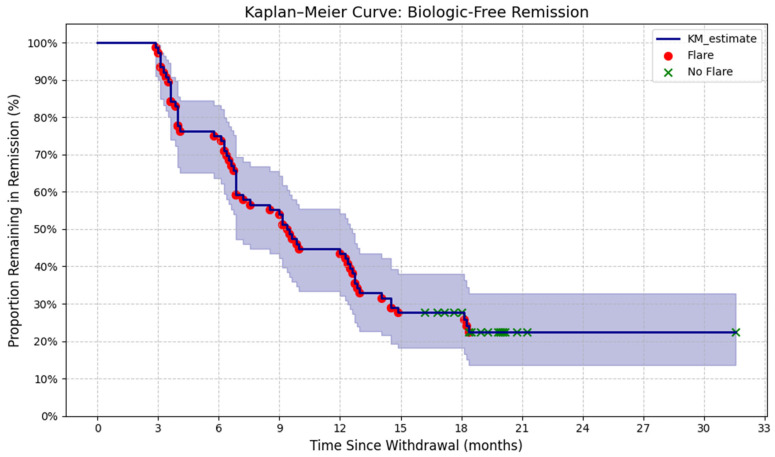 Figure 1
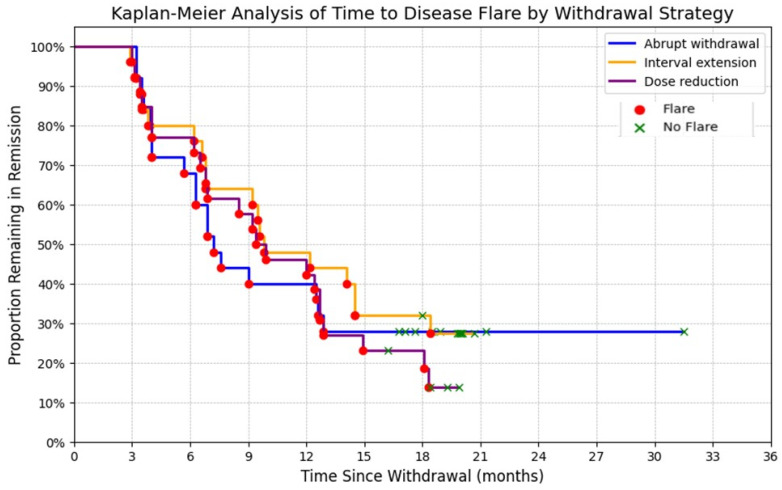 Figure 2
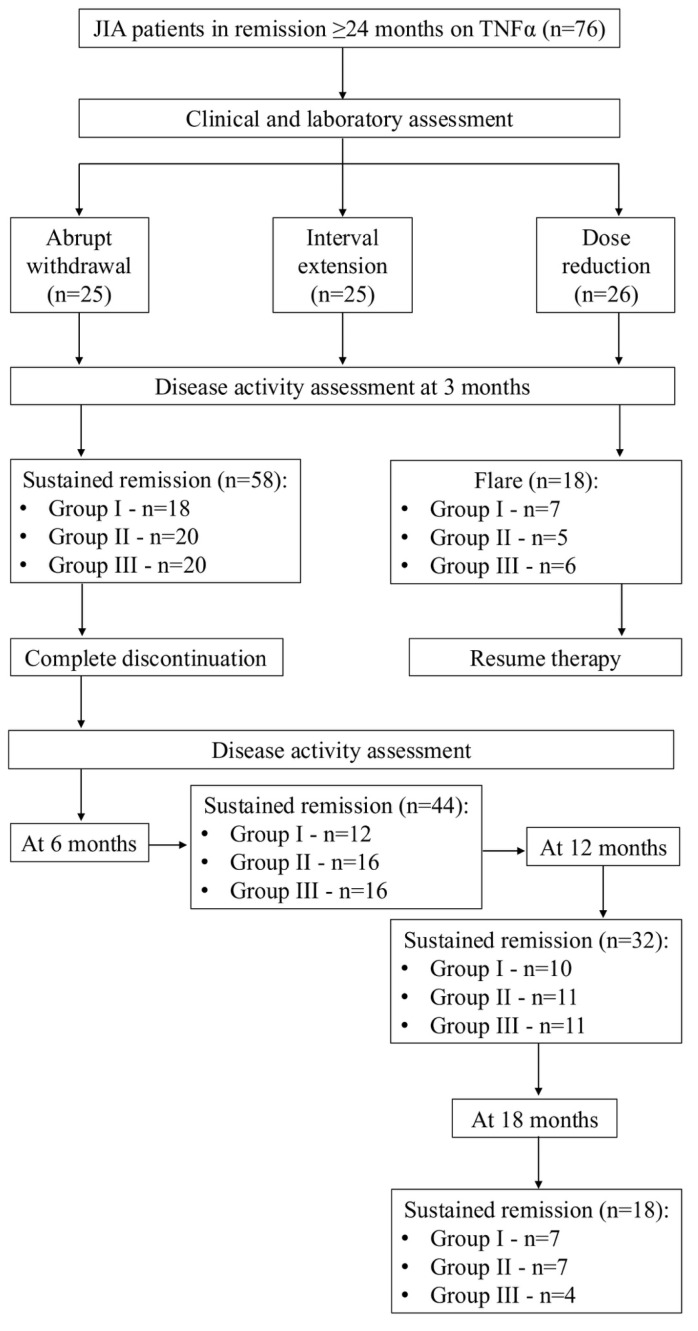 Figure 3
Peer Reviews
No public reviews on file for this paper yet. If you reviewed it on a platform where reviews are public (OpenReview, ICLR, NeurIPS, ICML), you can paste yours below so the community can read it here.
Videos
No videos yet. Explain this paper in a talk, walkthrough, or lecture? Add one.
Taxonomy
TopicsAutoimmune and Inflammatory Disorders Research · Rheumatoid Arthritis Research and Therapies · Spondyloarthritis Studies and Treatments