Primary Fermentation in Wine Production Influence on Phenolic Retention and Valorization Potential of Berry Skin By-Products
Audrone Ispiryan, Elvyra Jarienė

TL;DR
This study shows how wine fermentation affects the phenolic content of berry skins, revealing species-specific changes that could help improve the use of these by-products in food and health products.
Contribution
The study provides a comparative analysis of how primary fermentation alters phenolic profiles in different berry species, offering insights for optimizing by-product valorization.
Findings
Primary fermentation caused significant species-dependent changes in phenolic composition of berry skins.
Cranberry and chokeberry skins showed increased phenolic content due to the release of bound phenolics and new low-molecular-weight acids.
Fermentation enhanced biotransformation into simpler phenolics while reducing native anthocyanins and catechins.
Abstract
Berry skins are rich in phenolic compounds but are commonly discarded as low-value waste during berry wine production. The present study evaluated how primary alcoholic fermentation affects the retention and transformation of phenolics in berry skins of blackcurrant (Ribes nigrum L.), black chokeberry (Aronia melanocarpa L.), lingonberry (Vaccinium vitis-idaea L.), rowanberry (Sorbus aucuparia L.), and cranberry (Vaccinium macrocarpon L.). Non-fermented and fermented skin fractions were analysed using Folin–Ciocalteu and HPLC to determine total and individual phenolic profiles. Primary fermentation induced significant species-dependent changes in phenolic composition. Blackcurrant, lingonberry, and rowanberry skins exhibited substantial decreases in total phenolics (−66%, −26%, and −57%, respectively), driven by strong losses of flavan-3-ols and hydroxycinnamic acids. In contrast,…
Genes, proteins, chemicals, diseases, species, mutations and cell lines named across the full text — each resolved to its canonical identifier and authoritative record.
Click any figure to enlarge with its caption.
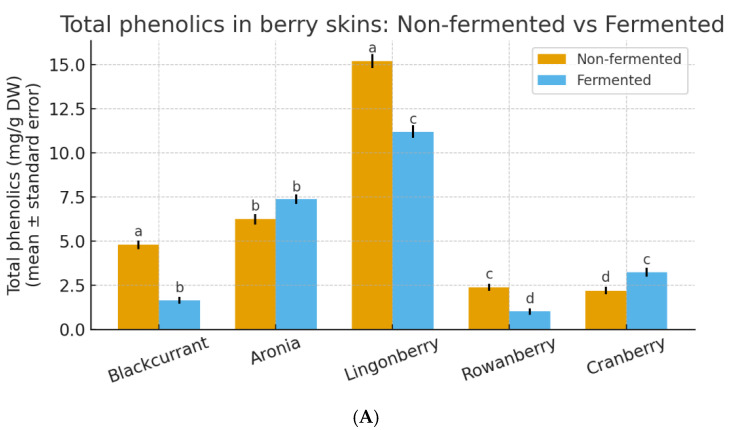 Figure 1
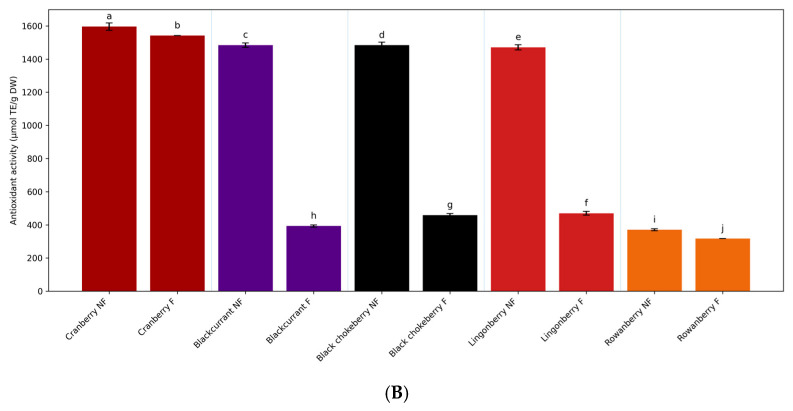 Figure 2
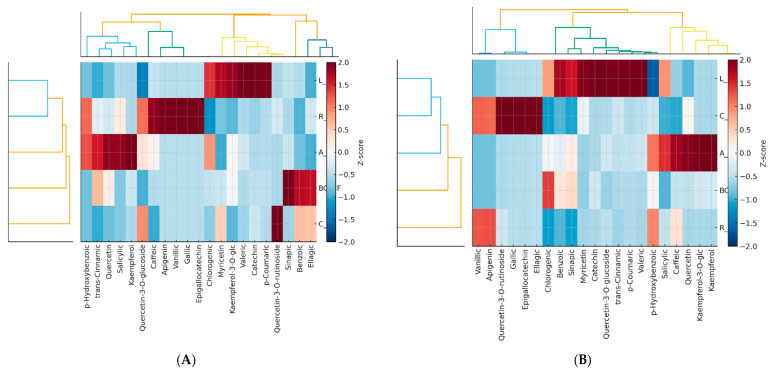 Figure 3
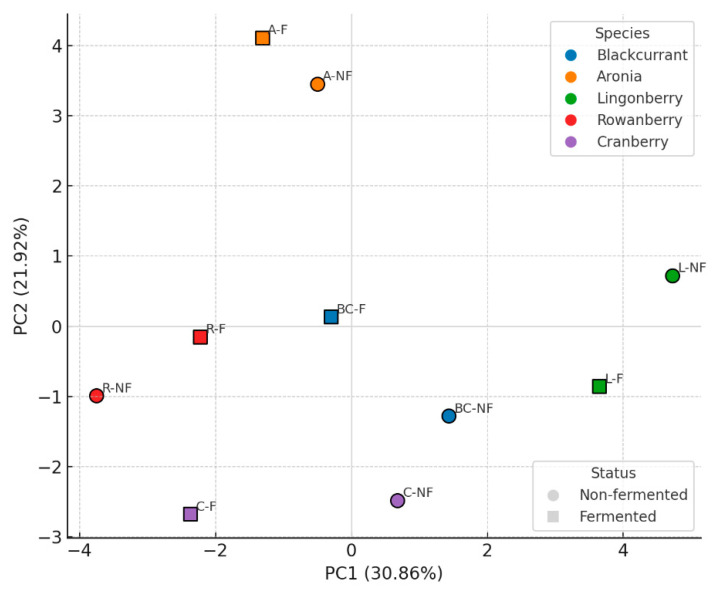 Figure 4
Peer Reviews
No public reviews on file for this paper yet. If you reviewed it on a platform where reviews are public (OpenReview, ICLR, NeurIPS, ICML), you can paste yours below so the community can read it here.
Videos
No videos yet. Explain this paper in a talk, walkthrough, or lecture? Add one.
Taxonomy
TopicsFermentation and Sensory Analysis · Phytochemicals and Antioxidant Activities · Biochemical and biochemical processes