Caffeine as an Ergogenic Aid for Neuromuscular Performance: Mechanisms of Action from Brain to Motor Units
Paolo Amoruso, Edoardo Lecce, Alessandro Scotto di Palumbo, Massimo Sacchetti, Ilenia Bazzucchi

TL;DR
This paper reviews how caffeine improves neuromuscular performance mainly by affecting the brain and nervous system, not directly through muscle action.
Contribution
The paper proposes that caffeine's ergogenic effects are primarily due to central nervous system modulation rather than direct muscle effects.
Findings
Caffeine's ergogenic effects are mainly due to central adenosine receptor antagonism.
Direct effects on muscle via ryanodine receptors are unlikely at safe doses.
Caffeine enhances performance by altering motor unit recruitment and neural excitability.
Abstract
Ergogenic aids have long attracted scientific interest for their potential to enhance neuromuscular performance, with caffeine being among the most extensively studied. While traditionally attributed to peripheral actions on skeletal muscle, accumulating evidence indicates that, at physiological doses, caffeine’s ergogenic effects are predominantly mediated by antagonism of central adenosine receptors. This antagonism leads to increased arousal, reduced inhibitory neuromodulation, enhanced corticospinal excitability, and altered motor unit recruitment and firing behavior. Importantly, the concentrations required to elicit direct effects on excitation–contraction coupling via ryanodine receptors exceed those compatible with human safety, rendering such mechanisms unlikely in vivo. This narrative review synthesizes contemporary neurophysiological evidence to propose that caffeine acts…
Genes, proteins, chemicals, diseases, species, mutations and cell lines named across the full text — each resolved to its canonical identifier and authoritative record.
Click any figure to enlarge with its caption.
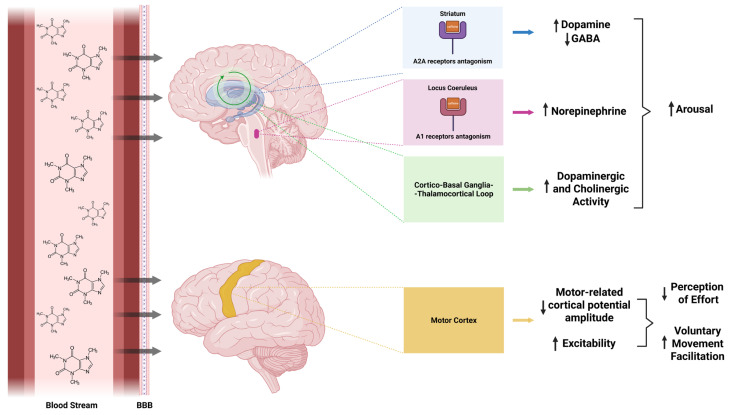 Figure 1
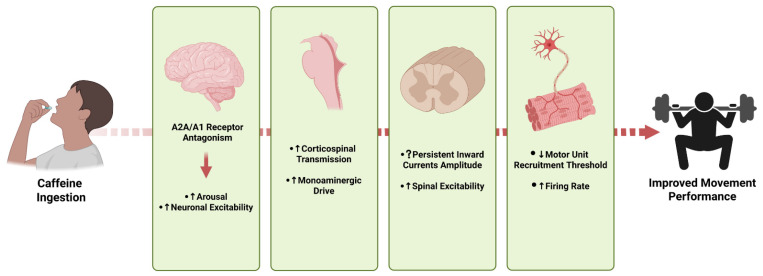 Figure 2
Peer Reviews
No public reviews on file for this paper yet. If you reviewed it on a platform where reviews are public (OpenReview, ICLR, NeurIPS, ICML), you can paste yours below so the community can read it here.
Videos
No videos yet. Explain this paper in a talk, walkthrough, or lecture? Add one.
Taxonomy
TopicsCoffee research and impacts · Adenosine and Purinergic Signaling · Pain Mechanisms and Treatments