Affinity- and Format-Dependent Pharmacokinetics of 89Zr-Labeled Albumin-Binding VHH Constructs
Simon Leekens, Peter Casteels, Tom Van Bogaert, Pieter Deschaght, Veronique De Brabandere, Christopher Cawthorne, Guy Bormans, Frederik Cleeren

TL;DR
This study shows how binding to albumin can improve the behavior of VHH molecules in the body, depending on how tightly they bind and their structure.
Contribution
The study systematically evaluates how albumin-binding affinity and valency affect VHH pharmacokinetics, revealing an affinity-dependent threshold for optimal performance.
Findings
Albumin-binding VHHs showed increased systemic exposure and reduced kidney uptake compared to non-binding controls.
Pharmacokinetics improved up to a nanomolar affinity threshold, beyond which further increases in affinity had no effect.
Bivalency had minimal impact at high affinity but increased kidney uptake at low affinity.
Abstract
Background/Objectives: NANOBODY® molecules (VHHs) are attractive vectors for radiopharmaceuticals due to their small size and high target affinity, but rapid clearance and pronounced kidney retention limit their therapeutic applicability. Binding to serum albumin is a widely used strategy to prolong circulation, yet the respective contributions of albumin-binding affinity and molecular format remain insufficiently defined. This study aimed to systematically evaluate how affinity and valency modulate VHH pharmacokinetics. Methods: Four monovalent albumin-binding VHHs spanning nanomolar to micromolar affinities and two bivalent constructs were engineered, generated by fusing an albumin-binding VHH to an irrelevant non-binding VHH. All constructs incorporated a site-specific cysteine for DFO* conjugation, enabling uniform zirconium-89 labeling with high radiochemical purity.…
Genes, proteins, chemicals, diseases, species, mutations and cell lines named across the full text — each resolved to its canonical identifier and authoritative record.
Click any figure to enlarge with its caption.
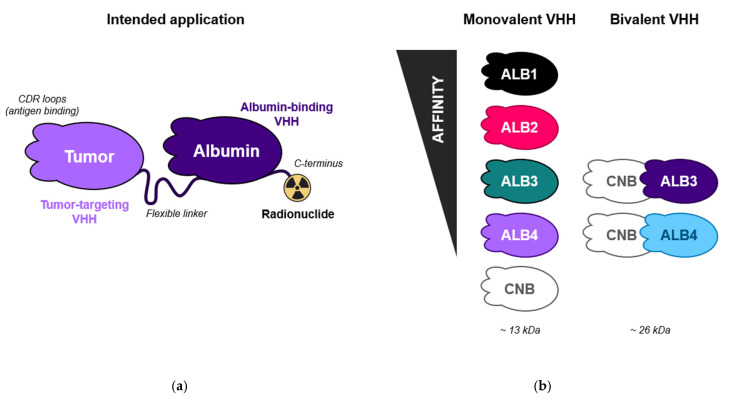 Figure 1
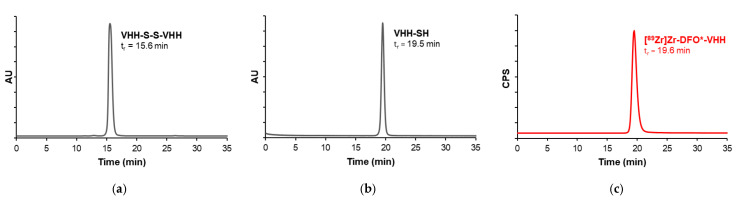 Figure 2
 Figure 3
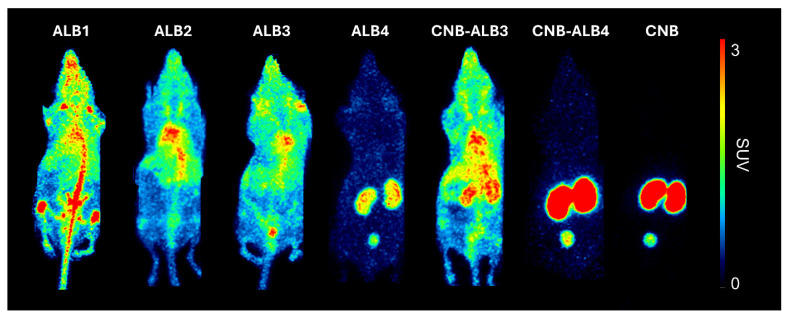 Figure 4
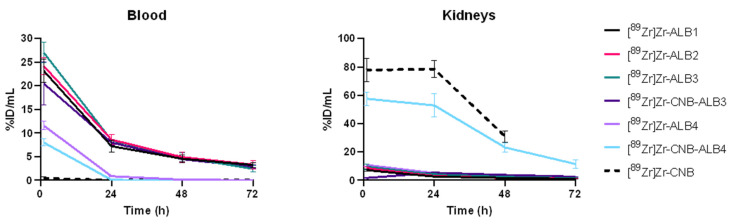 Figure 5
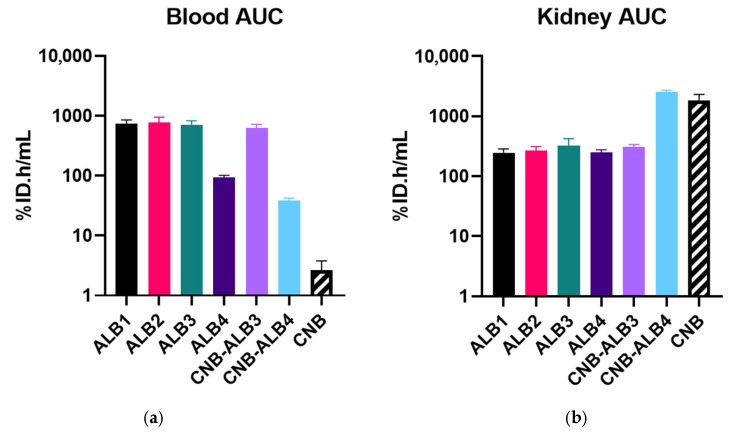 Figure 6
Peer Reviews
No public reviews on file for this paper yet. If you reviewed it on a platform where reviews are public (OpenReview, ICLR, NeurIPS, ICML), you can paste yours below so the community can read it here.
Videos
No videos yet. Explain this paper in a talk, walkthrough, or lecture? Add one.
Taxonomy
TopicsRadiopharmaceutical Chemistry and Applications · Monoclonal and Polyclonal Antibodies Research · Protein Interaction Studies and Fluorescence Analysis