Persistence and Transmission Dynamics of Babesia ovis After Imidocarb Dipropionate Treatment: Evaluation via Blood Transfusion and Tick Infestation
Recep Firat, Mehmet Can Ulucesme, Arda Eyvaz, Mehmet Alatas, Munir Aktas, Onur Ceylan, Ferda Sevinc, Sezayi Ozubek

TL;DR
This study shows that treating sheep with imidocarb dipropionate for Babesia ovis may not fully eliminate the parasite, allowing silent transmission through blood transfusion.
Contribution
The study demonstrates that residual B. ovis infections can persist and transmit silently after treatment, even when routine tests are negative.
Findings
IMDP resolves clinical signs and reduces parasitemia, but parasite DNA can persist for weeks.
Blood transfusion from treated sheep can transmit B. ovis to naïve recipients.
Ticks feeding on treated sheep did not acquire or transmit the parasite.
Abstract
Babesia ovis is a significant tick-borne parasite of sheep, capable of causing both acute disease and long-lasting, low-grade infections. Imidocarb dipropionate (IMDP) is commonly used against babesiosis, yet whether it can completely eliminate B. ovis remains uncertain. In this study, we examined whether the parasite persists after treatment and whether such residual infections can still be transmitted. Three sheep were experimentally infected, treated with IMDP once clinical signs appeared, and then monitored for 180 days by microscopy, nested PCR, and iELISA. Fever and microscopic parasitemia resolved soon after treatment, but nPCR intermittently detected parasite DNA for several weeks. By day 180, all treated sheep were negative by nPCR and microscopy, while two still showed detectable antibodies. Blood collected at this time was transfused into naïve sheep. Two of the three…
Genes, proteins, chemicals, diseases, species, mutations and cell lines named across the full text — each resolved to its canonical identifier and authoritative record.
Click any figure to enlarge with its caption.
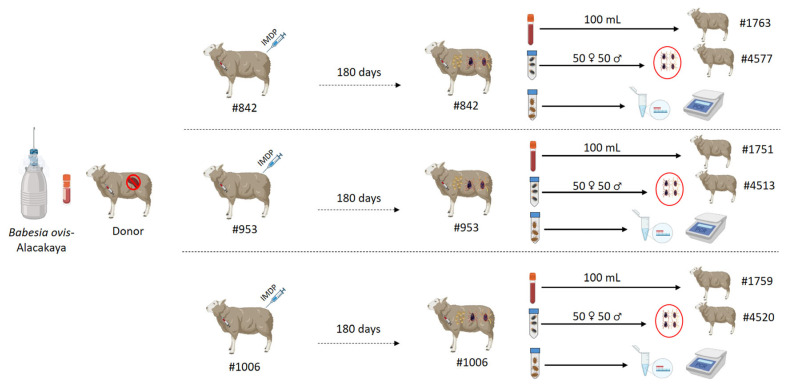 Figure 1
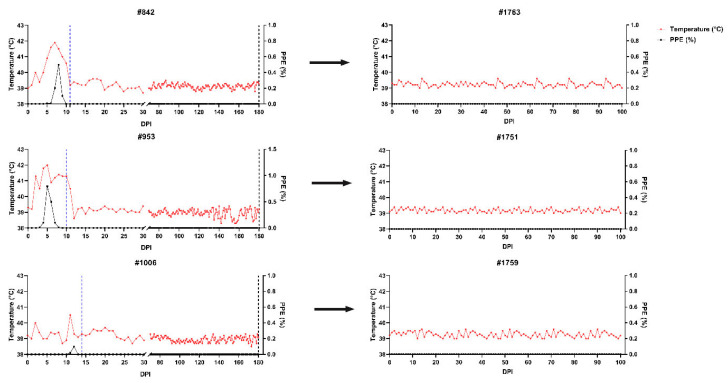 Figure 2
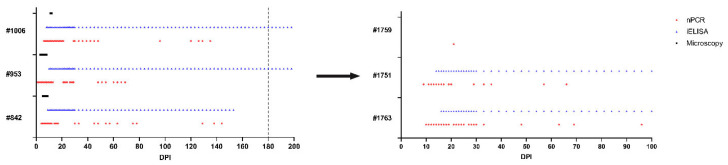 Figure 3
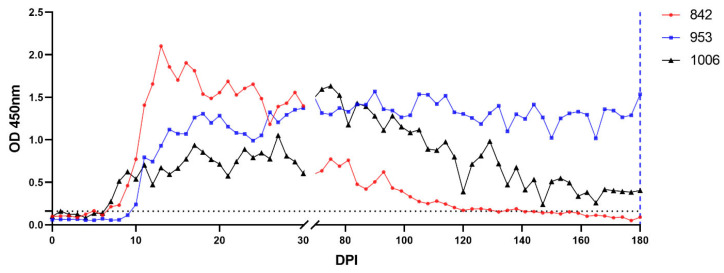 Figure 4
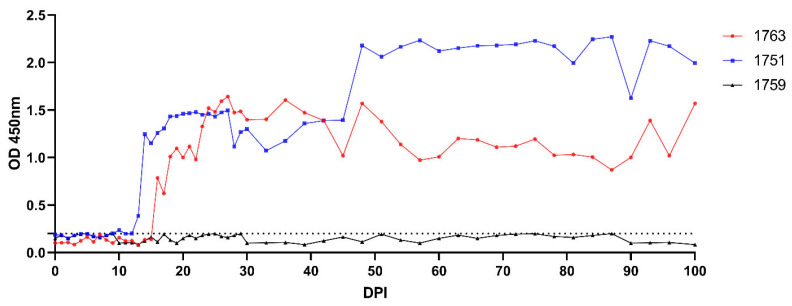 Figure 5
Peer Reviews
No public reviews on file for this paper yet. If you reviewed it on a platform where reviews are public (OpenReview, ICLR, NeurIPS, ICML), you can paste yours below so the community can read it here.
Videos
No videos yet. Explain this paper in a talk, walkthrough, or lecture? Add one.
Taxonomy
TopicsVector-borne infectious diseases · Parasites and Host Interactions · Trypanosoma species research and implications