Traditional and Non-Traditional Clustering Techniques for Identifying Chrononutrition Patterns in University Students
José Gerardo Mora-Almanza, Alejandra Betancourt-Núñez, Pablo Alejandro Nava-Amante, María Fernanda Bernal-Orozco, Andrés Díaz-López, José Alfredo Martínez, Barbara Vizmanos

TL;DR
This study compares traditional and non-traditional clustering methods to identify meal timing patterns in university students and finds that they reveal similar core structures.
Contribution
The study is the first to systematically compare clustering techniques for identifying chrononutrition patterns in university students.
Findings
Five distinct meal timing patterns were identified, including Early, Early–Intermediate, Late–Intermediate, Late, and Late with early breakfast.
Chronotype was aligned with meal timing patterns, with morning types more common in early clusters.
Food intake quality varied significantly, with healthier diets observed among early eaters compared to late eaters.
Abstract
Background/Objectives: Chrononutrition—the temporal organization of food intake relative to circadian rhythms—has emerged as an important factor in cardiometabolic health. While meal timing is typically analyzed as an isolated variable, limited research has examined integrated meal timing patterns, and no study has systematically compared clustering approaches for their identification. This cross-sectional study compared four clustering techniques—traditional (K-means, Hierarchical) and non-traditional (Gaussian Mixture Models (GMM), Spectral)—to identify meal timing patterns from habitual breakfast, lunch, and dinner times. Methods: The sample included 388 Mexican university students (72.8% female). Patterns were characterized using sociodemographic, anthropometric, food intake quality, and chronotype data. Clustering method concordance was assessed via Adjusted Rand Index (ARI).…
Click any figure to enlarge with its caption.
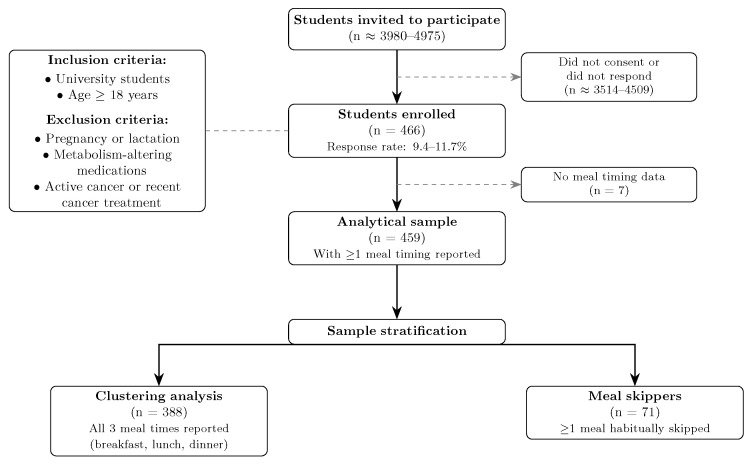 Figure 1
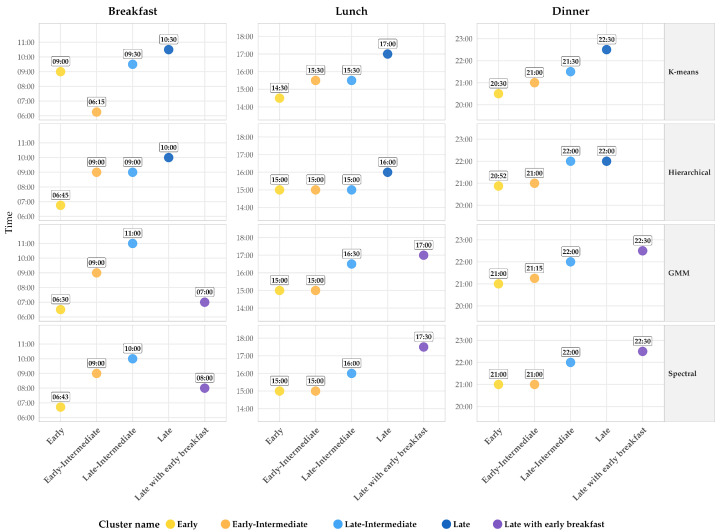 Figure 2
Peer Reviews
No public reviews on file for this paper yet. If you reviewed it on a platform where reviews are public (OpenReview, ICLR, NeurIPS, ICML), you can paste yours below so the community can read it here.
Videos
No videos yet. Explain this paper in a talk, walkthrough, or lecture? Add one.
Taxonomy
TopicsDietary Effects on Health · Nutritional Studies and Diet · Nutrition, Genetics, and Disease