Gammaretrovirus Infections in Humans in the Past, Present, and Future: Have We Defeated the Pathogen?
Antoinette Cornelia van der Kuyl

TL;DR
This review examines the history and potential future of gammaretrovirus infections in humans, focusing on past evidence, lab contamination issues, and risks of future transmission.
Contribution
The paper provides a comprehensive review of gammaretrovirus infections in humans, addressing historical findings, contamination issues, and future transmission risks.
Findings
Humans have not experienced novel gammaretrovirus infections for about 30 million years.
Earlier discoveries of gammaretroviruses in human samples were likely due to lab contamination.
Gammaretroviruses present in animal companions pose a potential transmission risk to humans.
Abstract
Gammaretroviruses are ubiquitous pathogens, often associated with the induction of neoplasia, especially leukemia, lymphoma, and sarcoma, and with a propensity to target the germline. The latter trait has left extensive evidence of their infectious competence in vertebrate genomes, the human genome being no exception. Despite the continuing activity of gammaretroviruses in mammals, including Old World monkeys, apes, and gibbons, humans have apparently evaded novel infections by the virus class for the past 30 million years or so. Nevertheless, from the 1970s onward, cell culture studies repeatedly discovered gammaretroviral components and/or virus replication in human samples. The last novel ‘human’ gammaretrovirus, identified in prostate cancer tissue, culminated in the XMRV frenzy of the 2000s. In the end, that discovery was shown to be due to lab contamination with a murine…
Genes, proteins, chemicals, diseases, species, mutations and cell lines named across the full text — each resolved to its canonical identifier and authoritative record.
Click any figure to enlarge with its caption.
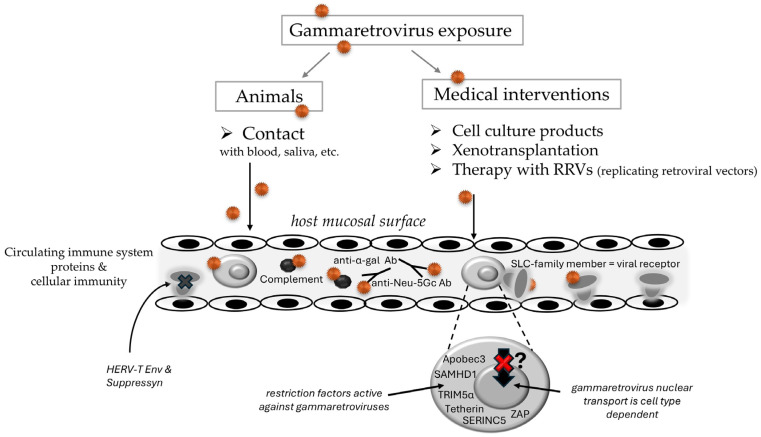 Figure 1
Peer Reviews
No public reviews on file for this paper yet. If you reviewed it on a platform where reviews are public (OpenReview, ICLR, NeurIPS, ICML), you can paste yours below so the community can read it here.
Videos
No videos yet. Explain this paper in a talk, walkthrough, or lecture? Add one.
Taxonomy
TopicsVirus-based gene therapy research · HIV Research and Treatment · Xenotransplantation and immune response