Evaluation of Commercial Immunoassays for Rubella Virus IgG Detection in Low-Antibody Sera Using a Recombinant Immunoblot as a Reference Method
Carmen Ortega, Antonio Sampedro-Padilla, Pablo Mazuelas, Jose Serrano, Ana Abreu, Juan Antonio Reguera, Javier Rodríguez-Granger, Fernando Cobo, Juan Francisco Gutiérrez-Bautista, Antonio Sampedro

TL;DR
This study compares commercial tests for rubella immunity and finds significant variability, suggesting the need for standardized thresholds and methods.
Contribution
The study evaluates commercial immunoassays for rubella IgG detection using a recombinant immunoblot as a reference, revealing limitations in current methods.
Findings
Sensitivity of commercial assays ranged from 19.6% to 70.1%, with specificity exceeding 94%.
Only 18.6% of immunoblot-positive samples tested positive across all assays.
Reclassifying equivocal results improved concordance without reducing specificity.
Abstract
Rubella virus (RV) IgG quantification is essential for verifying immunity, particularly in prenatal care. However, substantial variability exists among commercial immunoassays, especially when testing low-antibody sera. In this study, we evaluated five commercial assays—four chemiluminescent immunoassays (CLIAs) and one Enzyme-linked Immunosorbent Assay (ELISA)—using a recombinant immunoblot (IB) as the reference method. A panel of 137 serum samples with low or undetectable IgG levels was analyzed. Sensitivity ranged from 19.6% to 70.1%, while specificity exceeded 94%. Only 18.6% of immunoblot-positive samples tested positive across all assays. Marked quantitative differences were observed, with the Atellica assay yielding the highest titers and Alinity the lowest. Reclassifying equivocal results as positive improved concordance without compromising specificity. These findings suggest…
Genes, proteins, chemicals, diseases, species, mutations and cell lines named across the full text — each resolved to its canonical identifier and authoritative record.
Click any figure to enlarge with its caption.
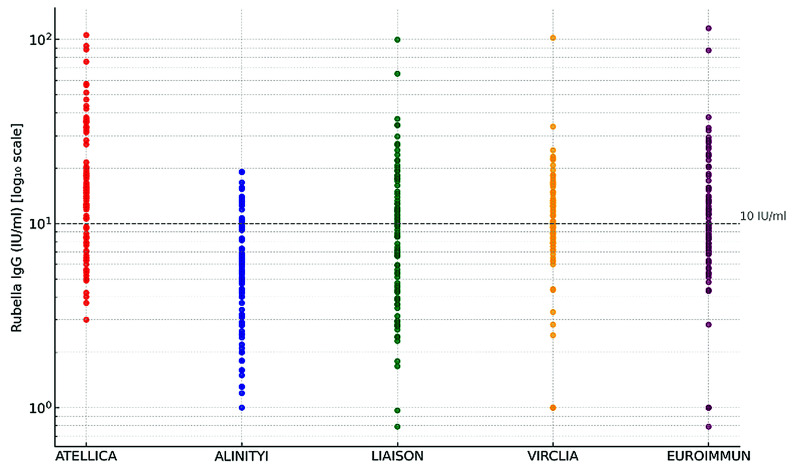 Figure 1
Peer Reviews
No public reviews on file for this paper yet. If you reviewed it on a platform where reviews are public (OpenReview, ICLR, NeurIPS, ICML), you can paste yours below so the community can read it here.
Videos
No videos yet. Explain this paper in a talk, walkthrough, or lecture? Add one.
Taxonomy
TopicsVirology and Viral Diseases · Respiratory viral infections research · Rabies epidemiology and control