The Prevalence, Mechanisms, and Clinical Significance of Inferior Vena Cava Compression in Autosomal Dominant Polycystic Kidney Disease: A Multicenter Retrospective Cohort Study Based on TriNetX
Ahmad Matarneh, Bayan Matarneh, Abdelrauof Akkari, Sundus Sardar, Omar Salameh, Navin Verma, Nasrollah Ghahramani

TL;DR
This study finds that compression of the inferior vena cava in patients with autosomal dominant polycystic kidney disease is linked to worse outcomes like higher risk of kidney failure and reduced survival.
Contribution
The study quantifies the clinical significance of inferior vena cava compression in ADPKD using a large multicenter cohort.
Findings
IVC compression in ADPKD is associated with a 2.61-fold increased risk of progressing to ESRD.
Patients with IVC compression had a 4.00-fold higher risk of mortality and reduced 5-year survival.
ESRD patients with IVC compression had a 5.60-fold higher risk of mortality compared to those without compression.
Abstract
Background and Objectives: Autosomal dominant polycystic kidney disease (ADPKD) is a leading cause of end-stage renal disease (ESRD). Progressive renal cyst growth in ADPKD can exert mass effects, including compression of the inferior vena cava (IVC), a rare but clinically significant complication with implications for hemodynamic stability and renal outcomes. This study evaluated the prevalence of IVC compression in ADPKD and its impact on progression to ESRD, mortality, and overall survival. We aimed to provide quantitative measures to elucidate its prognostic significance. Materials and Methods: Using the TriNetX database, we conducted a retrospective cohort study of 658 ADPKD patients with IVC compression, comparing them to unmatched controls without compression. Outcomes included ESRD incidence, mortality, and survival. Kaplan–Meier curves and hazard ratios (HRs) with 95%…
Genes, proteins, chemicals, diseases, species, mutations and cell lines named across the full text — each resolved to its canonical identifier and authoritative record.
Click any figure to enlarge with its caption.
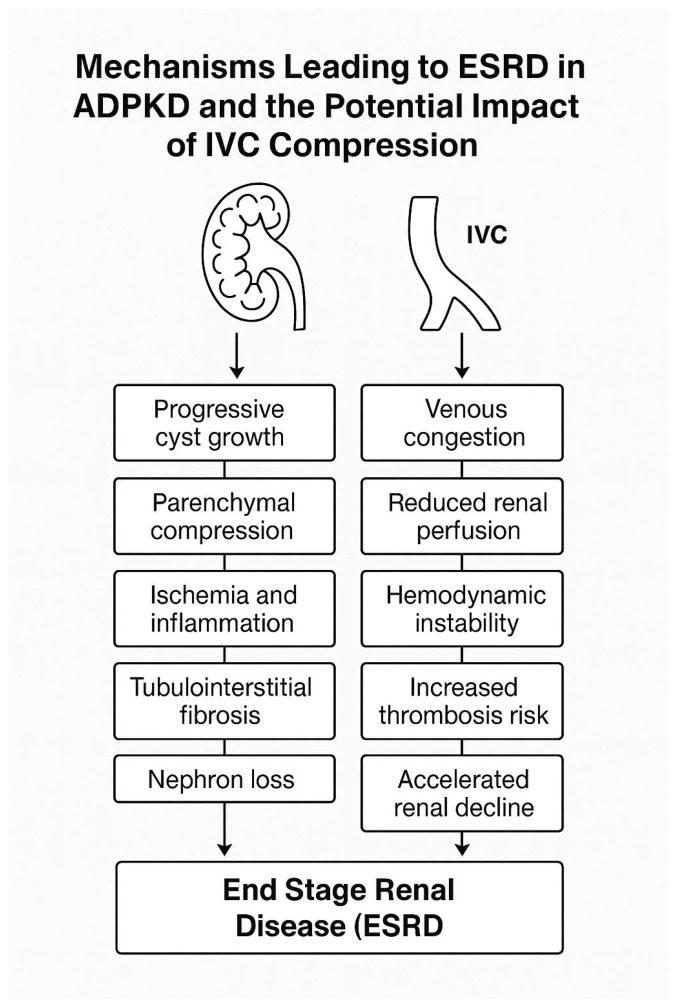 Figure 1
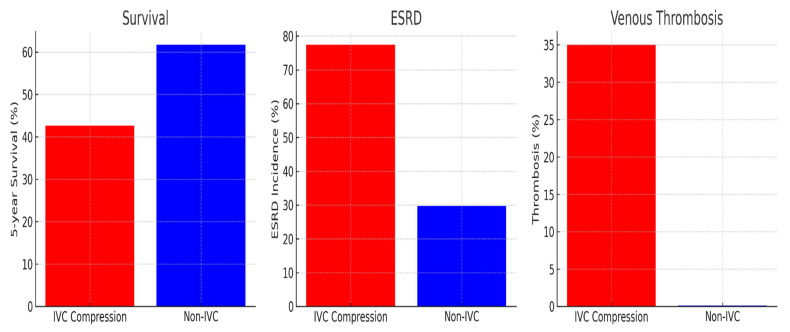 Figure 2
Peer Reviews
No public reviews on file for this paper yet. If you reviewed it on a platform where reviews are public (OpenReview, ICLR, NeurIPS, ICML), you can paste yours below so the community can read it here.
Videos
No videos yet. Explain this paper in a talk, walkthrough, or lecture? Add one.
Taxonomy
TopicsGenetic and Kidney Cyst Diseases · Pediatric Urology and Nephrology Studies · Renal cell carcinoma treatment