Calculation of the pH Values of Aqueous Systems Containing Carbonic Acid and Significance for Natural Waters, Following (Near-)Exact and Approximated Solutions: The Importance of the Boundary Conditions
Arianna Rosso, Davide Vione

TL;DR
This paper explains how to calculate pH in water systems with carbonic acid, showing exact and approximate methods and their relevance to environmental and climate studies.
Contribution
The paper introduces exact and approximate solutions for pH calculations in carbonic acid systems, emphasizing boundary conditions and applicability to natural waters.
Findings
Exact solutions for pH require solving third- to fourth-order equations numerically.
Approximations leading to second-order equations are valid under specific boundary conditions.
Exact solutions for closed systems with H2CO3* and alkalinity are provided for diverse aquatic environments.
Abstract
Calculating the pH values of carbonic acid solutions is an important task in studies of chemical equilibria in freshwater systems, with applications to environmental chemistry, geology, and hydrology. These pH values are also highly relevant in the context of climate change, since increasing atmospheric CO2 affects the concentration of dissolved carbon dioxide and carbonic acid, collectively denoted as [H2CO3*] = [H2CO3(aq)] + [CO2(aq)]. Solving equilibrium systems to obtain analytical functions is particularly useful when such functions are required, for example, in data fitting. We show here that, although exact or near-exact solutions typically result in third- to fourth-order equations that must be solved numerically, reasonable approximations can be derived that lead to analytical second-order equations. In this framework, the chosen approximations need to meet the boundary…
Genes, proteins, chemicals, diseases, species, mutations and cell lines named across the full text — each resolved to its canonical identifier and authoritative record.
Click any figure to enlarge with its caption.
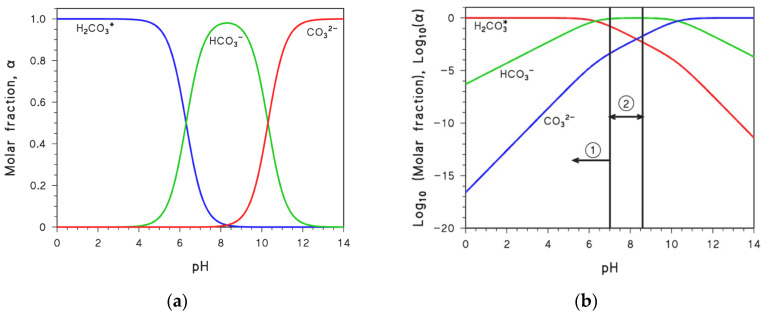 Figure 1
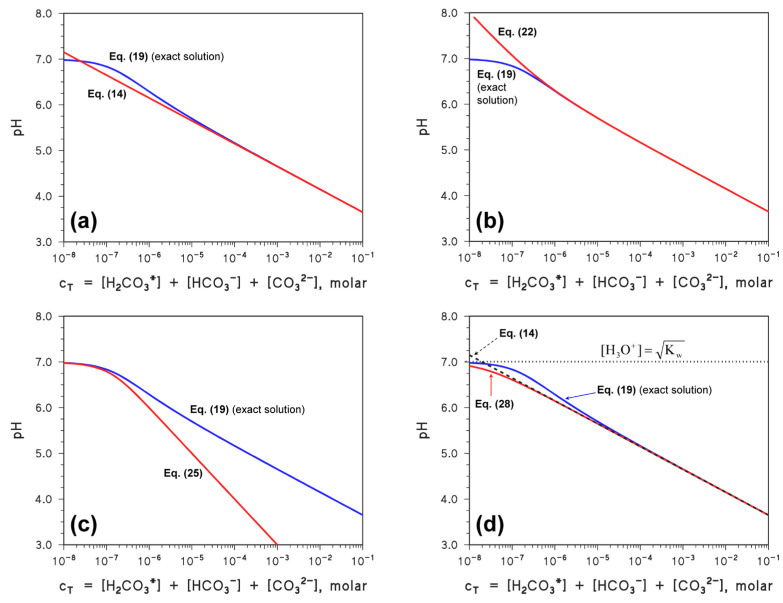 Figure 2
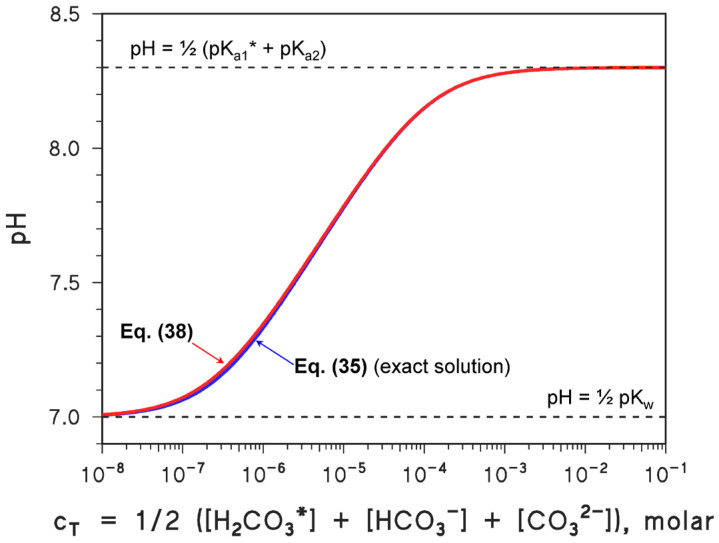 Figure 3
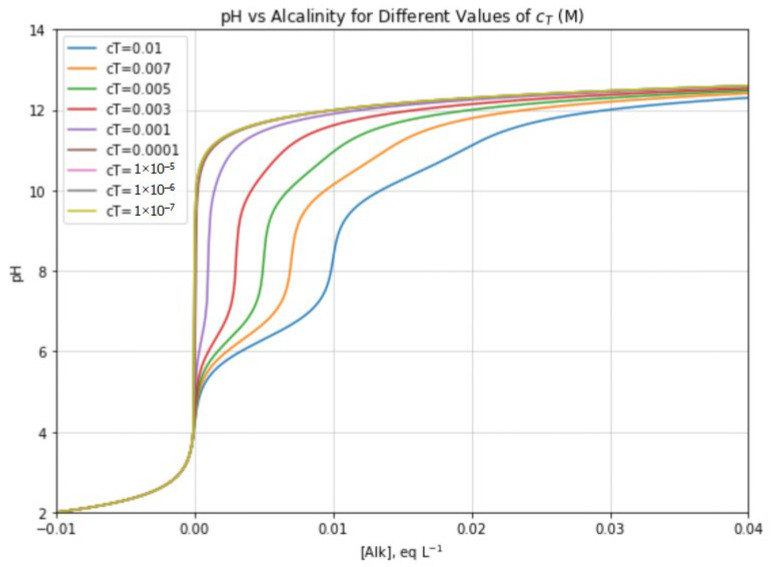 Figure 4
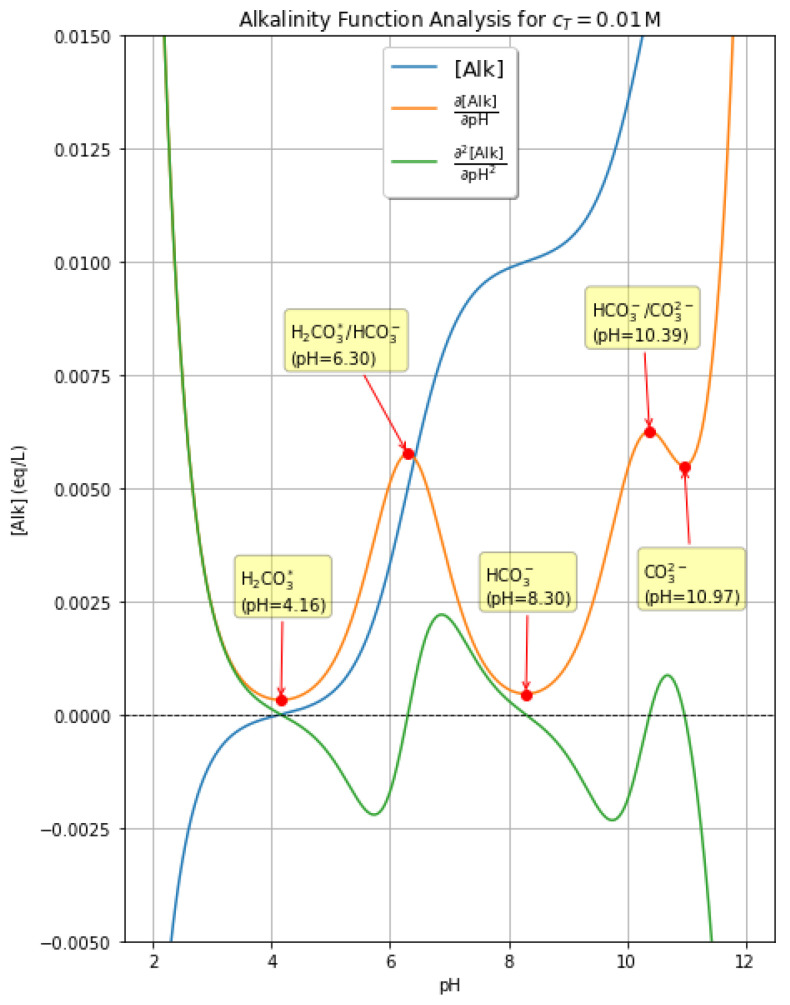 Figure 5
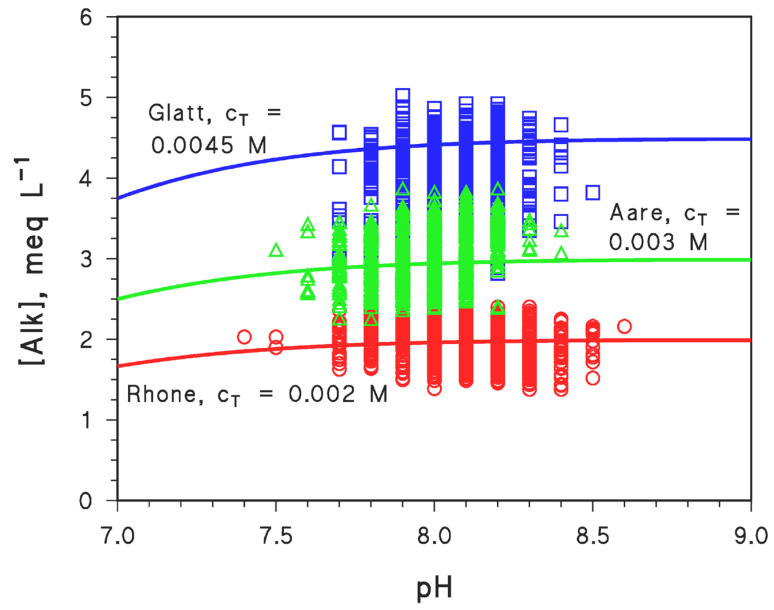 Figure 6
Peer Reviews
No public reviews on file for this paper yet. If you reviewed it on a platform where reviews are public (OpenReview, ICLR, NeurIPS, ICML), you can paste yours below so the community can read it here.
Videos
No videos yet. Explain this paper in a talk, walkthrough, or lecture? Add one.
Taxonomy
TopicsChemical and Physical Properties in Aqueous Solutions · Marine and coastal ecosystems · Spectroscopy and Quantum Chemical Studies