Self-Assembling Conjugated Organic Materials with a Silazane Anchor Group: Synthesis, Self-Organization, and Semiconductor Properties
Elizaveta A. Bobrova, Maxim S. Skorotetсky, Bogdan S. Kuleshov, Victoria P. Gaidarzhi, Askold A. Trul, Elena V. Agina, Oleg V. Borshchev, Sergey A. Ponomarenko

TL;DR
This paper describes a new organic semiconductor material with a silazane anchor group that self-assembles into thin layers and functions as a p-type transistor.
Contribution
The novel organic semiconductor molecule NH(Si-Und-BTBT-Hex)2 with a silazane anchor group is synthesized and shown to self-organize into functional ultrathin layers.
Findings
NH(Si-Und-BTBT-Hex)2 was synthesized using direct hydrosilylation and self-organizes into ultrathin layers.
The material forms monolayer organic field-effect transistors that operate in p-type mode.
Self-organization was achieved on air-water interfaces and solid substrates using Langmuir–Schaefer or Langmuir–Blodgett methods.
Abstract
An efficient synthetic method for the preparation of self-assembling conjugated organic materials with a silazane anchor group based on direct hydrosilylation reaction is reported. A novel organic semiconductor molecule, NH(Si-Und-BTBT-Hex)2, consisting of a polar silazane anchor group linked through undecylenic (Und) aliphatic spacers to conjugated blocks based on benzothieno[3,2-b][1]benzothiophene (BTBT) and solubilizing hexyl (Hex) end groups, was synthesized. Its self-organization on the air-water interface and solid substrates into ultrathin layers obtained by the Langmuir–Schaefer or Langmuir–Blodgett methods was investigated. Monolayer organic field-effect transistors manufactured from NH(Si-Und-BTBT-Hex)2 showed operation in the p-type mode.
Genes, proteins, chemicals, diseases, species, mutations and cell lines named across the full text — each resolved to its canonical identifier and authoritative record.
Click any figure to enlarge with its caption.
 Figure 1
 Figure 2
 Figure 3
 Figure 4
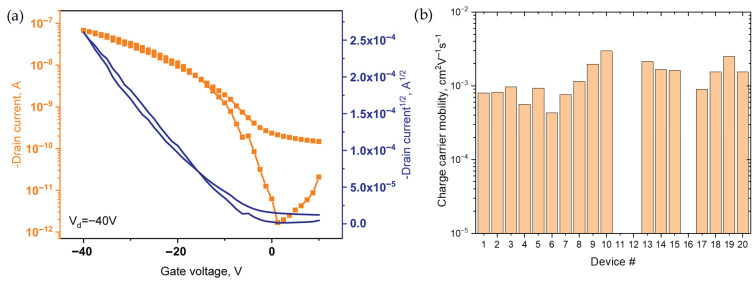 Figure 5
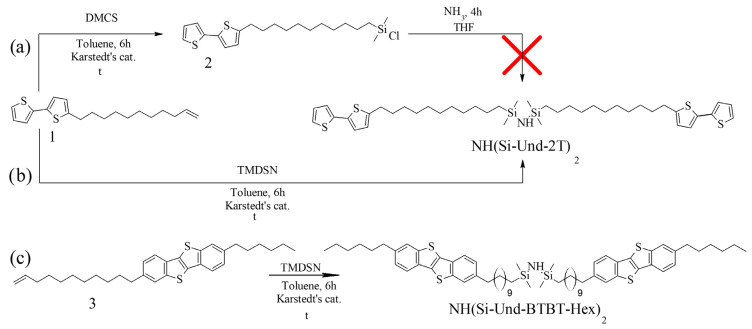 Figure 6
Peer Reviews
No public reviews on file for this paper yet. If you reviewed it on a platform where reviews are public (OpenReview, ICLR, NeurIPS, ICML), you can paste yours below so the community can read it here.
Videos
No videos yet. Explain this paper in a talk, walkthrough, or lecture? Add one.
Taxonomy
TopicsMolecular Junctions and Nanostructures · Organic Electronics and Photovoltaics · Mesoporous Materials and Catalysis