Fragmentation Resilience Energy Mass Spectrometry (FREMS): Methods Validation and Compound Differentiation
Alexander Yevdokimov, Kevin Colizza, James L. Smith, Jimmie C. Oxley

TL;DR
FREMS is a new mass spectrometry method that improves compound differentiation and structural analysis by measuring fragmentation resilience with high precision.
Contribution
FREMS introduces a novel metric, Fragmentation Resilience (FR50), validated as reliable for compound differentiation and structural elucidation.
Findings
FREMS breakdown energies depend on ion trap parameters like ion count, inject time, and activation time.
FR50 shows a strong linear relationship (R2 > 0.95) with m-SY50 and C-I metrics.
FREMS reveals that precursor ion decomposition rates match fragment formation rates under CAD conditions.
Abstract
Fragmentation Resilience Energy Mass Spectrometry (FREMS) builds on the field of energy-resolved mass spectrometry and previously used methods, e.g., Survival Yield. It exploits breakdown energies at near “continuous” ramp (0.2% NCE increments) to offer higher resolution and a reliable method for compound differentiation, contaminant identification and structural elucidation. Implementation of FREMS involves acquiring ion breakdown/formation curves as collision energy is incrementally increased. These curves themselves can be analyzed by several means to give a single metric—Fragmentation Resilience (FR50). This value has been shown to be experimentally interchangeable with the modified-Survival Yield (m-SY50) and the Cross-Intersect (C-I). A full panel of testing on an LTQ-Orbitrap revealed that breakdown energies depend only on three controllable parameters—number of ions inside the…
Genes, proteins, chemicals, diseases, species, mutations and cell lines named across the full text — each resolved to its canonical identifier and authoritative record.
Click any figure to enlarge with its caption.
 Figure 1
 Figure 2
 Figure 3
 Figure 4
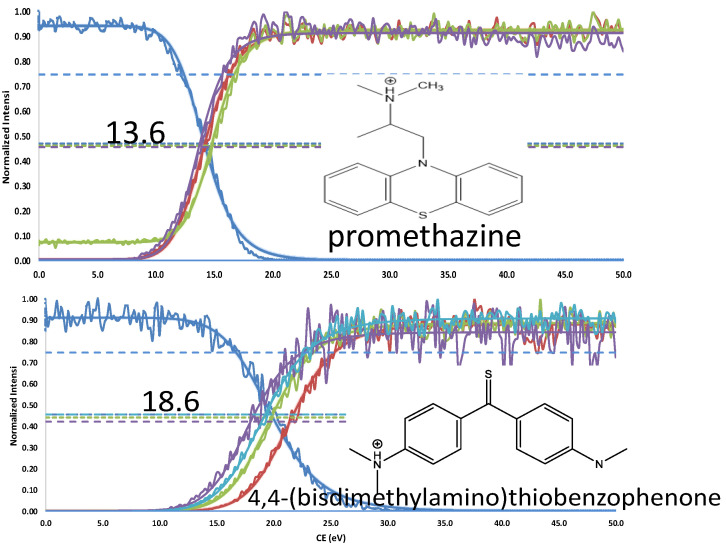 Figure 5
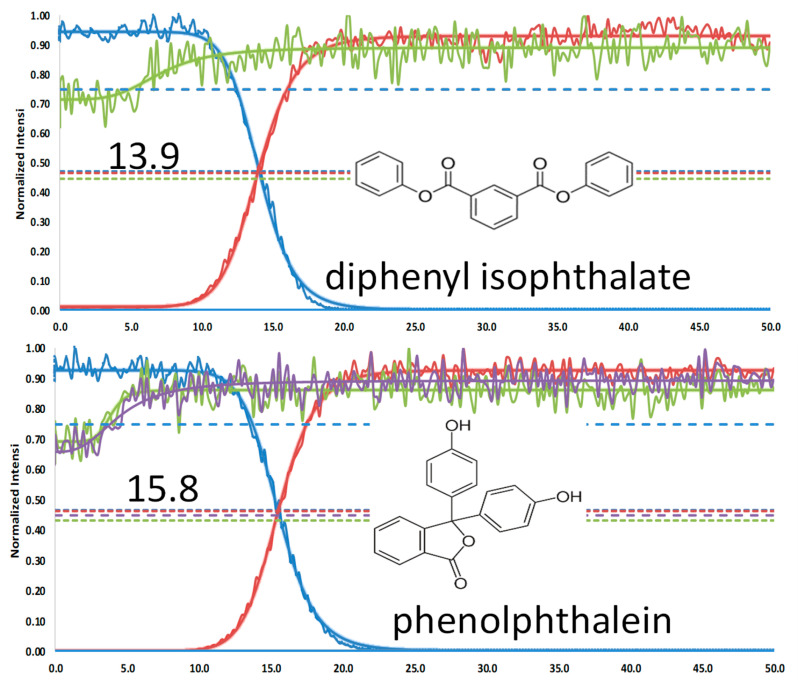 Figure 6
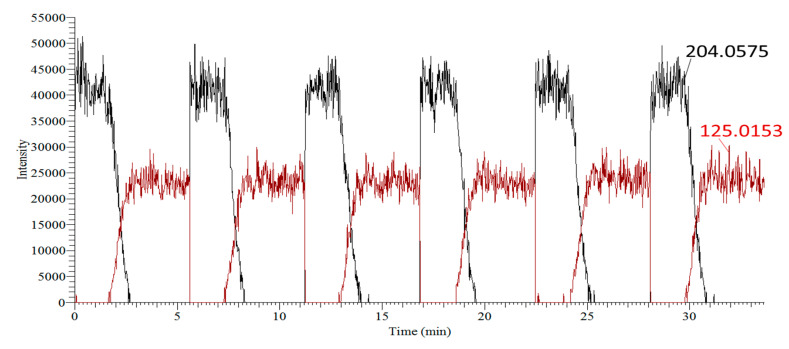 Figure 7
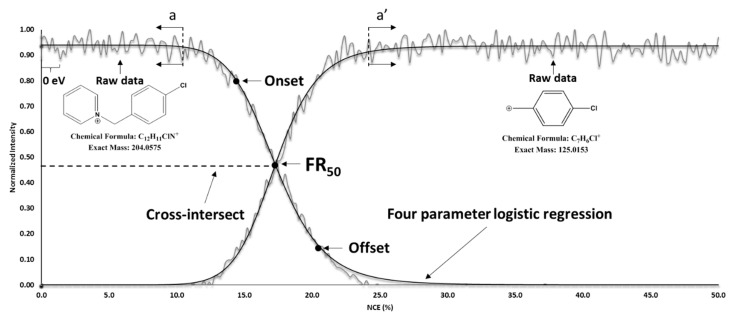 Figure 8
Peer Reviews
No public reviews on file for this paper yet. If you reviewed it on a platform where reviews are public (OpenReview, ICLR, NeurIPS, ICML), you can paste yours below so the community can read it here.
Videos
No videos yet. Explain this paper in a talk, walkthrough, or lecture? Add one.
Taxonomy
TopicsMass Spectrometry Techniques and Applications · X-ray Spectroscopy and Fluorescence Analysis · Ion-surface interactions and analysis