Detection of Pathogens by a Novel User-Developed Broad-Range BR 16S PCR rRNA Polymerase Chain Reaction/Gene Sequencing Assay: Multiyear Experience in a Large Canadian Healthcare Zone
Thomas Griener, Barbara Chow, Deirdre Church

TL;DR
A new 16S PCR assay improved pathogen detection in hard-to-diagnose infections, outperforming traditional culture methods in a large Canadian healthcare study.
Contribution
A novel DPO-based BR 16S PCR assay with fast protocols and high diagnostic accuracy for invasive infections is introduced.
Findings
The BR 16S PCR assay achieved 98.26% sensitivity and 99.79% specificity in detecting pathogens.
The assay provided results within 24–48 hours and minimized contamination compared to traditional culture methods.
BR 16S PCR detection led to appropriate clinical management for one-third of patients with invasive infections.
Abstract
Between 2015 and 2022, we evaluated a novel broad-range (BR) 16S PCR rDNA PCR/Sanger sequencing assay to improve diagnosis of invasive infections in culture-negative specimens. Using dual-priming oligonucleotides (DPO), this assay analyzed ribosomal DNA from sterile fluids or tissues. A total of 762 specimens were analyzed from 661 patients: 61% had negative cultures and BR 16S PCR tests; 35% had negative cultures but positive BR 16S PCR tests; and only 4% had negative cultures with indeterminate BR 16S PCR results. After resolution of indeterminate BR 16S PCR results (i.e., 29 negative, 1 false-positive, and 1 positive) the assay showed a sensitivity of 98.26% (95% CI = 96.00–99.43%), specificity of 99.79% (95% CI: 99.82–99.99%), positive predictive value of 99.65% (95% CI: 97.56–99.95%), negative predictive value of 98.94% (95% CI: 97.51–99.55%), and accuracy of 99.21% (95% CI:…
Genes, proteins, chemicals, diseases, species, mutations and cell lines named across the full text — each resolved to its canonical identifier and authoritative record.
Click any figure to enlarge with its caption.
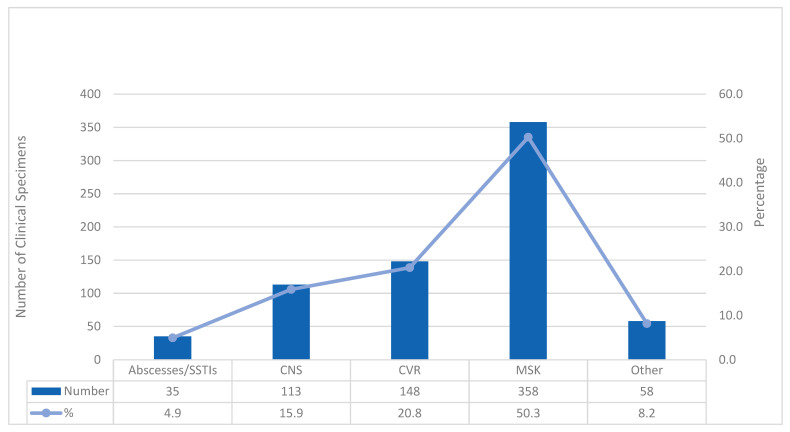 Figure 1
Peer Reviews
No public reviews on file for this paper yet. If you reviewed it on a platform where reviews are public (OpenReview, ICLR, NeurIPS, ICML), you can paste yours below so the community can read it here.
Videos
No videos yet. Explain this paper in a talk, walkthrough, or lecture? Add one.
Taxonomy
TopicsBacterial Identification and Susceptibility Testing · Infective Endocarditis Diagnosis and Management · Molecular Biology Techniques and Applications