Clinical Significance of cfiA Positivity Detected by Matrix-Assisted Laser Desorption/Ionization Time-of-Flight Mass Spectrometry in Bacteroides fragilis Infections
Wing-Man Chik, Lam-Kwong Lee, Jason Chi-Ka Cheng, Suk-Han Yuen, Rocky Shum, Gilman Kit-Hang Siu, Sandy Ka-Yee Chau

TL;DR
This study shows that MALDI-TOF MS can rapidly detect cfiA-positive Bacteroides fragilis, which is linked to carbapenem resistance and poor clinical outcomes.
Contribution
The study establishes the clinical relevance of MALDI-TOF MS for detecting cfiA-positive B. fragilis and its association with antibiotic resistance and mortality.
Findings
cfiA positivity detected by MALDI-TOF MS strongly correlates with carbapenem resistance in B. fragilis isolates.
cfiA+ isolates are predominantly of sequence type ST157 and often carry IS1187 insertion sequences upstream of cfiA.
High 30-day mortality (13.3%) is associated with comorbidities and lack of early source control in B. fragilis infections.
Abstract
The MALDI-TOF MS Bruker Biotyper MBT subtyping IVD module enables the early detection of cfiA-positive Bacteroides fragilis (cfiA+ BF) during bacterial identification. However, the relationship between genetic positivity, phenotypic resistance, and clinical outcomes has not been fully elucidated. This retrospective study analyzed B. fragilis isolates from three Hong Kong hospitals between 2021 and 2025 to examine their prevalence and the clinical utility of MALDI-TOF MS in rapid cfiA detection. Antibiotic susceptibility testing, cfiA gene detection using MALDI-TOF MS, and Oxford Nanopore sequencing were performed. Medical records were reviewed, and univariate analyses and multivariate logistic regression were used to identify factors associated with cfiA positivity and 30-day all-cause mortality. Overall, B. fragilis exhibited a high rate of antibiotic resistance. Concomitant resistance…
Genes, proteins, chemicals, diseases, species, mutations and cell lines named across the full text — each resolved to its canonical identifier and authoritative record.
Click any figure to enlarge with its caption.
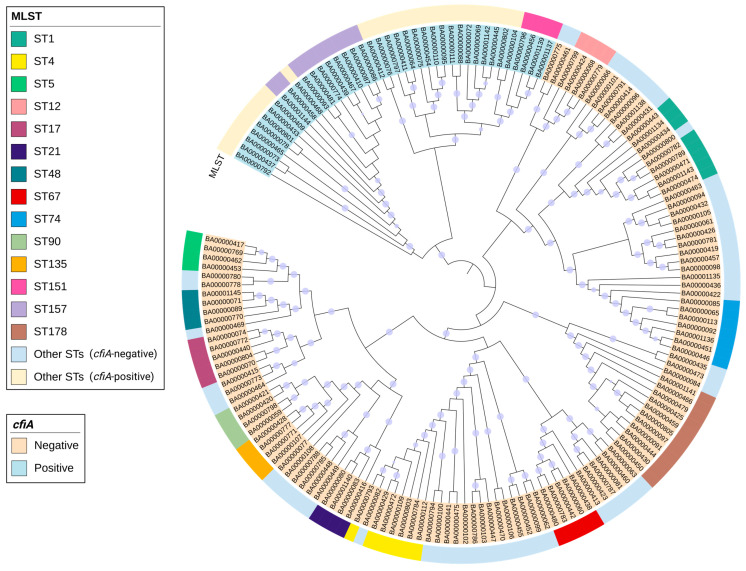 Figure 1
Peer Reviews
No public reviews on file for this paper yet. If you reviewed it on a platform where reviews are public (OpenReview, ICLR, NeurIPS, ICML), you can paste yours below so the community can read it here.
Videos
No videos yet. Explain this paper in a talk, walkthrough, or lecture? Add one.
Taxonomy
TopicsBacterial Identification and Susceptibility Testing · Neonatal and Maternal Infections · Diphtheria, Corynebacterium, and Tetanus