Unlocking the Secrets of Roman Chamomile (Anthemis nobilis L.) Essential Oil: Structural Elucidation and Acute Toxicity of New Esters
Niko S. Radulović, Marko Z. Mladenović

TL;DR
This study identifies new esters in Roman chamomile essential oil and evaluates their toxicity, expanding our understanding of its chemical composition.
Contribution
The paper reports four new natural ester compounds in Roman chamomile essential oil and confirms their chemical structures.
Findings
Four new esters (methallyl 3-methylbutanoate, methallyl senecioate, 3-methylpentyl 2-methylbutanoate, and 5-methylhexyl angelate) were identified as previously unreported natural products.
Methacrylates and related esters showed low toxicity in Artemia salina assays at high concentrations.
The study confirmed the thiol-acceptor reactivity of methacrylates through model Michael additions.
Abstract
To address gaps in the characterization of Roman chamomile (Anthemis nobilis L., Asteraceae)—an ethnobotanically and commercially important species—we profiled its essential oil (EO), focusing on esters that are incompletely characterized or unreported. Comprehensive GC-MS of two commercial EOs and their chromatographic fractions, combined with synthesis and co-injection of reference compounds, enabled the identification of 190 constituents. We uncovered a homologous series of angelates, tiglates, and senecioates by partial-ion-current (PIC) screening (m/z 55, 83, 100, 101), augmented by co-injection and NMR confirmation. Among these EO constituents, four esters, methallyl 3-methylbutanoate (6h), methallyl senecioate (3h), 3-methylpentyl 2-methylbutanoate (5c), and 5-methylhexyl angelate (2g) are reported here as new natural products and previously unreported compounds in the…
Genes, proteins, chemicals, diseases, species, mutations and cell lines named across the full text — each resolved to its canonical identifier and authoritative record.
Click any figure to enlarge with its caption.
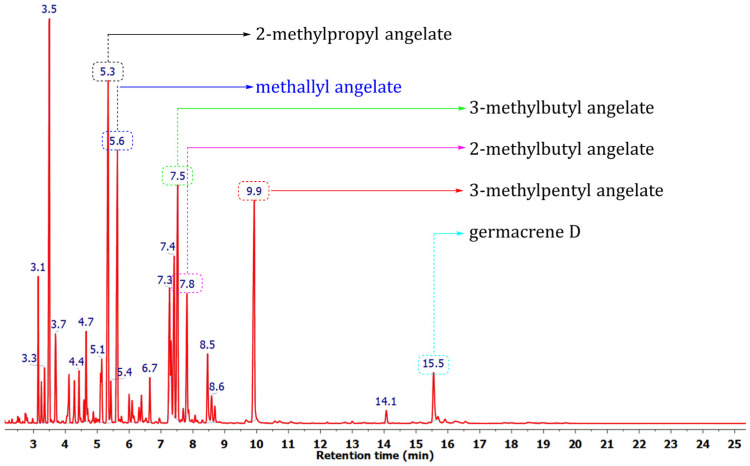 Figure 1
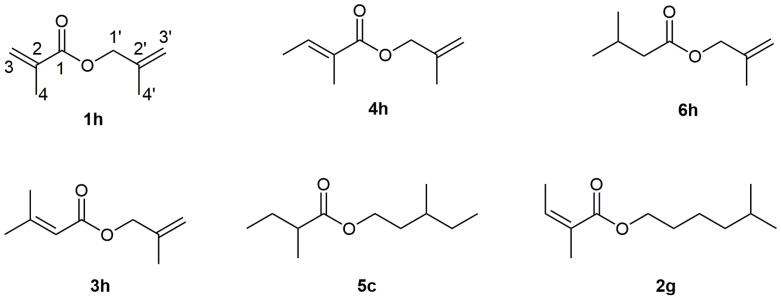 Figure 2
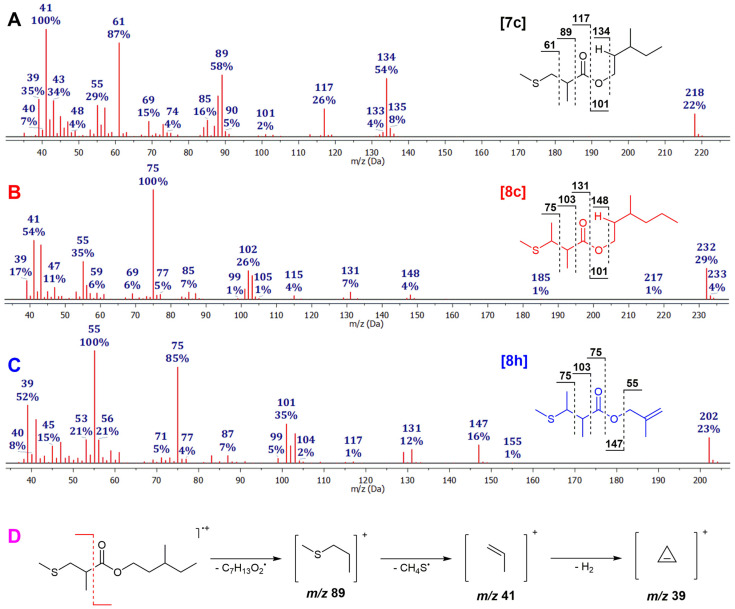 Figure 3
Peer Reviews
No public reviews on file for this paper yet. If you reviewed it on a platform where reviews are public (OpenReview, ICLR, NeurIPS, ICML), you can paste yours below so the community can read it here.
Videos
No videos yet. Explain this paper in a talk, walkthrough, or lecture? Add one.
Taxonomy
TopicsSesquiterpenes and Asteraceae Studies · Essential Oils and Antimicrobial Activity · Plant chemical constituents analysis