Metabolomics Analysis Reveals the Potential Advantage of Artificial Diet-Fed Bombyx Batryticatus in Disease Treatment
Han Chen, Yuting Feng, Daorui Pang, Qiong Yang, Yuxiao Zou, Ping Lin, Guanwang Shen, Dongxu Xing

TL;DR
This study compares the metabolomic profiles of a medicinal silkworm species reared on artificial diets versus mulberry leaves, finding minimal differences in key bioactive compounds.
Contribution
The study provides new insights into how artificial diets affect the metabolomic profile and pharmacological quality of Bombyx Batryticatus.
Findings
Artificial diet feeding did not significantly alter the levels of the key bioactive compound beauvericin in Bombyx Batryticatus.
Artificial diet feeding promoted the accumulation of certain flavonoids like apigenin and luteolin.
Several metabolites were found to be significantly correlated with artificial diet supplementation, including N,N′-diferuloylputrescine and 3,4-dimethoxyphenylacetic acid.
Abstract
Background: Beauveria bassiana infection of silkworm forms Bombyx Batryticatus (BB). It is a medicinal material with significant pharmacological potential. While artificial diet feeding improves the production efficiency of BB, it might alter host metabolism, consequently affecting its bioactive components and efficacy. To address this, we conducted a metabolomics analysis of BB reared under different feeding conditions; Methods: UPLC-MS/MS was employed to conduct metabolomic analysis of BB under three rearing conditions: all instars mulberry leaf feeding (MF), all instars artificial diet feeding (AF), and mixed feeding (AMF). The sample collection time was selected as the time when silkworms died after infection (D0), and the fifth day after death (D5), which is the time when fungus produces biologically active secondary metabolites to reach a stable state; Results: Compared to MF, AF…
Genes, proteins, chemicals, diseases, species, mutations and cell lines named across the full text — each resolved to its canonical identifier and authoritative record.
Click any figure to enlarge with its caption.
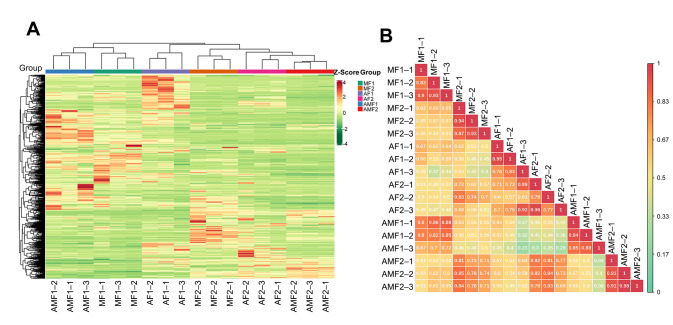 Figure 1
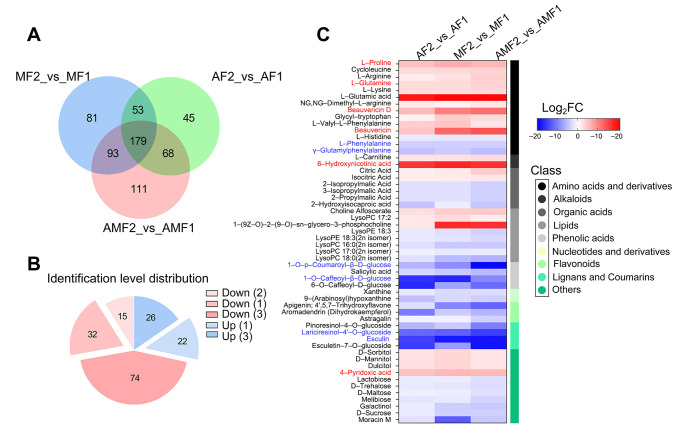 Figure 2
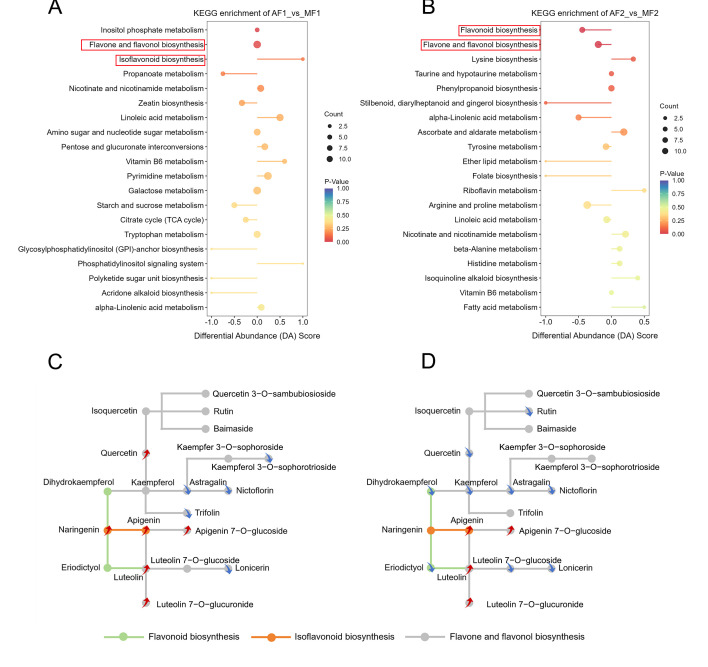 Figure 3
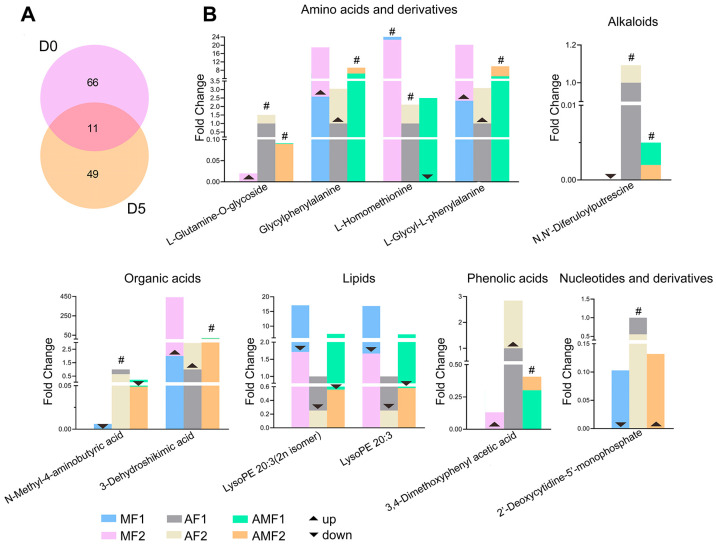 Figure 4
Peer Reviews
No public reviews on file for this paper yet. If you reviewed it on a platform where reviews are public (OpenReview, ICLR, NeurIPS, ICML), you can paste yours below so the community can read it here.
Videos
No videos yet. Explain this paper in a talk, walkthrough, or lecture? Add one.
Taxonomy
TopicsSilkworms and Sericulture Research · Silk-based biomaterials and applications · Invertebrate Immune Response Mechanisms