Quantitative Assessment of Total Aerobic Viable Counts in Apitoxin-, Royal-Jelly-, Propolis-, Honey-, and Bee-Pollen-Based Products Through an Automated Growth-Based System
Harold A. Prada-Ramírez, Raquel Gómez-Pliego, Humberto Zardo, Willy-Fernando Cely-Veloza, Ericsson Coy-Barrera, Rodrigo Palacio-Beltrán, Romel Peña-Romero, Sandra Gonzalez-Alarcon, Juan Camilo Fonseca-Acevedo, Juan Pablo Montes-Tamara, Lina Nieto-Celis, Ruth Dallos-Acosta

TL;DR
This study evaluates an automated system for measuring bacteria in bee-derived cosmetic products, showing it works reliably and efficiently.
Contribution
The study validates an automated growth-based system for assessing aerobic bacteria in bee-derived products using polysorbates to neutralize antimicrobial compounds.
Findings
The automated system met pivotal validation criteria for reliable total aerobic viable count measurements.
Polysorbates effectively neutralize antimicrobial bioactive compounds in bee-derived products, enabling accurate microbial recovery.
The system can be used in the cosmetic industry for faster product release of bee-derived items like anti-aging creams.
Abstract
Bee-derived products such as apitoxin, royal jelly, propolis, bee pollen, and honey are increasingly being used as part of cosmetic products because all of them contain a large number of bioactive compounds with antioxidant, anti-inflammatory, antimicrobial, and regenerative properties, which enable them to be used for therapeutic purposes. The aim of this investigation was to assess the performance of an automated growth-based system in order to make a quantitative examination of the total aerobic viable counts in bee-derived personal care products using NF-TVC vials that contained a nutrient-based medium with dextrose as the carbon source. According to USP general chapter <1223>, pivotal validation criteria such as linearity, equivalence of results, operative range, precision, accuracy, ruggedness, limit of quantification, and limit of detection have demonstrated that the automated…
Genes, proteins, chemicals, diseases, species, mutations and cell lines named across the full text — each resolved to its canonical identifier and authoritative record.
Click any figure to enlarge with its caption.
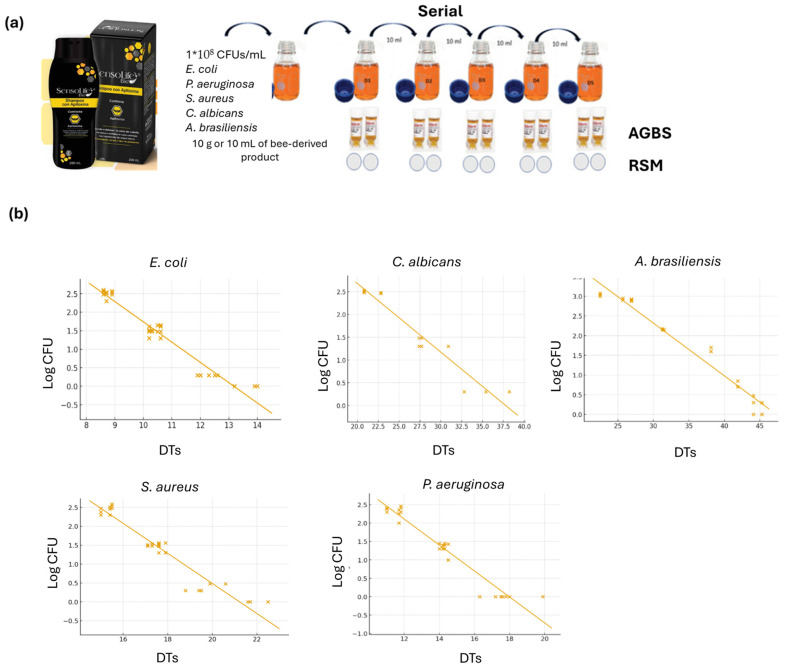 Figure 1
Peer Reviews
No public reviews on file for this paper yet. If you reviewed it on a platform where reviews are public (OpenReview, ICLR, NeurIPS, ICML), you can paste yours below so the community can read it here.
Videos
No videos yet. Explain this paper in a talk, walkthrough, or lecture? Add one.
Taxonomy
TopicsBee Products Chemical Analysis · Healthcare and Venom Research · Microbial Metabolism and Applications