A probabilistic approach to enhance the efficiency of case finding in hospital quality management: A case study using readmissions
Michael M. Havranek, Aleksandra Bosancic, Esther Ammann, Balthasar L. Hug

TL;DR
This paper introduces a probabilistic method to identify preventable hospital readmissions, helping hospitals focus on cases where improvements could reduce readmission rates.
Contribution
A novel probabilistic approach to efficiently identify potentially preventable readmissions using patient characteristics and logistic regression.
Findings
Patients with the lowest expected readmission probability had 6.6 to 8.7 times higher odds of experiencing a preventable readmission.
Surgical complications, medication issues, nonsurgical complications, and premature discharge were leading causes of preventable readmissions.
The probabilistic model can guide hospital quality managers to prioritize cases for improvement efforts.
Abstract
Hospital readmissions prolong patient suffering and increase healthcare expenditures. Unplanned readmission rates, such as those reported by the Center for Medicare & Medicaid Services (CMS), distinguish between planned and unplanned readmissions. However, within unplanned readmissions, there is no distinction between those that are preventable versus unpreventable by the hospitals. Alternative approaches attempting to identify potentially preventable readmissions directly from coded medical data have been explored but have shown low sensitivity. Consequently, identifying preventable readmissions remains a time-consuming task for hospital quality managers seeking to allocate improvement resources effectively. To address this challenge, we aimed to develop and evaluate a probabilistic approach to improve the identification of preventable readmissions among unplanned readmissions. Using a…
Genes, proteins, chemicals, diseases, species, mutations and cell lines named across the full text — each resolved to its canonical identifier and authoritative record.
Click any figure to enlarge with its caption.
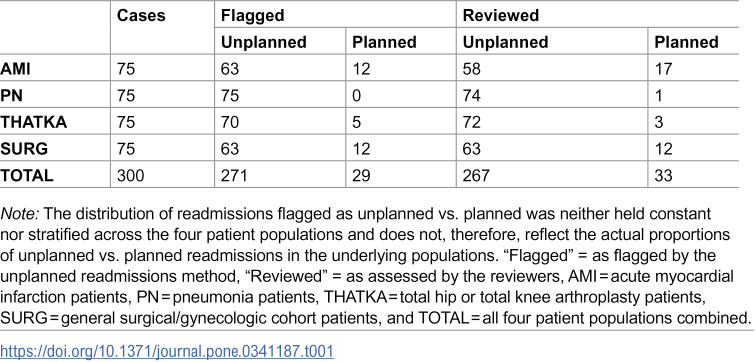 Figure 1
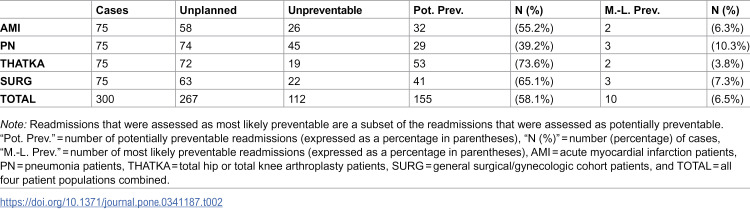 Figure 2
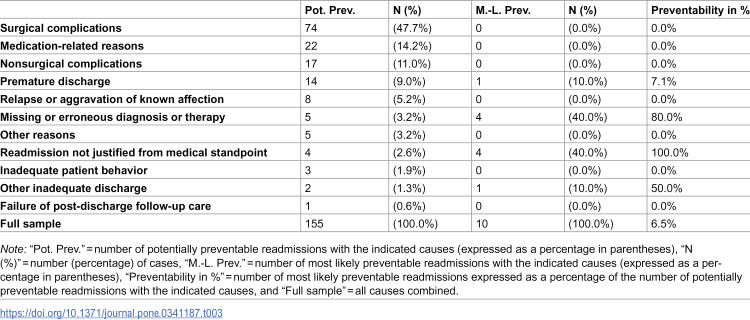 Figure 3
Peer Reviews
No public reviews on file for this paper yet. If you reviewed it on a platform where reviews are public (OpenReview, ICLR, NeurIPS, ICML), you can paste yours below so the community can read it here.
Videos
No videos yet. Explain this paper in a talk, walkthrough, or lecture? Add one.
Taxonomy
TopicsHeart Failure Treatment and Management · Hospital Admissions and Outcomes · Transplantation: Methods and Outcomes