Trends in the Management of Bladder Cancer with Emphasis on Frailty: A Nationwide Analysis of More Than 49,000 Patients from a German Hospital Network
Tobias Klatte, Frederic Bold, Julius Dengler, Michela de Martino, Sven Hohenstein, Ralf Kuhlen, Andreas Bollmann, Thomas Steiner, Nora F. Dengler

TL;DR
This study examines how bladder cancer treatment and patient frailty have changed in Germany over six years, showing shifts in treatment approaches and the importance of considering frailty in care decisions.
Contribution
The study provides a nationwide analysis of bladder cancer management trends in Germany, highlighting the role of frailty in treatment decisions and outcomes.
Findings
The proportion of patients with low frailty increased from 73.4% to 75.5% between 2016–2019 and 2020–2022.
Use of systemic therapy increased, especially among low frailty elderly patients, while early intravesical chemotherapy declined significantly, particularly in high frailty elderly patients.
Hospital stay duration decreased by one day, but ICU admission rates and in-hospital mortality remained stable over time.
Abstract
Background: Bladder cancer (BC) predominantly affects older patients, and their multidisciplinary treatment often includes surgical intervention. Frailty can influence treatment decisions and is associated with poorer outcomes. This study analyses trends in demographics, treatment patterns and frailty in a large, nationwide, real-world inpatient cohort in Germany. Methods: This retrospective observational study included a total of 49,139 consecutive patients, who received inpatient care for BC at all HELIOS hospitals in Germany between 2016 and 2022. Frailty was assessed using the Hospital Frailty Risk Score (HFRS) and categorised as low (<5), intermediate (5–15), or high (>15). Trends in HFRS, treatment modalities, and demographic variables were analysed using regression models and compared between the periods 2016–2019 and 2020–2022. Results: Of the 49,139 patients, 27,979 were…
Genes, proteins, chemicals, diseases, species, mutations and cell lines named across the full text — each resolved to its canonical identifier and authoritative record.
Click any figure to enlarge with its caption.
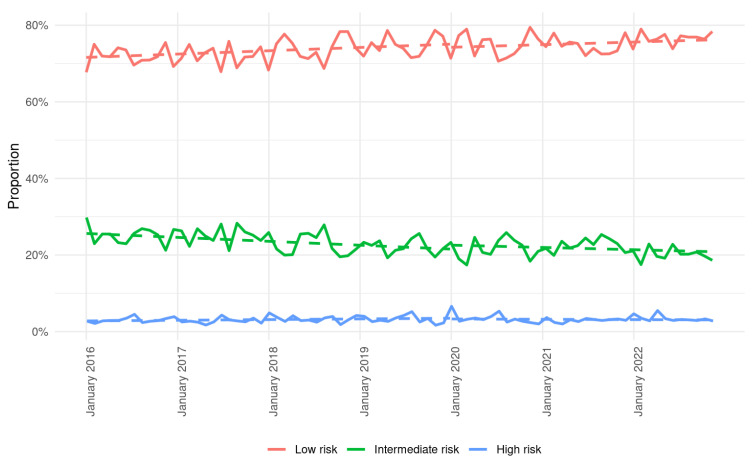 Figure 1
Peer Reviews
No public reviews on file for this paper yet. If you reviewed it on a platform where reviews are public (OpenReview, ICLR, NeurIPS, ICML), you can paste yours below so the community can read it here.
Videos
No videos yet. Explain this paper in a talk, walkthrough, or lecture? Add one.
Taxonomy
TopicsBladder and Urothelial Cancer Treatments · Frailty in Older Adults · Esophageal Cancer Research and Treatment