Advanced Biomaterials for Craniofacial Tissue Regeneration: From Fundamental Mechanism to Translational Applications—A Scoping Review
Żaneta Anna Mierzejewska, Valentina Veselinović, Nataša Trtić, Saša Marin, Jan Borys, Bożena Antonowicz

TL;DR
This review explores new biomaterials and technologies for regenerating craniofacial tissues, aiming to improve personalized and biologically integrated surgical solutions.
Contribution
The paper offers a scoping review of advanced biomaterials and translational technologies for craniofacial tissue regeneration.
Findings
Bioactive ceramics, biodegradable polymers, and hybrid composites are key materials for craniofacial regeneration.
Translational technologies like 3D bioprinting and extracellular vesicles show promise but face challenges like bioink standardization.
A shift toward personalized and biologically active regenerative solutions is emerging in maxillofacial surgery.
Abstract
Recent advances in biomaterials, immunomodulation, stem cell therapy, and biofabrication are reshaping maxillofacial surgery, shifting reconstruction paradigms toward biologically integrated and patient-specific tissue regeneration. This review provides a comprehensive synthesis of current and emerging strategies for bone and soft-tissue regeneration in the craniofacial region, with particular emphasis on bioactive ceramics, biodegradable polymers, hybrid composites, and stimuli-responsive smart materials. We further examine translational technologies such as extracellular vesicles, decellularized extracellular matrices, organoids, and 3D bioprinting, highlighting key challenges such as bioink standardization, perfusion limitations, and regulatory classification. Maxillofacial surgery is positioned for a paradigm shift toward personalized, biologically active, and clinically scalable…
Genes, proteins, chemicals, diseases, species, mutations and cell lines named across the full text — each resolved to its canonical identifier and authoritative record.
Click any figure to enlarge with its caption.
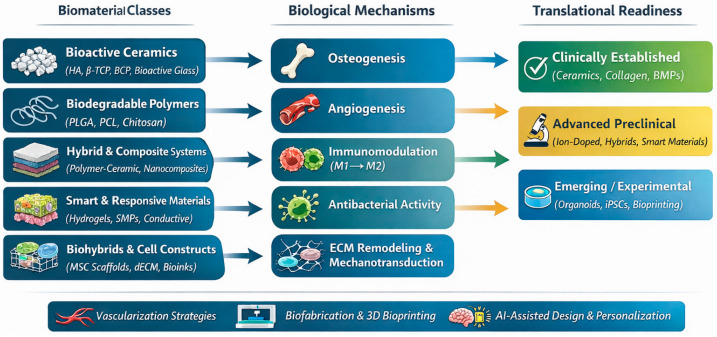 Figure 1
 Figure 2
 Figure 3
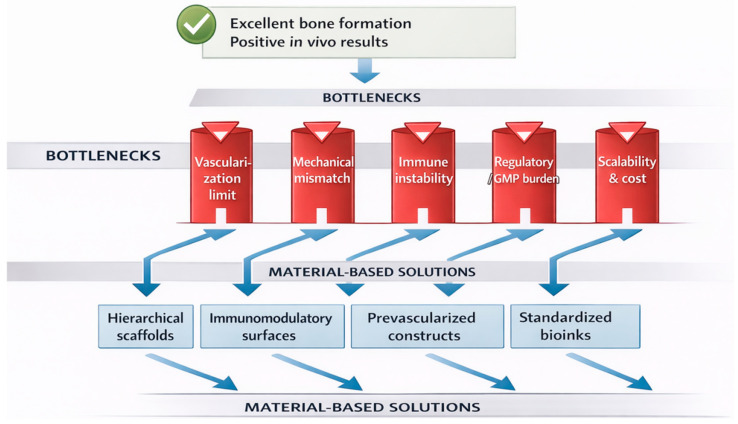 Figure 4
Peer Reviews
No public reviews on file for this paper yet. If you reviewed it on a platform where reviews are public (OpenReview, ICLR, NeurIPS, ICML), you can paste yours below so the community can read it here.
Videos
No videos yet. Explain this paper in a talk, walkthrough, or lecture? Add one.
Taxonomy
TopicsBone Tissue Engineering Materials · Tissue Engineering and Regenerative Medicine · 3D Printing in Biomedical Research