Ultrasound-Guided Femoral Hemostasis in Peripheral Angioplasty: Real-World Outcomes with Vascular Closure Devices Versus Manual Compression
Ioannis Skalidis, Livio D’Angelo, Mariama Akodad, Youcef Lounes, Hakim Benamer, Benjamin Honton, Antoine Sauguet, Neila Sayah, Pietro Laforgia, Nicolas Amabile, Thomas Hovasse, Philippe Garot, Antoinette Neylon, Francesca Sanguineti, Stephane Champagne, Thierry Unterseeh

TL;DR
Using vascular closure devices instead of manual compression after ultrasound-guided femoral access reduces access-site complications in peripheral angioplasty.
Contribution
Real-world evidence showing vascular closure devices reduce complications compared to manual compression in ultrasound-guided peripheral interventions.
Findings
VCDs were associated with lower 30-day access-site complication rates than manual compression.
VCD failure occurred in 3.6% of cases, with no failures in collagen plug-based devices.
Sheath size > 6 Fr and puncture-site calcification were independently linked to higher complication rates.
Abstract
Background and Objectives: Access-site complications (ASCs) remain clinically relevant after peripheral endovascular procedures, particularly with large femoral sheaths and complex anatomy. While randomized coronary trials show non-inferiority of vascular closure devices (VCDs) versus manual compression (MC), real-world data in peripheral interventions performed under systematic ultrasound-guided access are limited. Materials and Methods: This retrospective single-center cohort included consecutive peripheral arterial revascularizations (2010–2023) performed via common femoral access under real-time ultrasound guidance. Hemostasis was achieved using MC or VCDs, categorized as collagen plug-based, suture-mediated, or clip-based systems. The primary endpoint was 30-day ASCs, defined as hematoma requiring management, pseudoaneurysm, bleeding requiring transfusion, access-site…
Genes, proteins, chemicals, diseases, species, mutations and cell lines named across the full text — each resolved to its canonical identifier and authoritative record.
Click any figure to enlarge with its caption.
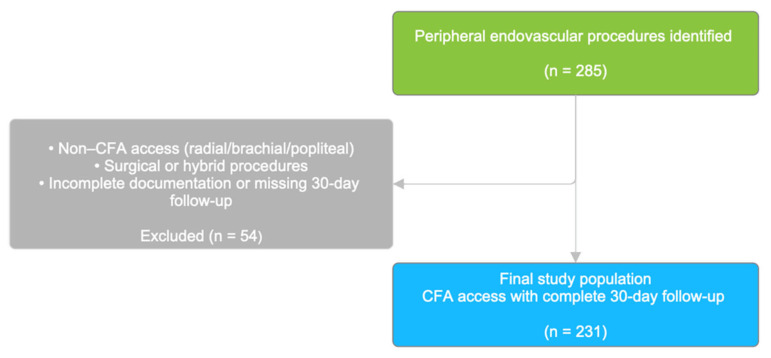 Figure 1
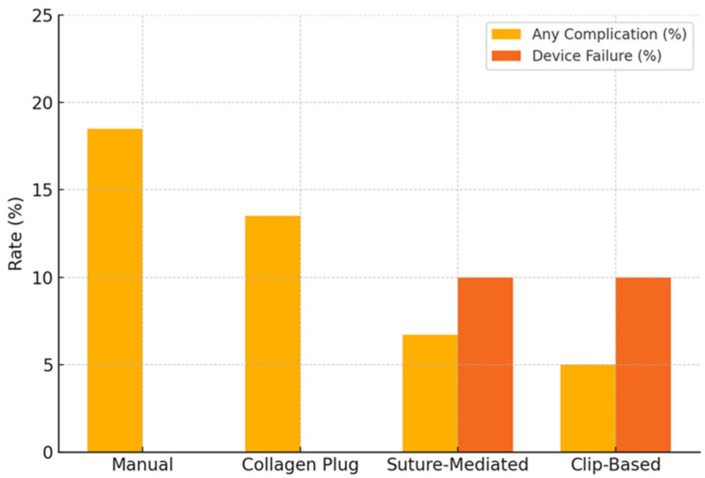 Figure 2
Peer Reviews
No public reviews on file for this paper yet. If you reviewed it on a platform where reviews are public (OpenReview, ICLR, NeurIPS, ICML), you can paste yours below so the community can read it here.
Videos
No videos yet. Explain this paper in a talk, walkthrough, or lecture? Add one.
Taxonomy
TopicsVascular Procedures and Complications · Peripheral Artery Disease Management · Infectious Aortic and Vascular Conditions