Genome Mining and Heterologous Reconstitution of a PKS-NRPS Gene Cluster from Aspergillus flavipes LY1-5 Affords Structurally Novel Tetronates
Quan Dai, Yiqiao Li, Shuzhe Lv, Shuang Zhao, Liyuan Han, Jiaxin Xu, Hui Shuai, Youming Zhang, Fu Yan

TL;DR
Scientists discovered ten new natural products from a fungal gene cluster, revealing unique chemical structures and potential antibacterial properties.
Contribution
The study reports the discovery of ten novel tetronate natural products with unique chemical structures from a heterologously expressed fungal gene cluster.
Findings
Ten new tetronate natural products, talactones A–J, were identified from a fungal PKS-NRPS gene cluster.
Talactone A contains a rare 1,4-thiazepane scaffold formed via a non-enzymatic reaction.
Talactones B and C feature a novel 2,3-dihydrofuro [3,4-b]pyridine-4,5(1H,7H)-dione skeleton formed by intramolecular cyclization.
Abstract
Heterologous expression of silent biosynthetic gene clusters represents a key strategy for the discovery of structurally novel natural products. In this study, we obtained ten new tetronate natural products, designated as talactones A–J (1–10), through heterologous expression of a polyketide synthase–nonribosomal peptide synthetase (PKS-NRPS) gene cluster (tho) from the fungus Aspergillus flavipes LY1-5 in A. nidulans A1145. Their structures were elucidated by comprehensive HR-ESI-MS and NMR analyses. Notably, talactone A (1) contains a rare 1,4-thiazepane scaffold, whereas talactones B (2) and C (3) feature a novel 2,3-dihydrofuro [3,4-b]pyridine-4,5(1H,7H)-dione skeleton. Biosynthetic investigations indicate that the 1,4-thiazepane ring in 1 arises from a non-enzymatic reaction between a tetronate acid and cysteine, while 2 and 3 are derived from 5 and 6, respectively, via spontaneous…
Genes, proteins, chemicals, diseases, species, mutations and cell lines named across the full text — each resolved to its canonical identifier and authoritative record.
Click any figure to enlarge with its caption.
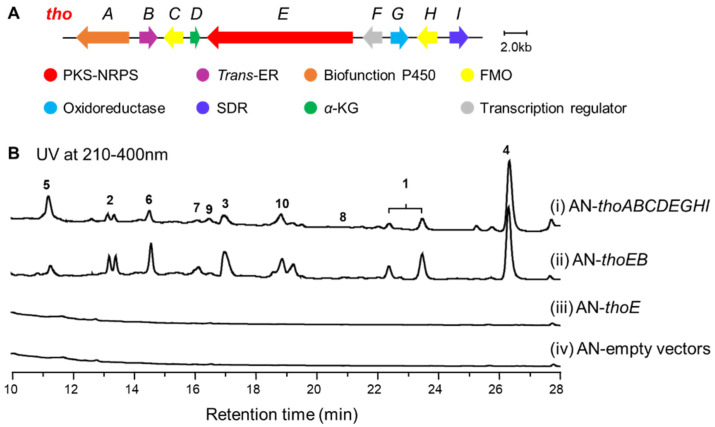 Figure 1
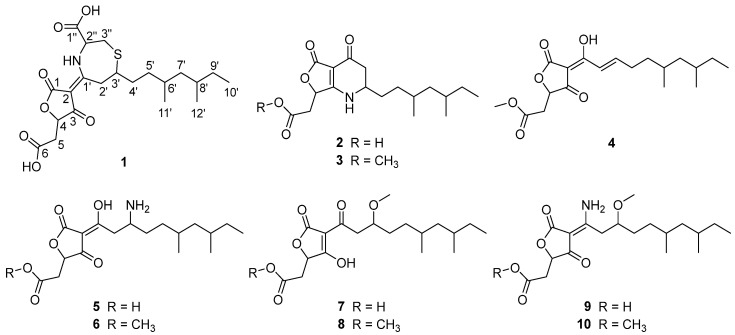 Figure 2
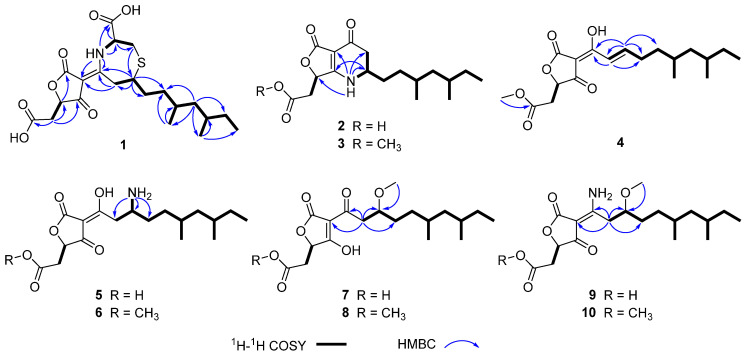 Figure 3
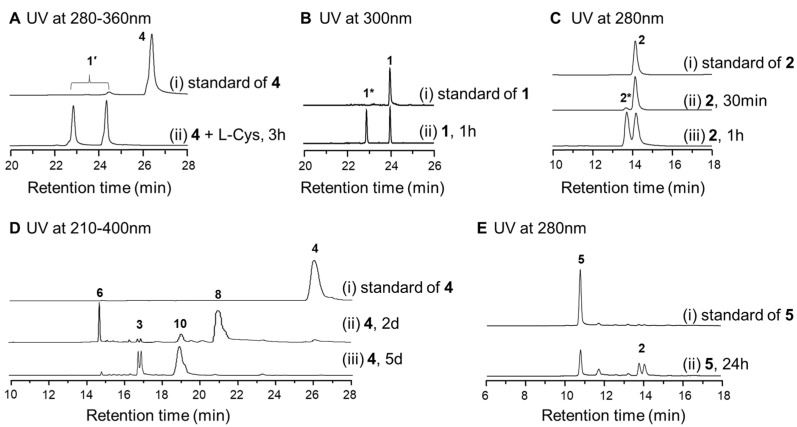 Figure 4
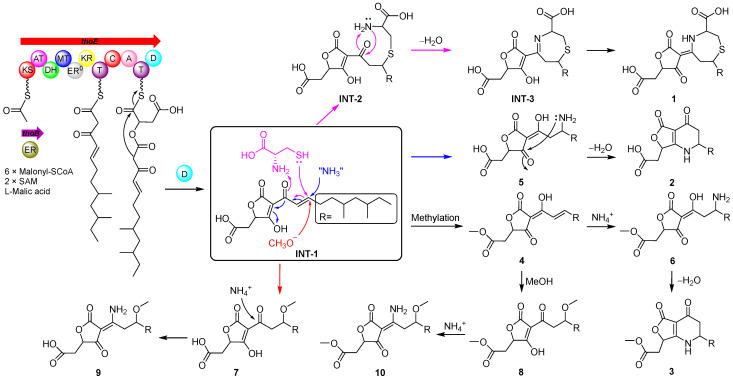 Figure 5
Peer Reviews
No public reviews on file for this paper yet. If you reviewed it on a platform where reviews are public (OpenReview, ICLR, NeurIPS, ICML), you can paste yours below so the community can read it here.
Videos
No videos yet. Explain this paper in a talk, walkthrough, or lecture? Add one.
Taxonomy
TopicsMicrobial Natural Products and Biosynthesis · Plant biochemistry and biosynthesis · Synthetic Organic Chemistry Methods