Influence of Posture, Spinal Level, Gender and Muscle Activation on Biomechanical Properties of Lumbar Erector Spinae in Healthy Young Adults
Yueh-Ling Hsieh, Heng-Yi Lin, Andy Chien

TL;DR
This study shows that posture, muscle activation, gender, and spinal level significantly affect the biomechanical properties of the lumbar erector spinae in young adults.
Contribution
The study provides new insights into how posture and gender interact with muscle activation and spinal level to influence paraspinal muscle properties.
Findings
Sitting and standing postures increased stiffness and tone of the lumbar erector spinae compared to prone.
Males exhibited higher stiffness and tone than females.
Posture, gender, and spinal level showed significant interactions affecting muscle properties.
Abstract
Background and Objectives: This study set out to better understand how posture, spinal level, gender and muscle activation influence the biomechanical properties of the lumbar erector spinae (LES) in healthy young adults. We aimed to measure how these factors influence LES tone, stiffness, and damping using a myotonometry device. Materials and Methods: Thirty healthy young adults (14 males, 16 females; aged 20–25 years) were evaluated at bilateral L3–L5 levels in prone, unsupported sitting, and standing positions, both under relaxed conditions and during submaximal isometric lumbar extension. The myotonometer measured LES tone (Hz), stiffness (N/m), and damping (logarithmic decrement). For each outcome, a mixed-model repeated-measures ANOVA was conducted with Gender as a between-subject factor and Posture, Level, and Action (relaxed vs. contracted) as within-subject factors…
Click any figure to enlarge with its caption.
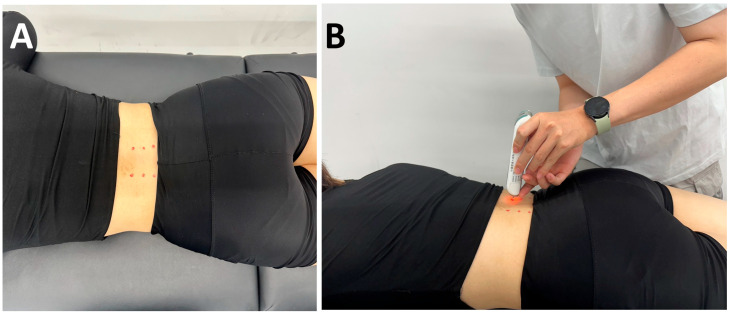 Figure 1
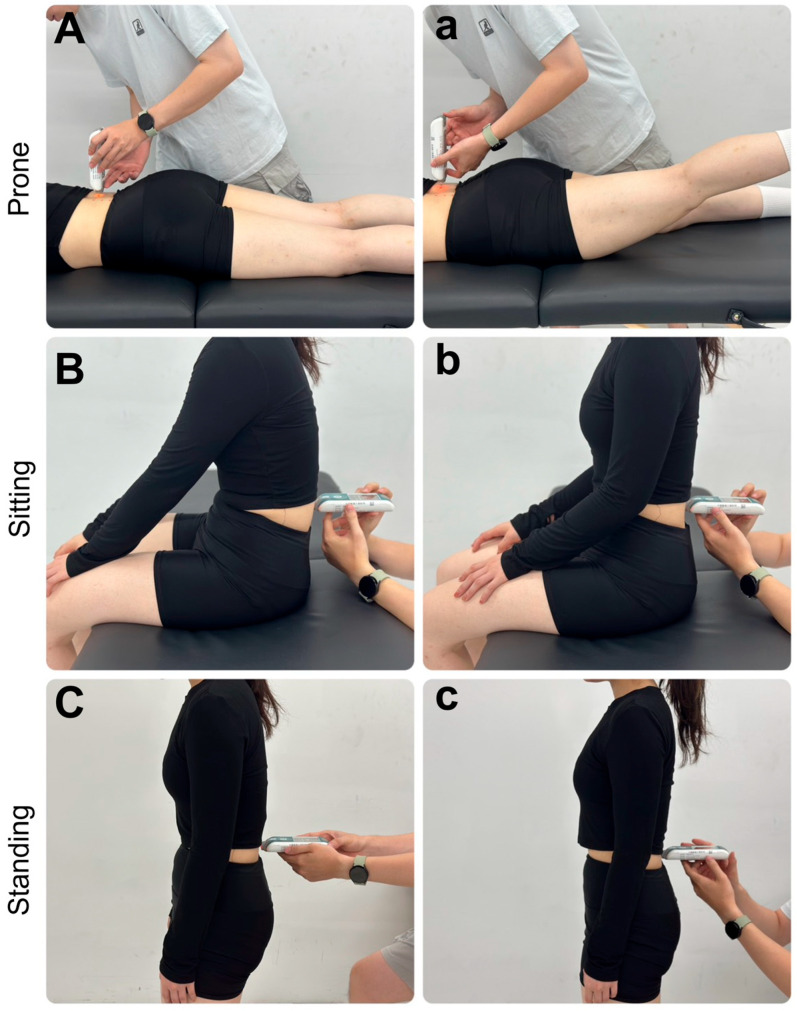 Figure 2
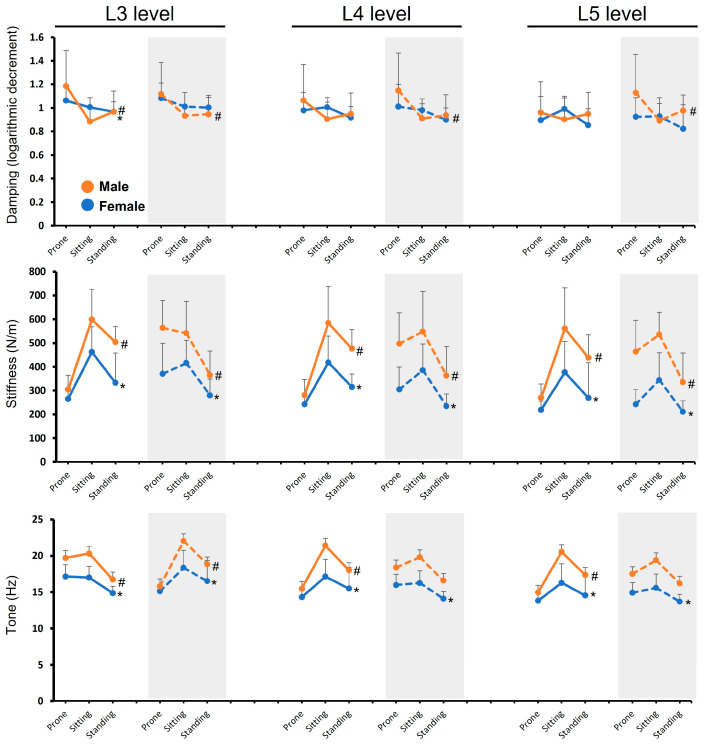 Figure 3
Peer Reviews
No public reviews on file for this paper yet. If you reviewed it on a platform where reviews are public (OpenReview, ICLR, NeurIPS, ICML), you can paste yours below so the community can read it here.
Videos
No videos yet. Explain this paper in a talk, walkthrough, or lecture? Add one.
Taxonomy
TopicsMusculoskeletal pain and rehabilitation · Spine and Intervertebral Disc Pathology · Scoliosis diagnosis and treatment