Promoting Growth Performances and Phytochemicals of Black Upland Rice Through the Co-Inoculation of Arbuscular Mycorrhizal Fungi and Endophytic Fungi Under Drought Conditions
Saralee Suphaphan, Thanawan Gateta, Wasan Seemakram, Thanapat Suebrasri, Saranya Chantawong, Chaiya Klinsukon, Piyada Theerakulpisut, Sophon Boonlue

TL;DR
This study shows that using specific fungi can help black upland rice grow better and produce more healthy compounds even during droughts.
Contribution
The study demonstrates the effectiveness of co-inoculating AMF and EPF in improving drought tolerance and functional quality of black upland rice.
Findings
Fungal inoculation increased plant growth and stress tolerance enzymes under drought conditions.
Functional grain quality, including antioxidants and phenolics, improved with fungal treatments.
Co-inoculation enhanced antioxidant activity and biomass more than single inoculation in some cases.
Abstract
Drought is a major problem affecting upland rice growth worldwide, including in northeast Thailand, with insufficient irrigation, where drought stress leads to reduced yields and may affect the functional compound content of rice grains. This research aimed to study the efficacy of arbuscular mycorrhizal fungi (AMF) Rhizophagus variabilis KS-02 and endophytic fungi (EPF) Trichoderma zelobreve PBMP16 on promoting the growth and accumulation of functional substances in upland black rice under drought conditions. Factorial experiments in a randomized complete block design (RCBD) were conducted by cultivating rice inoculated with AMF and EPF as well as co-inoculated with AMF+EPF under three watering conditions: 100% field capacity (FC), 66% FC, and 33% FC. The results show that both AMF, EPF improved some plant growth parameters and physiological performance under both well-watered and…
Genes, proteins, chemicals, diseases, species, mutations and cell lines named across the full text — each resolved to its canonical identifier and authoritative record.
Click any figure to enlarge with its caption.
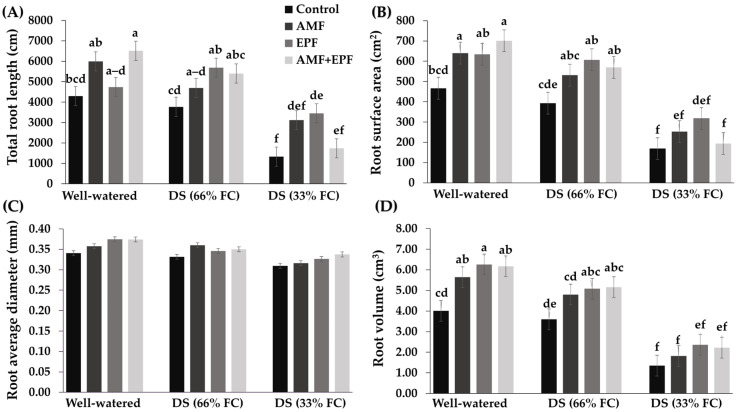 Figure 1
 Figure 2
Peer Reviews
No public reviews on file for this paper yet. If you reviewed it on a platform where reviews are public (OpenReview, ICLR, NeurIPS, ICML), you can paste yours below so the community can read it here.
Videos
No videos yet. Explain this paper in a talk, walkthrough, or lecture? Add one.
Taxonomy
TopicsMycorrhizal Fungi and Plant Interactions · Plant-Microbe Interactions and Immunity · Fungal Biology and Applications