Radiological Outcomes, Complications, and the Influence of Risk Factors in PHILOS Repair of Three- and Four-Part Proximal Humerus Fractures with and Without Femoral Head Allograft: Insights from a Cohort of 116 Patients
Zoltan Cibula, Milan Cipkala, Diaa Sammoudi, Marian Grendar, Monika Cervencova

TL;DR
This study examines the outcomes of PHILOS repair for proximal humerus fractures with and without allograft augmentation in 116 patients, finding that allograft improves stability but does not prevent complications from poor surgical technique.
Contribution
The study provides insights into the influence of allograft augmentation and risk factors on radiological outcomes and complications in proximal humerus fracture repair.
Findings
Allograft augmentation increases surgical time but does not prevent complications like avascular necrosis or screw cut-out.
Greater tubercle comminution and calcar loss are significant risk factors for head collapse and screw cut-out.
Medial hinge restoration and allograft use are associated with reduced redislocation of the greater tubercle.
Abstract
Background: Complications after proximal humerus osteosynthesis are not uncommon. The aim of this study was to compare the outcomes of osteosynthesis using PHILOS with fresh-frozen femoral head allograft augmentation and without it, and to assess the influence of risk factors and their impact on the occurrence of postoperative complications. Methods: This retrospective study evaluates the radiological outcomes and complications of treating proximal humerus fractures (Neer III–IV) in 116 patients over 50 years of age treated between 2017 and 2021. Results: Osteosynthesis without allograft was performed in 84 patients and with allograft in 32 patients. In total, 42 patients (36%) had a three-part fracture and 74 (64%) had a four-part fracture. The Deltoid Tuberosity Index was comparable between the groups (1.59 ± 0.25 vs. 1.50 ± 0.26; p = 0.802). The average duration of surgery was 101.3…
Genes, proteins, chemicals, diseases, species, mutations and cell lines named across the full text — each resolved to its canonical identifier and authoritative record.
Click any figure to enlarge with its caption.
 Figure 1
 Figure 2
 Figure 3
 Figure 4
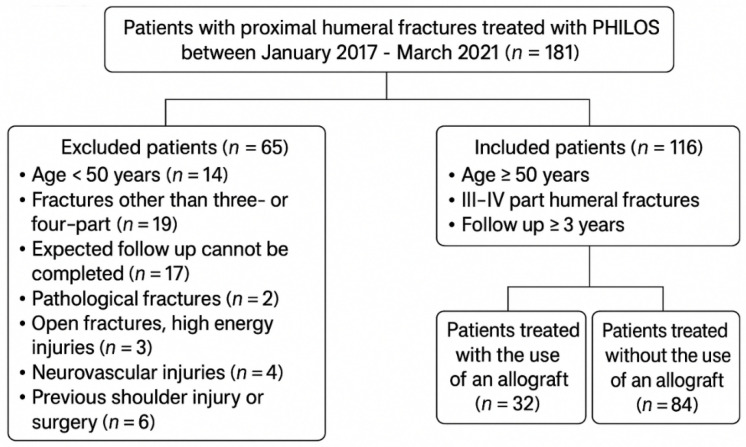 Figure 5
Peer Reviews
No public reviews on file for this paper yet. If you reviewed it on a platform where reviews are public (OpenReview, ICLR, NeurIPS, ICML), you can paste yours below so the community can read it here.
Videos
No videos yet. Explain this paper in a talk, walkthrough, or lecture? Add one.
Taxonomy
TopicsShoulder Injury and Treatment · Hip and Femur Fractures · Shoulder and Clavicle Injuries