Endosymbiont Infections in Korean Insects: Patterns Across Orders and Habitat Types
Jae-Yeon Kang, Gilsang Jeong, In Jung An, Kihyun Kim, Se-hwan Son, Soyeon Park

TL;DR
This study explores how three endosymbiotic bacteria are distributed in Korean insects, finding patterns influenced by insect order and habitat.
Contribution
The study provides baseline data on endosymbiont distributions in Korean insects, highlighting patterns shaped by host taxonomy and habitat.
Findings
Single infections of endosymbionts were more common than co-infections in Korean insects.
Wolbachia was more frequently detected in terrestrial insects compared to aquatic ones.
Endosymbiont infection patterns varied by insect order, particularly in Coleoptera and Hemiptera.
Abstract
Endosymbiotic bacteria—microbes that live inside insect cells—play important roles in shaping the biology and evolution of their hosts. In this study, we examined more than 1000 insects from 14 different orders across Korea to explore how three representative endosymbionts (Wolbachia, Rickettsia, and Spiroplasma) are distributed among hosts living in different environments. Single infections predominated, while co-infections were infrequent among the infected insects. Overall associations among symbiont pairs were weak, but varied among insect orders, with significant associations concentrated in Coleoptera and Hemiptera. Infection rates were broadly similar across most host orders, although Spiroplasma displayed detectable order-level differences. In addition, Wolbachia infections were more frequently detected in terrestrial than in aquatic insects. These findings indicate that…
Genes, proteins, chemicals, diseases, species, mutations and cell lines named across the full text — each resolved to its canonical identifier and authoritative record.
Click any figure to enlarge with its caption.
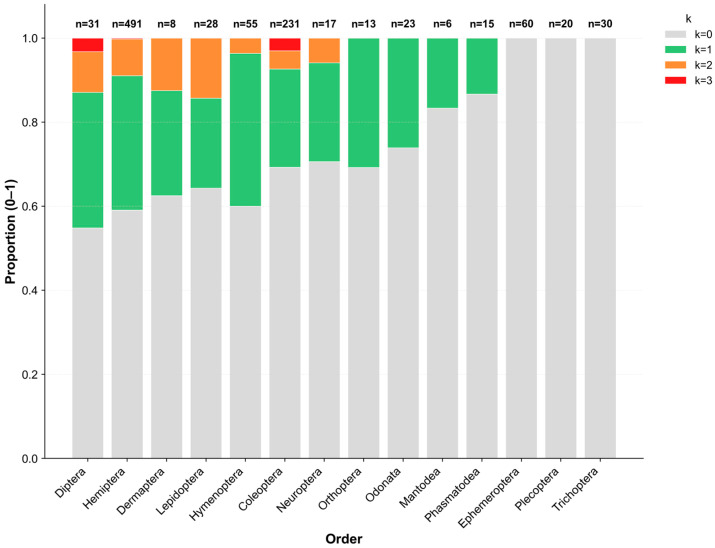 Figure 1
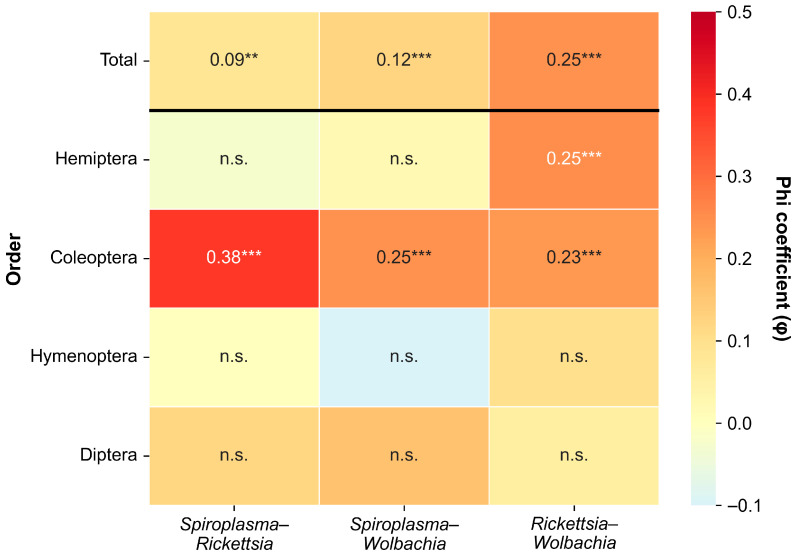 Figure 2
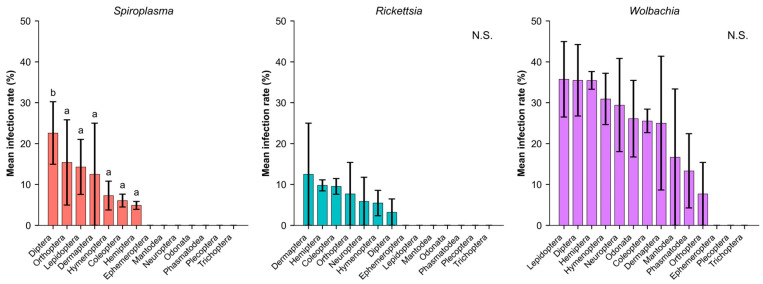 Figure 3
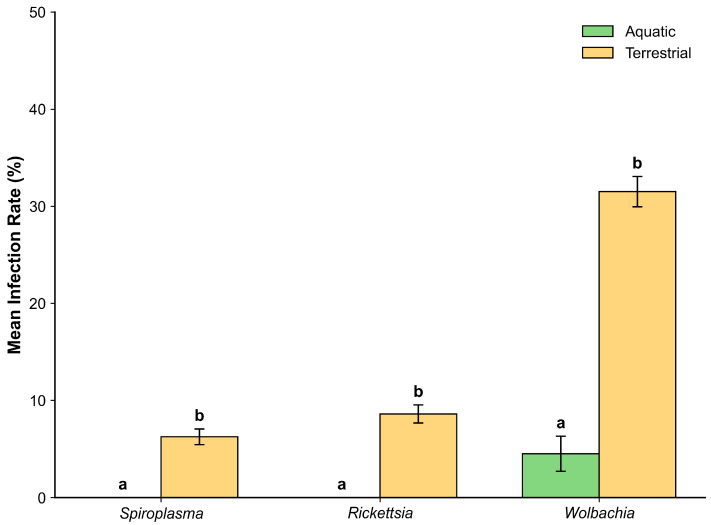 Figure 4
Peer Reviews
No public reviews on file for this paper yet. If you reviewed it on a platform where reviews are public (OpenReview, ICLR, NeurIPS, ICML), you can paste yours below so the community can read it here.
Videos
No videos yet. Explain this paper in a talk, walkthrough, or lecture? Add one.
Taxonomy
TopicsInsect symbiosis and bacterial influences · Phytoplasmas and Hemiptera pathogens · Invertebrate Immune Response Mechanisms