Flow Cytometric Assessment of Sperm DNA Fragmentation by TUNEL and Acridine Orange: Methodological and Clinical Insights
Mohamed Abdelkarim, Nadine Ghannem, Khadija Kacem-Berjeb, Sana Chtourou, Linda Debbabi, Anis Fadhlaoui, Mounir Ben Mefeteh, Fethi Zhioua, Marouen Braham, Nozha Chakroun

TL;DR
This study compares two methods for measuring sperm DNA damage and finds they provide different results and limited prediction of IVF success.
Contribution
The study directly compares TUNEL and AO methods for sperm DNA fragmentation in a clinical ICSI setting.
Findings
TUNEL measured higher DNA fragmentation than AO (17.2% vs. 10.15%).
AO results correlated with age, but neither method predicted ICSI outcomes effectively.
The weak correlation between the two methods suggests they measure different aspects of DNA damage.
Abstract
Background/Objectives: Male infertility contributes to nearly half of global infertility cases, yet conventional semen analysis is insufficient to predict assisted reproductive technology (ART) outcomes such as intracytoplasmic sperm injection (ICSI). Sperm DNA fragmentation (SDF) is a promising biomarker of genomic integrity, but clinical implementation remains hindered by methodological heterogeneity. This study compared two SDF assays—TUNEL and Acridine Orange (AO)—regarding their correlations with semen parameters and ICSI outcomes. Methods: Sixty men undergoing ICSI were prospectively enrolled. SDF was analyzed using two flow cytometric assays: TUNEL (detecting DNA strand breaks) and AO (assessing chromatin instability). Semen quality and ICSI outcomes (fertilization, cleavage, blastulation, and embryo utilization rates) were evaluated. Statistical analyses included Spearman’s rank…
Genes, proteins, chemicals, diseases, species, mutations and cell lines named across the full text — each resolved to its canonical identifier and authoritative record.
Click any figure to enlarge with its caption.
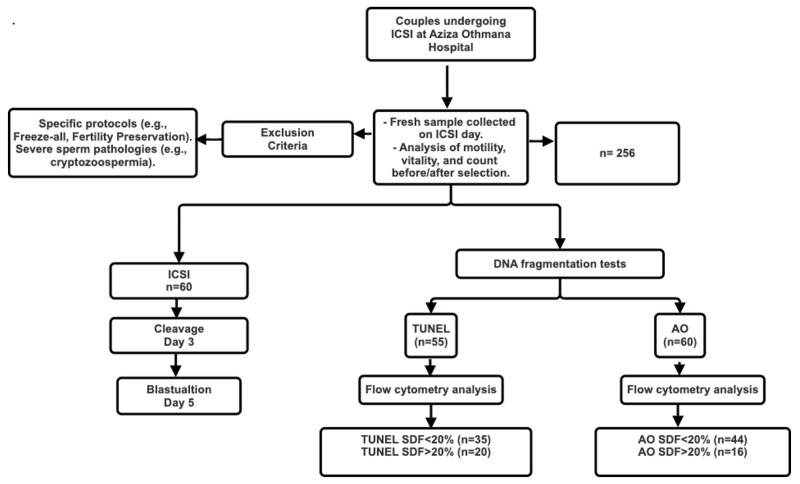 Figure 1
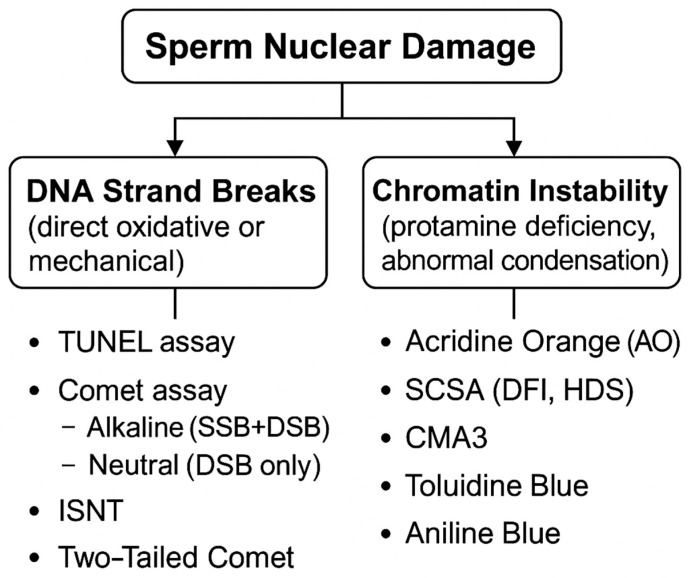 Figure 2
Peer Reviews
No public reviews on file for this paper yet. If you reviewed it on a platform where reviews are public (OpenReview, ICLR, NeurIPS, ICML), you can paste yours below so the community can read it here.
Videos
No videos yet. Explain this paper in a talk, walkthrough, or lecture? Add one.
Taxonomy
TopicsSperm and Testicular Function · Reproductive Biology and Fertility · Reproductive Health and Technologies