Myostatin in Obesity: A Molecular Link Between Metabolic Dysfunction and Musculotendinous Remodeling
Leonardo Cesanelli, Petras Minderis, Andrej Fokin, Aivaras Ratkevicius, Danguole Satkunskiene, Hans Degens

TL;DR
This paper explores how myostatin, a protein linked to muscle regulation, contributes to obesity-related muscle and tendon issues, suggesting it could be a key target for treatment.
Contribution
The paper introduces myostatin's role in musculotendinous remodeling and metabolic dysfunction in obesity, beyond its known effects on muscle mass.
Findings
Elevated myostatin levels in obesity are linked to insulin resistance and muscle atrophy.
Myostatin inhibition improves glucose homeostasis and increases lean mass in preclinical studies.
Myostatin affects extracellular matrix organization and tissue fragility in musculotendinous systems.
Abstract
Obesity is increasingly recognized not only as a metabolic disorder but also as a condition marked by the structural and functional deterioration of skeletal muscle and tendon tissues. Central to this process is the dysregulation of the extracellular matrix (ECM) resulting in fibrosis and ectopic fat accumulation, factors that contribute to impaired tissue mechanics. Myostatin (GDF-8), a member of the TGF-β superfamily, is known as a negative regulator of muscle mass. It can also mediate interaction between adipose and other tissues including muscles and tendons. In obesity, elevated myostatin levels have been reported to be associated with insulin resistance, muscle atrophy, and activation of SMAD2/3 signaling, while experimental and preclinical studies indicate that myostatin inhibition can improve glucose homeostasis and increase lean mass. Emerging evidence suggests that myostatin…
Genes, proteins, chemicals, diseases, species, mutations and cell lines named across the full text — each resolved to its canonical identifier and authoritative record.
Click any figure to enlarge with its caption.
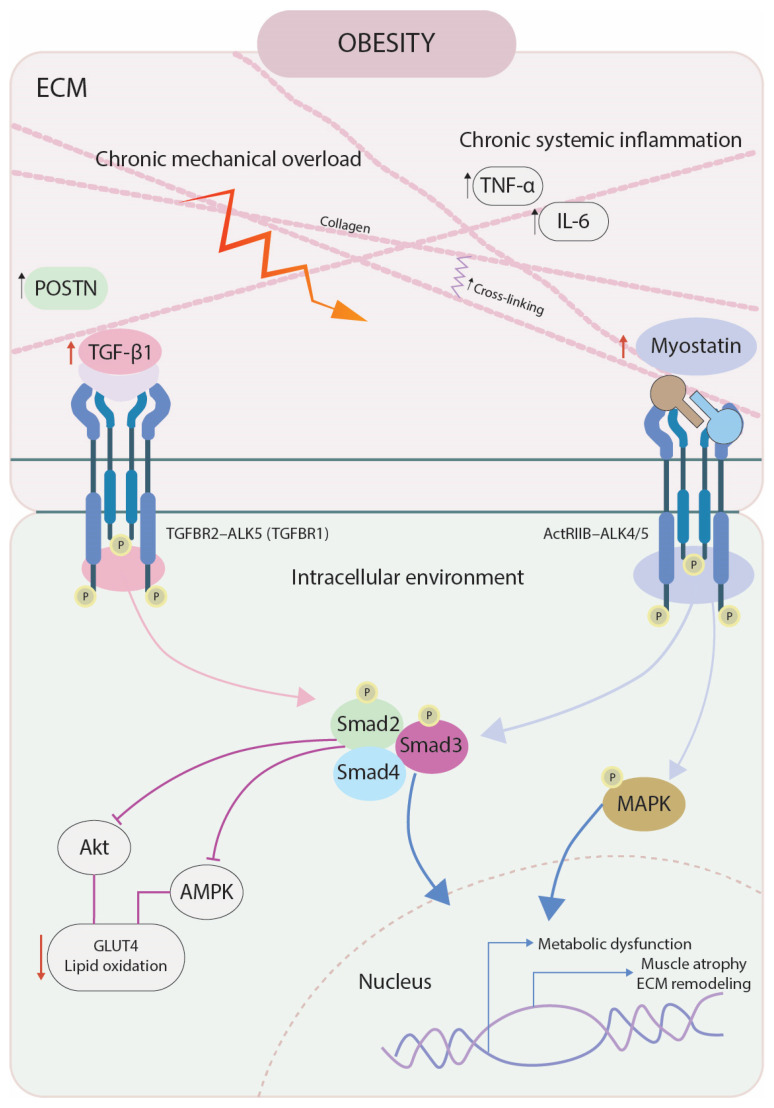 Figure 1
Peer Reviews
No public reviews on file for this paper yet. If you reviewed it on a platform where reviews are public (OpenReview, ICLR, NeurIPS, ICML), you can paste yours below so the community can read it here.
Videos
No videos yet. Explain this paper in a talk, walkthrough, or lecture? Add one.
Taxonomy
TopicsTendon Structure and Treatment · Muscle Physiology and Disorders · Knee injuries and reconstruction techniques