Quantitative 3D Evaluation of Facial Soft Tissue Modifications Following Complete Denture Treatment in Edentulous Patients: A Prospective Before–After Study
Isabela Toser, Ioana Veja, Adrian Cândea, Andrei-Bogdan Faur, George Dumitru Constantin, Anca-Elena Anghel-Lorinti, Anca Jivănescu

TL;DR
This study uses 3D facial scans to show that complete dentures improve facial soft-tissue appearance in toothless patients, especially around the lips and mouth.
Contribution
The study introduces a structured-light 3D scanning method to objectively quantify facial changes after complete denture treatment in edentulous patients.
Findings
Complete dentures significantly increased upper and lower lip thickness in relaxed posture.
The nasolabial angle decreased, indicating a more aesthetically favorable facial profile.
Mouth width increased in maximal intercuspation following denture treatment.
Abstract
Background: Three-dimensional (3D) facial scanning is an objective, non-invasive method for quantifying facial soft-tissue changes following complete denture (CD) rehabilitation. Reliable quantification of these changes in completely edentulous patients can support more predictable aesthetic and functional outcomes. Methods: This prospective before–after observational study included 30 completely edentulous patients (12 men, 18 women; age 48–87 years; mean ± SD: 67.8 ± 9.2 years) who received new maxillary and mandibular CDs. Structured-light 3D facial scans were obtained at baseline (edentulous, without dentures) and post-rehabilitation with dentures in place, in relaxed posture (RP) and maximal intercuspation (MI). Sixty-five validated anthropometric landmarks were analyzed. Primary outcomes were lower facial height (Sn-Gn), nasolabial angle (Cm-Sn-Ls), lower facial convexity…
Genes, proteins, chemicals, diseases, species, mutations and cell lines named across the full text — each resolved to its canonical identifier and authoritative record.
Click any figure to enlarge with its caption.
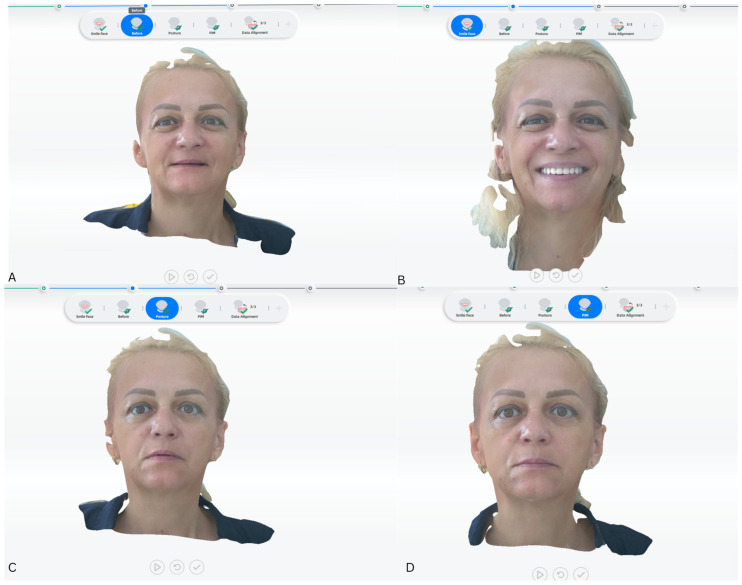 Figure 1
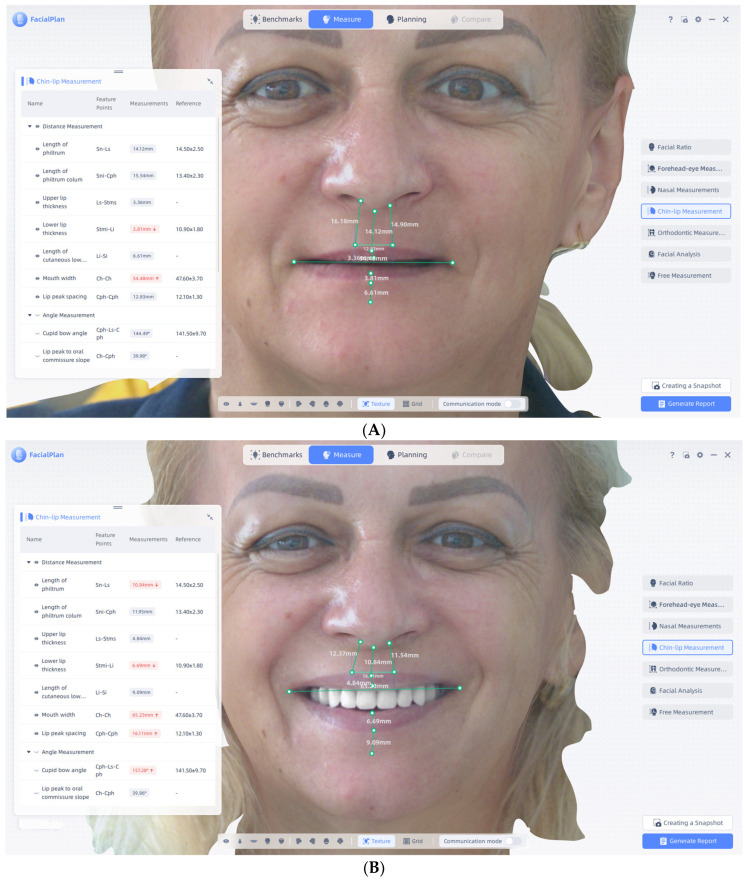 Figure 2
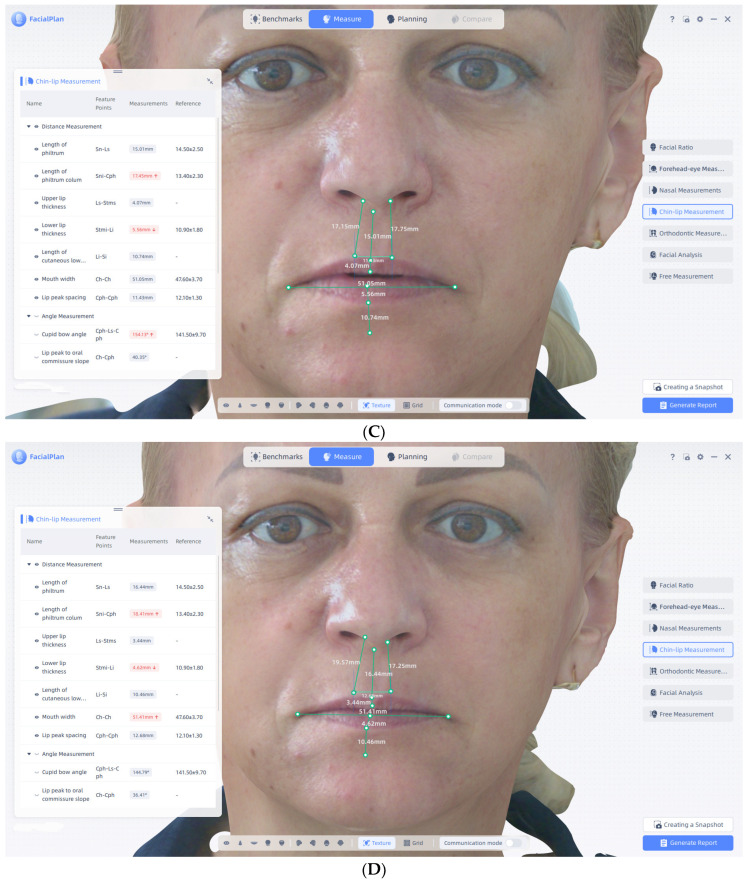 Figure 3
Peer Reviews
No public reviews on file for this paper yet. If you reviewed it on a platform where reviews are public (OpenReview, ICLR, NeurIPS, ICML), you can paste yours below so the community can read it here.
Videos
No videos yet. Explain this paper in a talk, walkthrough, or lecture? Add one.
Taxonomy
TopicsOrthodontics and Dentofacial Orthopedics · Dental Implant Techniques and Outcomes · Temporomandibular Joint Disorders