State-Dependent Distortions of Short-Range Internal Timing: A Narrative Review Across Stress, Anxiety, Depression, Parkinson’s Disease, and Epilepsy
Ekaterina Andreevna Narodova

TL;DR
This paper reviews how different mental and neurological states affect how people perceive and process short-term time intervals.
Contribution
The paper introduces a framework for understanding timing distortions as state-dependent reconfigurations rather than fixed dysfunctions.
Findings
Anxiety and stress are linked to perceived time acceleration, while depression is associated with time slowing.
Neurological conditions like Parkinson’s disease and epilepsy show complex, non-uniform timing distortions.
Timing variability may serve as a marker of internal states, offering insights for clinical research.
Abstract
Short-range internal timing supports coordinated movement, attention, and physiological regulation, yet distortions of time experience are frequently reported across clinical and high-arousal states. Patients with anxiety or acute stress often describe an apparent acceleration of time, whereas depressive states are more commonly associated with a slowing of subjective time. Neurological conditions, including Parkinson’s disease and epilepsy, further demonstrate alterations in temporal processing that cannot be reduced to a single mechanism. This narrative review synthesizes evidence from experimental timing paradigms, subjective passage-of-time judgments, and chronobiological approaches to examine how internal timing varies across biological states. In this study, we highlight the distinction between experiential time distortion and performance-based interval timing and discuss how task…
Genes, proteins, chemicals, diseases, species, mutations and cell lines named across the full text — each resolved to its canonical identifier and authoritative record.
Click any figure to enlarge with its caption.
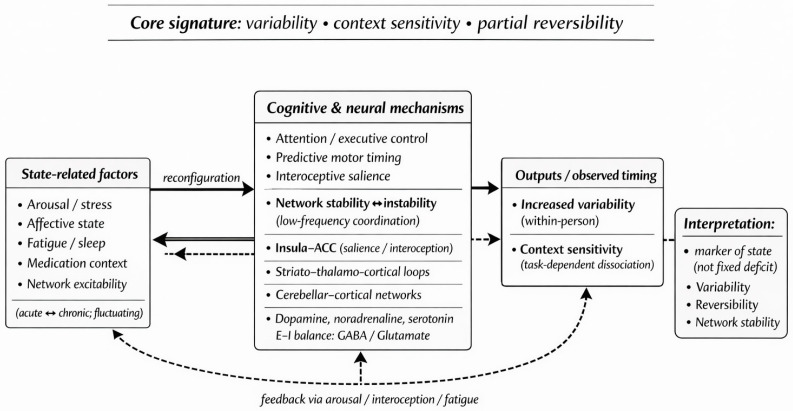 Figure 1
Peer Reviews
No public reviews on file for this paper yet. If you reviewed it on a platform where reviews are public (OpenReview, ICLR, NeurIPS, ICML), you can paste yours below so the community can read it here.
Videos
No videos yet. Explain this paper in a talk, walkthrough, or lecture? Add one.
Taxonomy
TopicsNeuroscience and Music Perception · Music Therapy and Health · Multisensory perception and integration